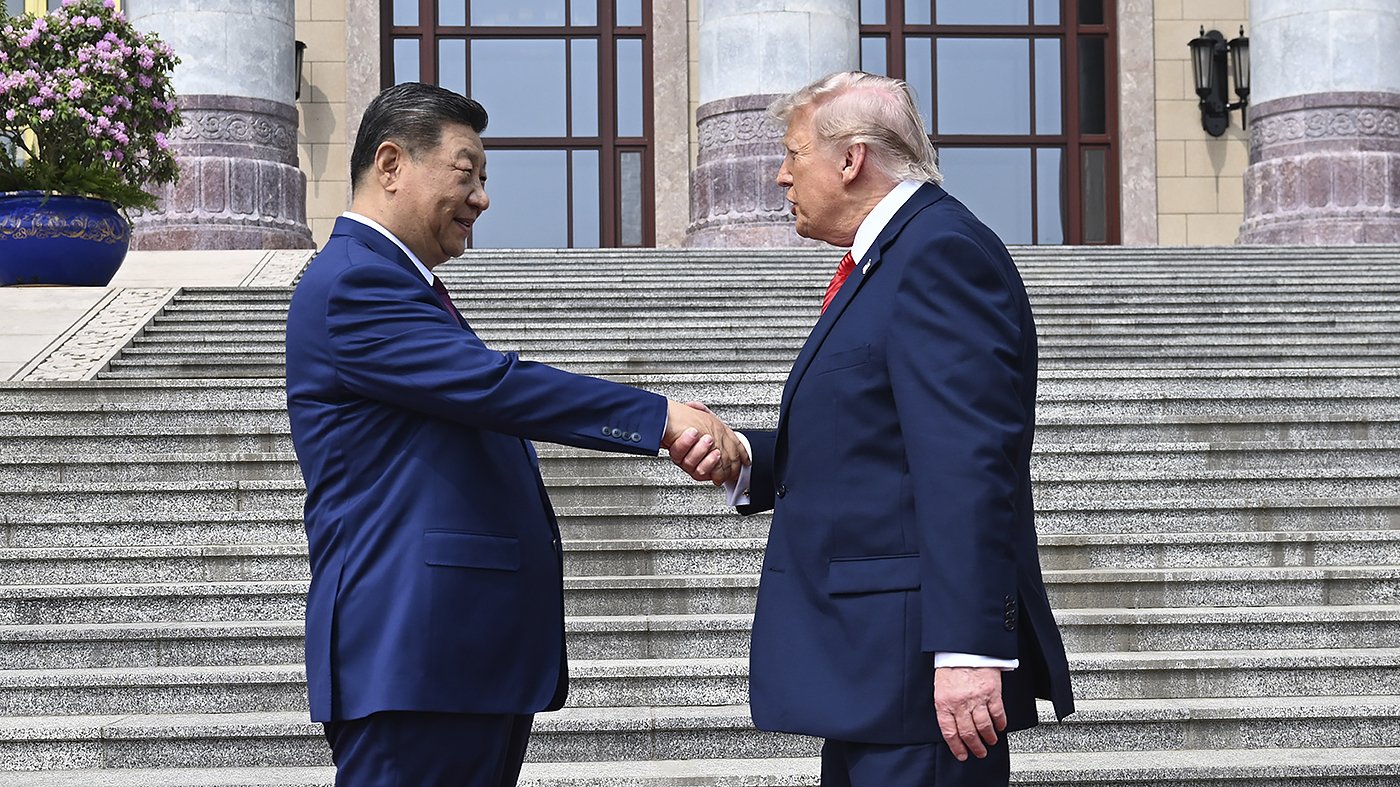
In a high-stakes meeting in Beijing, Chinese President Xi Jinping directly raised the concept of the 'Thucydides Trap' with President Donald Trump, framing the central challenge of US-China relations as whether the two powers can avoid a historical pattern of conflict between rising and established powers.
Xi posed the question, as reported by state broadcaster CCTV and cited by CNBC, asking whether both nations can overcome the trap and build a new model of major-power relations. This marks the latest instance of Xi invoking the term, which he has used since at least 2014, according to Bloomberg.
Xi's Warning on Taiwan
Xi also delivered a pointed warning on Taiwan, telling Trump that 'Taiwan independence' and cross-Strait peace are as irreconcilable as fire and water, according to Chinese Foreign Ministry spokesperson Mao Ning on social platform X. The remark underscores Beijing's red line on the issue, which remains a core flashpoint in US-China ties.
The 'Thucydides Trap' was popularized by Harvard political scientist Graham Allison in the early 2010s, drawing on the ancient Greek historian Thucydides' account of the Peloponnesian War. The concept holds that when a rising power threatens to displace an established one, the structural tension often leads to war.
Thucydides wrote, 'It was the rise of Athens and the fear that this instilled in Sparta that made war inevitable,' as noted by the Harvard Kennedy School's Belfer Center. Allison applied this framework to the US-China rivalry in his book 'Destined for War: Can America and China Escape Thucydides's Trap?', analyzing 16 historical cases where a rising power confronted a ruling one. Twelve ended in war, while four avoided open conflict.
Historical Precedents
Among the examples Allison cites are the US-Japan rivalry in the 20th century, which culminated in Japan's attack on Pearl Harbor and US entry into World War II, with Japan as the rising power and the US as the established one. In contrast, the Cold War between the US and the Soviet Union saw proxy wars but no direct military confrontation between the superpowers.
Allison's more recent non-conflict example involves the United Kingdom and France facing a rising Germany after the Cold War, where Germany chose peaceful economic expansion over military rearmament.
The meeting came amid broader tensions over trade, technology, and regional security. Trump later claimed Xi pledged major purchases of soybeans, energy, and jets, though details remain unconfirmed. The president also extended a formal White House invitation to Xi for a September visit, signaling an effort to maintain diplomatic momentum despite underlying frictions.
Xi's explicit invocation of the Thucydides Trap serves as a strategic warning: without careful management, the structural rivalry between the world's two largest economies could spiral into conflict. His 'fire and water' comment on Taiwan reinforces Beijing's determination to prevent any move toward formal independence for the island, which China claims as its own territory.
Analysts note that the Trump administration's approach to China has oscillated between confrontation and engagement, with the Beijing summit reflecting both dynamics. The outcome of these talks may shape not only bilateral relations but also global stability in the years ahead.