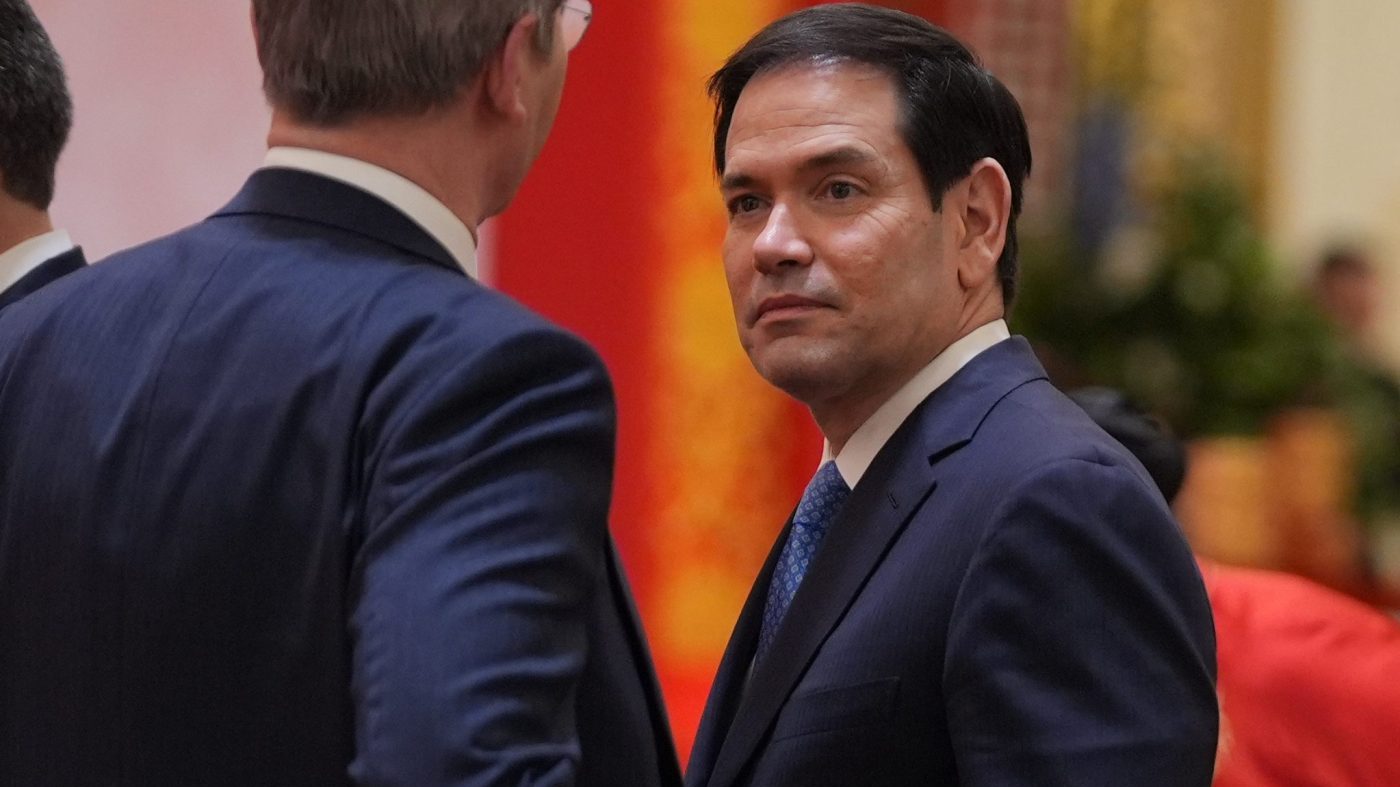
Secretary of State Marco Rubio confirmed Thursday that President Trump's administration will use the upcoming summit with Chinese President Xi Jinping to push Beijing into a more assertive mediating role in the Iran conflict, with the goal of ending hostilities and reopening the Strait of Hormuz to global shipping.
In an interview with Fox News host Sean Hannity from Beijing, Rubio argued that the current standoff—marked by both U.S. naval blockades and Iranian restrictions on vessels—has directly harmed Chinese interests. “The Chinese have ships stuck in the Persian Gulf,” he said, noting that Tehran’s policy of selectively allowing passage has proven unworkable.
China is the largest buyer of Iranian crude, purchasing roughly 90 percent of its exported oil, according to a March report from the U.S.-China Economic and Security Review Commission. That dependence gives Beijing a clear economic incentive to stabilize the region, Rubio suggested.
“It’s a huge source of instability,” he said of the strait’s closure. “It threatens to destabilize Asia more than any other part of the world, because it’s heavily reliant on the straits for energy.”
U.S. Navy forces have blockaded Iranian ports for over a month, choking Tehran’s oil exports. Meanwhile, data from the Energy Information Administration shows China received more than 37 percent of all oil transiting the Strait of Hormuz in the first quarter of 2025—more than any other nation. India, South Korea, and Japan together accounted for another 37 percent, while the United States received just 2.5 percent.
Rubio also pointed to China’s export-driven economy, warning that a global downturn sparked by the conflict would reduce demand for Chinese goods. “So it’s in their interest to resolve this,” he said. “We hope to convince them to play a more active role in getting Iran to walk away from what they’re doing now.”
So far, Xi has not deployed Chinese naval assets to help reopen the strait, and his government has advised domestic refineries to ignore U.S. sanctions on Iranian oil purchases. The New York Times reported Wednesday, citing U.S. officials, that Chinese companies have even discussed arms sales to Iran, potentially routing weapons through third countries.
The push for Chinese mediation comes amid broader tensions between Washington and Beijing. Xi has warned Trump that Taiwan is a “fire and water” issue that could rupture bilateral relations, and the House recently passed a resolution demanding Trump take action on Chinese detainees. Rubio, who has emerged as a leading GOP figure, is also seen as a potential 2028 presidential contender—a dynamic that could shape his approach to the talks.
Rubio’s remarks underscore a strategic calculation: the U.S. needs China’s leverage over Iran to de-escalate a crisis that threatens global energy markets and Asian stability. Whether Beijing will step up remains an open question, but the stakes—for both economies and for regional security—could not be higher.