As global attention remains fixed on the success of the Artemis II mission and ambitious plans for lunar bases and Mars expeditions, a significant intellectual challenge to crewed space exploration has emerged from prominent scientific figures. Astronomer Royal Martin Rees and astrophysicist Donald Goldsmith have publicly argued that human spaceflight is prohibitively expensive and dangerous, advocating instead for a future where artificial intelligence and robotics alone handle extraterrestrial exploration and commerce.
In their view, advanced machines could perform all necessary functions—from lunar mining to maintaining scientific instruments—without the risks and costs associated with human life support. They envision fully automated outposts, dismissing the need for astronauts as sentimental and inefficient.

This perspective, however, clashes fundamentally with current industry trajectories and technological assessments. Contrary to fears of replacement, evidence from terrestrial applications suggests AI and robotics will serve as force multipliers for human capabilities. Analysis from sources like the Harvard Business Review indicates that while automation eliminates some roles, it creates new opportunities centered on human-machine collaboration. These systems excel at repetitive tasks and pattern recognition, freeing human operators to focus on creative problem-solving, strategic oversight, and tasks requiring emotional intelligence.
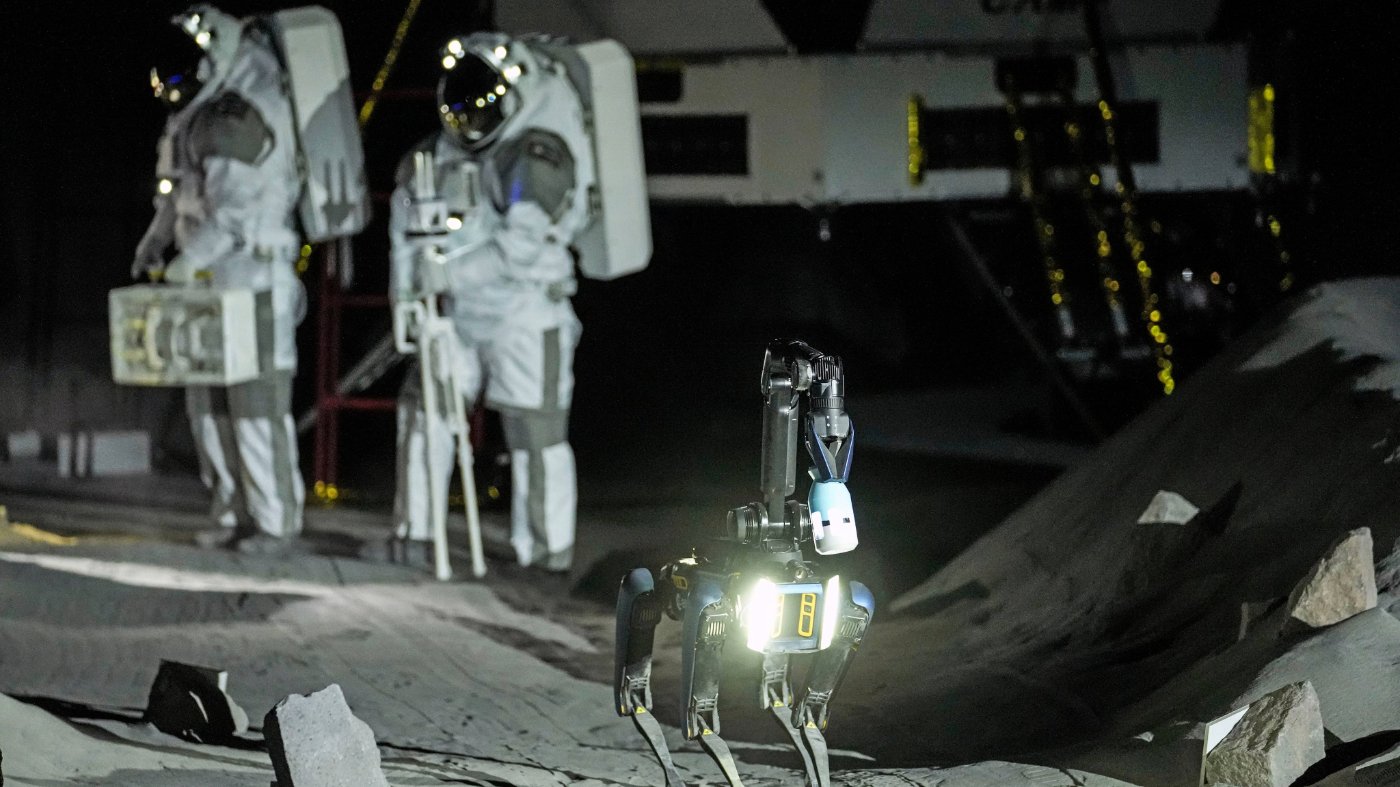
Applied to space, this collaborative model transforms the concept of a lunar base. An AI hub could manage rovers for terrain mapping and resource prospecting, process sensor data locally, maintain critical life-support systems, and predict equipment failures. Robots would handle manual labor and hazardous maintenance. This division of labor, as seen in the recent Artemis II mission which overcame significant technical skepticism, allows astronauts to concentrate on exploration, geological analysis, and discovery—areas where human intuition and contextual understanding remain irreplaceable.
The late planetary scientist Dr. Paul Spudis emphasized in his work that field geologists possess an innate ability to interpret a site's context in ways machines cannot replicate. Furthermore, the human element of space exploration carries intangible value. The crew of Artemis II, who completed a historic lunar return, communicated a sense of awe and wonder that resonates publicly in a manner no machine-generated report could achieve. This inspirational effect, sparking scientific interest and national pride, is a critical political and cultural justification for continued investment.
Rees and Goldsmith also critique the cost and danger of human spaceflight, dismissing private sector leaders like Elon Musk, Jeff Bezos, and Peter Beck. This dismissal overlooks a central reality: these entrepreneurs have dramatically reduced launch costs through innovation and competitive market pressures, as seen in SpaceX's impending public offering. The financial calculus for human spaceflight is improving, not stagnating.
While acknowledging the inherent dangers—a reality underscored by historical tragedies—proponents argue that risk is intrinsic to human progress. The profession of astronaut remains highly sought after, reflecting a enduring drive to explore. Withdrawing from the frontier, they contend, leads to cultural and technological stagnation.
The debate extends beyond technical feasibility into the realm of political will and vision. As nations navigate terrestrial challenges, from national security debates over surveillance reauthorization to nuclear non-proliferation efforts, the decision to pursue a human future in space represents a definitive statement on ambition and identity. The emerging consensus within the space industry is not a choice between humans and machines, but a strategy for their integration, ensuring that the next era of exploration leverages the full spectrum of both robotic efficiency and human genius.