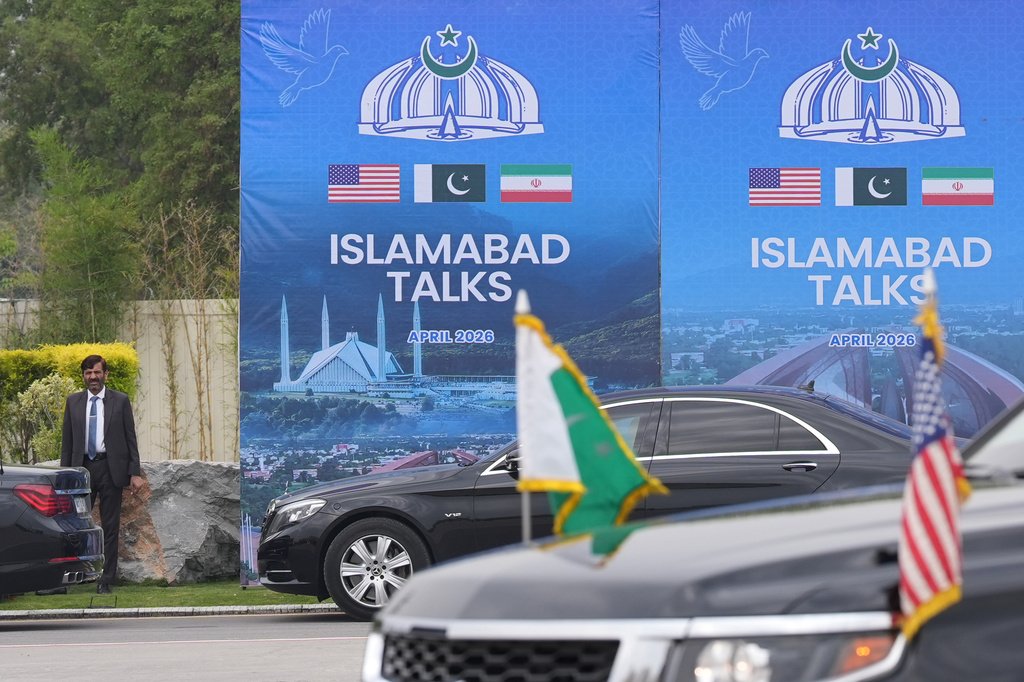
The breakdown of U.S.-Iran negotiations in Islamabad last month was more than just another diplomatic dead end. It exposed a profound transformation in Tehran's strategic calculus — one that places nuclear capability at the center of regime survival, not as a bargaining chip but as a structural necessity.
The February-March war that killed Ayatollah Ali Khamenei triggered a rapid leadership transition. While Mojtaba Khamenei succeeded his father as supreme leader, real power migrated to the Islamic Revolutionary Guard Corps (IRGC). Commanders now dominate the institutions shaping Iran's foreign policy, internal security, and regional posture. Analysts at the Soufan Center and Journal of Democracy describe this as the consolidation of a militarized security state, where clerical bodies provide legitimacy but the IRGC sets strategic direction.
Mustafa Fahs, a specialist on Iran's clerical establishment, highlighted Mojtaba Khamenei's weakness. “He is not an Ayatollah like his late father or Ayatollah Khomeini,” Fahs said. “That lack of formal religious qualification complicates his standing and gives the IRGC a kind of upper hand over him.”
This internal shift shaped the Islamabad talks. The negotiations collapsed over a package linking nuclear restrictions, verification, sanctions relief, and regional guarantees. U.S. negotiators demanded long-term limits on enrichment and stockpile removal; Tehran insisted on immediate sanctions relief and security assurances. Neither side could accept the other's red lines. For Iran's new power center, the failure confirmed a conclusion years in the making: traditional diplomacy cannot reliably deliver sanctions relief or protect the regime from external pressure.
That conclusion is reshaping Iran's nuclear calculus. The war demonstrated the vulnerability of Iran's leadership to targeted strikes. The Islamabad collapse showed that even high-level negotiations with Washington produce no relief unless Tehran accepts constraints it views as existential. Hardline voices now argue that nuclear latency — and potentially an overt deterrent — is the only reliable guarantee of regime survival. The logic mirrors North Korea's model: sanctions can be endured, but a nuclear shield deters external coercion.
There is no public evidence that Iran has decided to build a bomb. But the incentives for a stronger nuclear hedge have clearly intensified. Iranian commanders increasingly argue that deterrence — not clerical authority — is what ultimately protects the state. As Fahs put it, the generals believe that “what safeguards them and their interests is the nuclear program — not the supreme leader.”
Iran's grand strategic doctrine has long prioritized deterrence through cost-imposition — missiles, proxies, and maritime leverage — rather than diplomatic compromise. A nuclear dimension fits seamlessly into that framework, offering ultimate protection without requiring conventional parity. This approach also aligns with global trends: geopolitical tensions are driving many nations to reconsider energy security, as seen in the global shift toward renewables and nuclear power.
The Islamabad failure reinforced the belief that sanctions relief will not come through negotiation alone. For Iran's emerging leadership, the lesson was not that diplomacy is impossible, but that diplomacy without leverage is ineffective. In this environment, nuclear capability is not viewed as a bargaining chip but as a structural requirement for regime security. Recent actions, such as Iran's seizure of commercial vessels in the Strait of Hormuz, underscore this assertive posture.
The result is a harder, more insulated Iranian state. The war, the succession, and the diplomatic collapse have produced a leadership that is more skeptical of negotiation and more convinced that only self-generated deterrence can secure the regime's future. The U.S. retains significant leverage, but the window for diplomacy that shaped earlier nuclear talks has narrowed. Any future negotiations will be conducted with a leadership whose priorities are shaped by security institutions rather than clerical councils.
The Islamabad breakdown was not just a failed meeting. It was a signal that Iran's internal logic has shifted — and that nuclear deterrence, not diplomatic compromise, is increasingly seen as the foundation of regime survival. Iran's generals understand the strategic cost of openly pursuing a nuclear deterrent — Tehran is far more geopolitically exposed than North Korea — but they increasingly view nuclear leverage as indispensable to protecting the regime. This shift also raises questions about how presidential stability shapes nuclear command structures in volatile states.