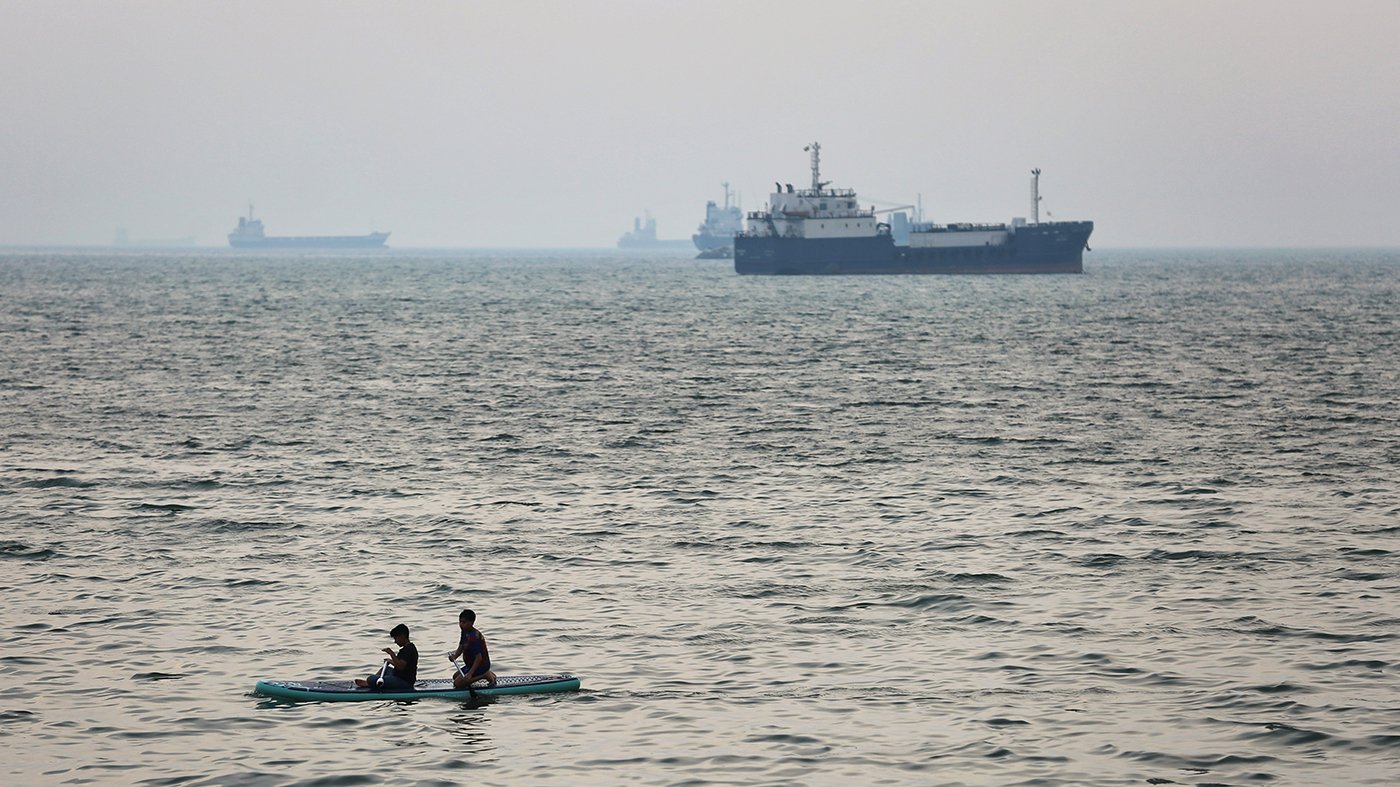
The relative calm on land between the United States, Iran, and Israel has given way to a sharp escalation at sea, as both sides seized tankers in international waters this week and Tehran struck vessels in the strategic Strait of Hormuz. The waterway, which carries roughly one-fifth of the world's crude oil in peacetime, has become the stage for a dangerous game of gunboat diplomacy that threatens to unravel a ceasefire that has largely held since the initial wave of missile, bomb, and drone strikes.
President Trump on Thursday ordered the Navy to fire on any Iranian vessels laying mines in the strait, a move that experts say could further destabilize a region already reeling from an energy crisis. The U.S. military has seized at least three Iranian oil tankers this week, including one in the Indian Ocean, and has directed 31 vessels to turn around or return to port as part of a broader blockade. The Pentagon described the latest seizure as part of efforts to disrupt illicit networks providing material support to Iran.
In response, Iran's Islamic Revolutionary Guard Corps (IRGC) has fired on ships to prevent passage through the Strait of Hormuz, attacking three vessels and seizing two on Wednesday. The tit-for-tat actions come despite Trump's extension of the ceasefire indefinitely on Tuesday, which he framed as a gesture to give Tehran time to present a peace proposal. However, the president made clear the U.S. would maintain its naval posture.
“This is sort of this test of wills,” said Jason Campbell, a senior fellow at the Middle East Institute. “The U.S. isn't carrying out airstrikes in Iran like it was. It is moving to the seas as a means of being able to exert some level of pressure. Iran has done so the same way.” He added that the ceasefire is “mostly in name.”
The conflict is now entering its ninth week, surpassing Trump's original four-to-six-week timeline. The president has framed the standoff as a waiting game, writing on Truth Social that he has “all the time in the World, but Iran doesn't — The clock is ticking!” In the Oval Office, he said any agreement would be on his terms and timeline, acknowledging that Americans could face higher gasoline prices “for a little while” in exchange for a deal that ensures global safety from “lunatics with nuclear weapons.”
Retired Marine Colonel Mark Cancian, a senior defense adviser at the Center for Strategic and International Studies, noted that the U.S. pressure campaign could push Iran to make concessions but risks backfiring. “Revolutionary Guards might become more kinetic. They might start shooting at the ships in the Persian Gulf,” he said, calling the strategy a gamble. Cancian suggested the U.S. could expand seizures to track down dozens of Iranian tankers outside the Gulf, a move echoed by Senator Lindsey Graham, who predicted the blockade “will be growing and that it could become global soon.”
The closure of the strait and the U.S. blockade have already strained global energy resources. International Energy Agency head Fatih Birol told CNBC that the world is “facing the biggest energy security threat in history.” Campbell warned that with the strait closed, the economic impacts “are going to get worse very quickly.”
Analysts see the White House as caught between two unpalatable options: a prolonged Middle East entanglement, which Trump has long opposed, or a political deal with Tehran that could be seen as weaker than the Obama-era nuclear deal. “Not wanting to take a bite of either of those apples, the White House appears to be playing for stalling tactics,” Campbell said.
For more on the evolving naval strategy, see U.S. Seizes Third Iranian Oil Tanker This Week Amid Strait of Hormuz Tensions. On the broader ceasefire dynamics, read Trump Extends Iran Ceasefire Despite IRGC Attack, Signaling Strategic Retreat. The Pentagon has also addressed mine clearance claims, as detailed in Pentagon Rejects Claim Strait of Hormuz Mine Clearance Would Take Six Months.