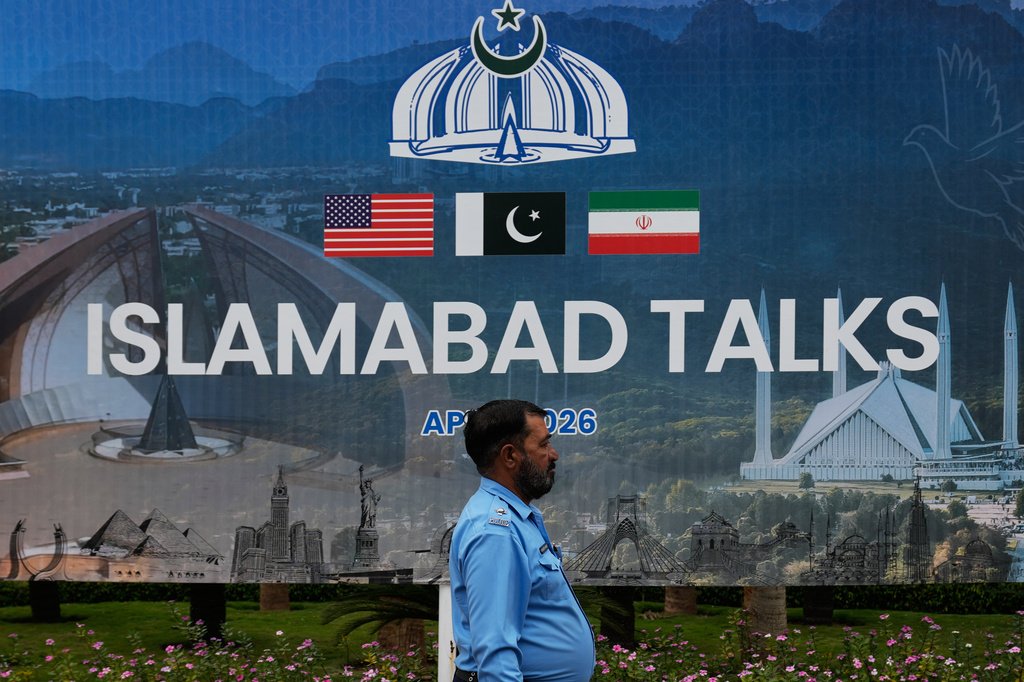
Just hours after President Trump agreed to an indefinite ceasefire proposed by Pakistani leaders, giving Tehran time to craft a unified proposal, Iran's Islamic Revolutionary Guards Corps attacked three commercial vessels in the Strait of Hormuz. The regime then declined to send negotiators to Islamabad and made no concessions—yet Trump still wavered on his previous threats to resume airstrikes.
With a two-week ceasefire set to expire, the president blinked. He extended the truce, publicly hoping internal fractures within Iran's government would force a breakthrough, while relying on a naval blockade to economically pressure the regime. As former Army Chief of Staff Gen. Gordon Sullivan once noted, 'hope is not a method.'
The proposal Trump awaits was delivered Wednesday by the IRGC itself: a defiant message to 'come and take it.' Despite Trump's assertion that Iran's government is 'seriously fractured,' the IRGC's most fanatical wing remains firmly in control. The Institute for the Study of War reported Saturday that IRGC leaders have likely secured temporary control over both Iran's military response and its negotiating position, sidelining more pragmatic figures with whom Washington had previously engaged.
IRGC commander Ahmad Vahidi has effectively broken the 'art of the deal' code, betting that Trump will not commit ground forces to eradicate the regime. Tehran is playing for time, gambling that the global economy's $2 billion daily loss from the strait closure will outweigh Iran's $300 million daily hit—and that Trump will eventually bend to pressure for a deal favorable to Iran.
Retired Navy Captain Lance Gordon noted that before February 28, Iran had pre-positioned roughly 200 million barrels of crude on tankers near China—equivalent to about five months of export supply. The IRGC, willing to martyr itself, faces a risk-averse White House reliant on stand-off weapons that have likely reached their limits.
Despite the 38-day Operation Epic Fury, which struck 13,000 targets and weakened the regime, Trump's actions now reinforce the 'Trump Always Chickens Out' (TACO) narrative. Analysts argue the strategic phase must transition to an operational-tactical one—requiring coordinated diplomatic, informational, economic, and military pressure, not invasion.
Trump should maintain the blockade, secure the Strait, and shut down communication channels to let the regime wither. Retired Army General Jack Keane and former U.N. Ambassador John Bolton have both warned, 'You can't trust Iran.' Like its Russian ally, Iran respects only strength—and sees weakness in this White House.
Tehran must understand it is not an equal partner. The last non-kinetic opportunity for peaceful regime change—surrender of enriched uranium, termination of nuclear and missile programs, defunding of proxies, and relinquishing control of the strait—has passed. Iran must be told that forces are ready to execute the next phase of the campaign, moving toward unconditional surrender.
The IRGC cannot remain in power, threatening Gulf states, Israel, the U.S., and its own citizens, nor can it control an international waterway. Ultimately, Trump will be judged on what he has not done: achieve regime change and reopen the Strait of Hormuz.