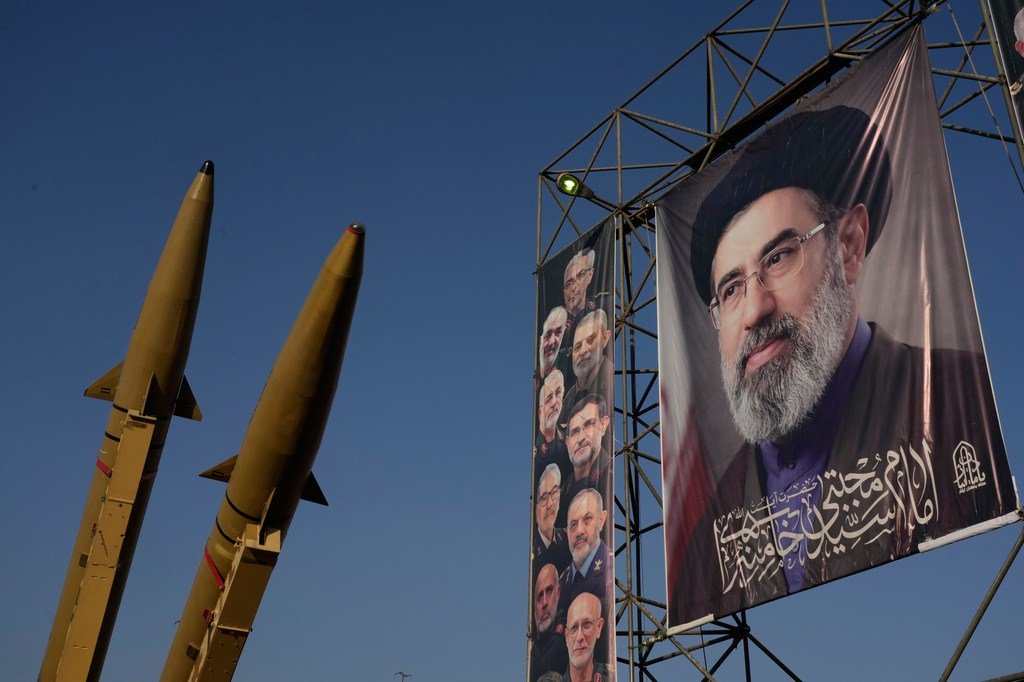
Six months after the deaths of Ayatollah Ali Khamenei and Ali Larijani, Iran has neither rebuilt the centralized hierarchy that once revolved around the supreme leader nor descended into chaos. Instead, the Islamic Republic has entered a more opaque phase of governance, where coercive institutions continue to function but authority is more insulated, more mediated by security bodies, and harder to translate into reliable control across every front.
Mojtaba Khamenei holds the formal office of supreme leader, and major appointments are still issued in his name. Yet public evidence does not show him exercising the visible, personalized authority associated with his father. The result is a more security-centered Iran, one in which outsiders can no longer safely infer how tightly the center controls the timing, escalation, and interpretation of actions across every theater.
Mojtaba has not made an independently confirmed public appearance since taking office, and no authenticated video or audio of him speaking after his appointment has been released. On Aug. 10, President Masoud Pezeshkian said he had spent about seven hours with Mojtaba in a meeting that has not been independently documented. Formal authority has continued to be exercised through institutions: A decree issued in Mojtaba's name designated Mohsen Rezaei as the supreme leader's representative to the Supreme National Security Council, after which Pezeshkian appointed Rezaei as secretary. On the same day, Hossein Taeb—a former Islamic Revolutionary Guard Corps intelligence chief described by analysts as close to Mojtaba—was appointed Basij commander by a decree issued in the supreme leader's name.
Leadership decapitation, a damaged command structure, economic siege, and regional pressure did not produce collapse. They produced a surviving system in which the security services and the Islamic Revolutionary Guard Corps are now the most visible and central wartime institutions.
The Islamic Revolutionary Guard Corps did not disappear into chaos. It became more central to the state's survival, but not necessarily a more transparent or frictionless command system. Senior command losses and scattered proxy theaters, together with the opacity of wartime decision-making, have left outsiders with evidence of more discretion and less visibility into who authorizes what.
Uneven behavior across Hormuz, Saudi Arabia, Iraq, Syria, Lebanon, and Yemen does not necessarily prove autonomous regional commands. It may reflect distinct local constraints, proxy-specific capabilities, deniability requirements, selective or delayed guidance, wartime delegation, and reduced outside visibility into the command process.
The result is a system of delegated coercion shaped by broadly understood Iranian guidance: Tehran's strategic intent may remain broad, but the specific authorization, timing, and calibration of local action are harder to infer. The public evidence does not establish proxy rebellion. The more supportable immediate concern is delegated escalation—partners pursuing overlapping objectives understanding guidance that can preserve deniability while making restraint and de-escalation harder to verify.
Three plausible trajectories
Iran's post-decapitation system now points toward three plausible trajectories:
- Security consolidation. Mojtaba retains formal authority while a small and fanatical leadership restores coherent command. Indicators would include consistent cross-theater signaling, appointments that produce a durable and visible chain of command, and a negotiating channel capable of delivering compliance.
- Insulated security equilibrium—the current baseline. Mojtaba remains unseen; key institutions mediate decisions; coercion is delegated; escalation is uneven. This resembles the present pattern: secrecy, selective escalation, and security appointments that have restored a wartime center of gravity without restoring Ali Khamenei's personalist command.
- Fragmentation under pressure. Economic stress and military losses produce open elite disputes, uncontrollable proxy actions, or contradictory orders. This would require visible defections, intra-elite conflict, or a sustained loss of internal-security control.
Iran has survived decapitation through a more opaque, security-centered system and more delegated coercion. That does not make it a failed state or a federation of Islamic Revolutionary Guard Corps commanders. It just makes the Islamic Republic harder to read.
For Washington and regional capitals, the lesson is not that Tehran has lost control of its allies. It is that deterrence and diplomacy can no longer be judged chiefly by statements issued from Tehran. A message from Mojtaba's office, an action in Hormuz, and a proxy escalation in Yemen may still serve the same broad strategy—but they cannot automatically be treated as evidence of a single, timely, and centrally calibrated decision.
Iran has neither restored its old order nor disintegrated into chaos. It is surviving through an opaque, security-centered system whose authority remains formal at the top, but whose coercion is now harder to read and more delegated in practice.