Last year, a young Muslim socialist’s upset victory in a New York primary stunned the political world. This year, the sequel was even more dramatic. On Tuesday, a slate of largely unknown candidates backed by the Democratic Socialists of America (DSA) swept through bitterly contested races, leaving the city’s Democratic establishment reeling.
The standout winners included Darializa Avila Chevalier, an eccentric Ph.D. student who captured the 13th Congressional District, and Assemblywoman Claire Valdez in the 7th District. Both are transplants to New York, and both are poised to reshape the city’s political landscape. The New York Post has dubbed them “Mamdanites,” a nod to the organizing machine built by Rep. Zoha Mamdani, who has become a symbol of the left’s growing muscle.

The DSA’s success was no fluke. They outorganized and out-messaged a flailing municipal Democratic establishment still smarting from its failed effort to install Andrew Cuomo in Gracie Mansion. But the question now is whether this wave can go national—or whether it’s a New York anomaly.
House Minority Leader Hakeem Jeffries (D-N.Y.) dismissed the socialist wave as confined to “the most gentrified district in the nation, by far,” noting that progressive candidates fared worse elsewhere. Yet Peter Rothpletz argues that New York is hardly uniquely radical—it elected Eric Adams just four years ago. The “Tea Party of the left” narrative, he says, is premature. Still, the Mamdani machine could become a national archetype for a new city politics.
Chevalier’s victory over Rep. Adriano Espaillat (D-N.Y.) was particularly striking. Espaillat, a five-term incumbent and chair of the Congressional Hispanic Caucus, had built a career on ethnic machine politics. He attacked Chevalier, the daughter of Dominican immigrants, by falsely claiming she was Haitian—a move that backfired. On election night in Harlem, voters—both new and longtime residents—expressed disgust with Espaillat’s establishment tactics. Chevalier won the Black vote and held her own among Hispanics, even as the Bronx kept Espaillat competitive.
Valdez faced a different challenge. Her opponent, Antonio Reynoso, was a progressive endorsed by retiring Rep. Nydia Velázquez and a host of unions, including the Working Families Party. But in a district reshaped by gentrification, the old progressive machinery looked hollow against the DSA’s intensive, volunteer-driven mobilization. Reynoso cast himself as “born and raised,” but as journalist Alex Bronzini-Vender noted, “most people in NY-7 don’t even know they live in NY-7!”
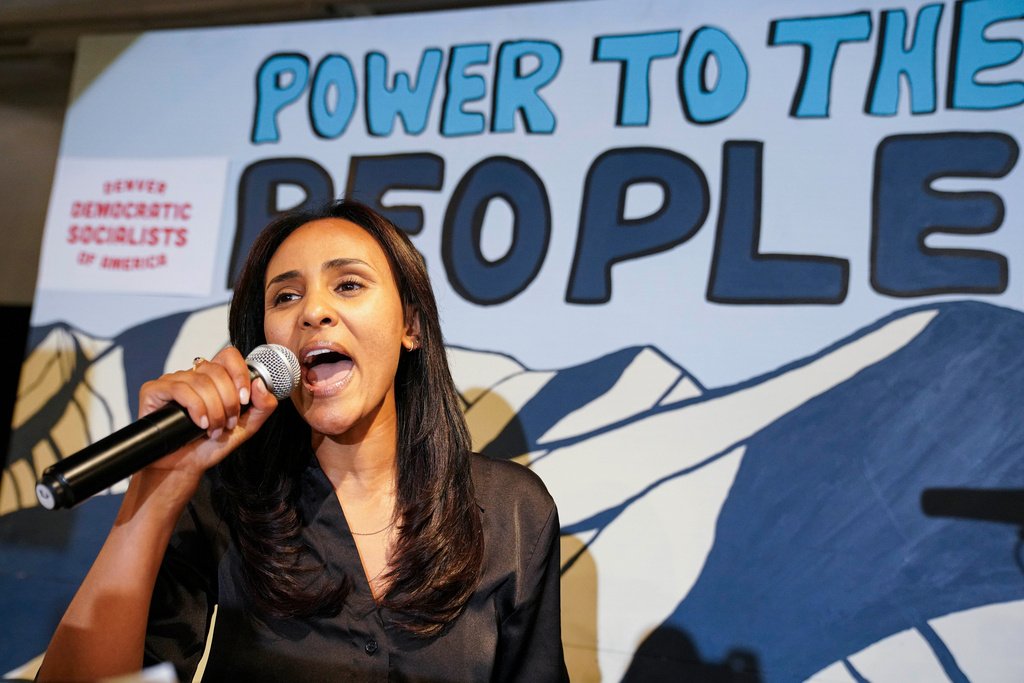
The left’s organizing muscle is not limited to New York. In Colorado’s 1st District, graduate student Melat Kiros beat a hapless incumbent by more than ten points despite being out-fundraised. Even in Utah, where a Blue Dog won a primary, runner-up Nate Blouin has since joined the DSA. Recent polling shows that wealthy, educated voters are driving this surge, suggesting the movement has deep roots.
The only major counterexample may be San Francisco, where centrist outsider Daniel Lurie—Mamdani’s West Coast twin—vanquished the city’s left coalition in primaries earlier this month. But in New York, the socialist left has built a municipal political machine within the Democratic system, much to the establishment’s chagrin. Mamdani herself has been vocal about inequality, and her machine appears to be thriving.
Whether this wave can spread nationally remains an open question. But for now, the DSA has proven it can compete—and win—against the Democratic establishment. With 29% of voters open to socialist candidates, the old machines may have more to fear than they admit.