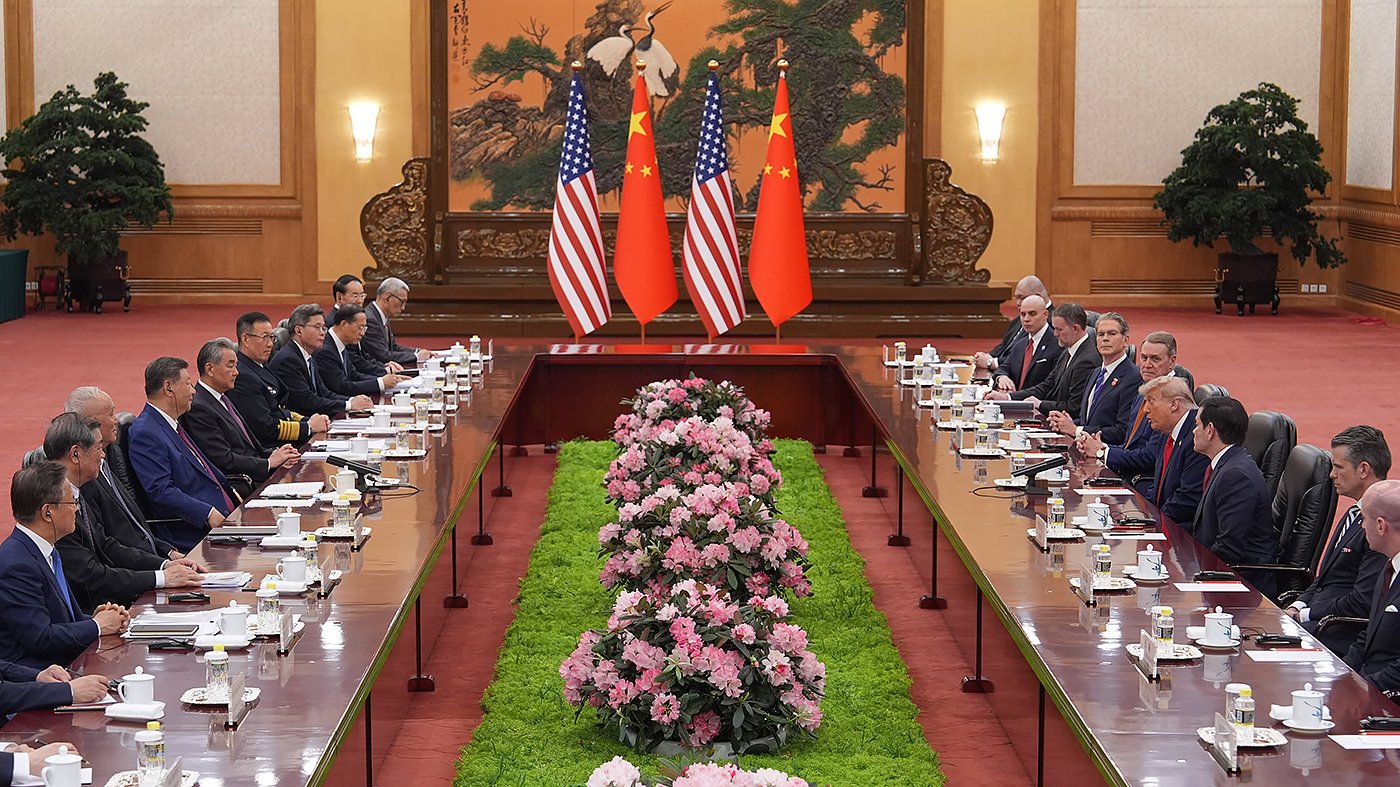
Chinese President Xi Jinping used the Taiwan issue as a blunt instrument to pressure President Trump during their high-stakes Beijing summit, warning that mishandling the island's status could jeopardize the entire bilateral relationship. The exchange, detailed by China's foreign ministry, underscores Beijing's growing confidence in leveraging its core interests against Washington's priorities.
During their bilateral meeting Thursday, Xi told Trump that the 'entire relationship' between the two nations would be endangered if the 'Taiwan question' was not handled properly, according to the Chinese foreign ministry readout. Beijing later labeled Taiwan 'the most important issue in China-U.S. relations,' a phrase that analysts say marks a sharp escalation in rhetoric.
The White House, in contrast, omitted any mention of Taiwan from its official readout, focusing instead on shared commitments like keeping the Strait of Hormuz open. Trump notably declined to answer reporters' questions on Taiwan when greeted by Xi, a silence that some observers interpreted as a tactical retreat or a sign of private reassurances.
'Beijing made clear, well before the summit, that Taiwan would be central to Xi Jinping's agenda, while the White House appeared much more focused on trade and economic issues,' said Patricia Kim, senior fellow at the Brookings Institution's John L. Thornton China Center. Trump himself had predicted Xi would raise the issue, telling reporters Monday that his Chinese counterpart would 'bring up Taiwan more than I will.'
The asymmetry in messaging stunned U.S. experts. Mick Mulvaney, who served as acting White House chief of staff under Trump, noted that Beijing's language was unusually harsh. 'The Chinese statement used some fairly harsh language. It's noteworthy in that it's different,' he said. 'I don't recall them using words like “conflict” and “clash” previously. Offering Taiwan as the single most important issue seems like an escalation.'
Secretary of State Marco Rubio confirmed in an NBC News interview that Taiwan was raised but said both sides understand each other's positions. 'We always make clear our position and we move on to the other topics,' he said. However, the gap in interpretation persists: Beijing views U.S. arms sales and defense support for Taiwan as encouragement of independence, while Washington insists they are defensive measures to maintain stability.
Kim explained that this 'gap in interpretation—over what constitutes support for Taiwan independence versus support for maintaining the status quo—has fueled tensions in the past and will likely continue to do so.' The U.S. has long maintained unofficial ties with Taiwan and provides defense support, even as China claims the island as its own territory.
Trump faces bipartisan pressure to reaffirm Washington's commitment to Taipei, including a $14 billion arms sale. Yet Mulvaney argued that no Chinese pressure would sway Trump. 'Trump understands the importance of Taiwan to the American supply chain and the American economy. He is not going to roll over on Taiwan because he knows it would crush the American economy,' he said.
The summit also covered trade, artificial intelligence, and Iran. Trump told Fox News that Xi agreed to purchase U.S. soybeans, energy, and jets, and pledged not to supply Iran with weapons. However, Trump's claims of Xi's Iran pledge have been met with skepticism, given China's previous denials. Nathan Sales, former State Department counterterrorism coordinator, warned that Xi will try to weaken U.S. commitment to a free and democratic Taiwan, potentially using future semiconductor deals as leverage.
As the two leaders navigate these tensions, the Taiwan issue remains a central fault line. Xi's broader strategy, including his warnings about historical power transitions, suggests Beijing intends to keep Taiwan at the forefront of U.S.-China talks, using it as a bargaining chip on trade, technology, and regional security.