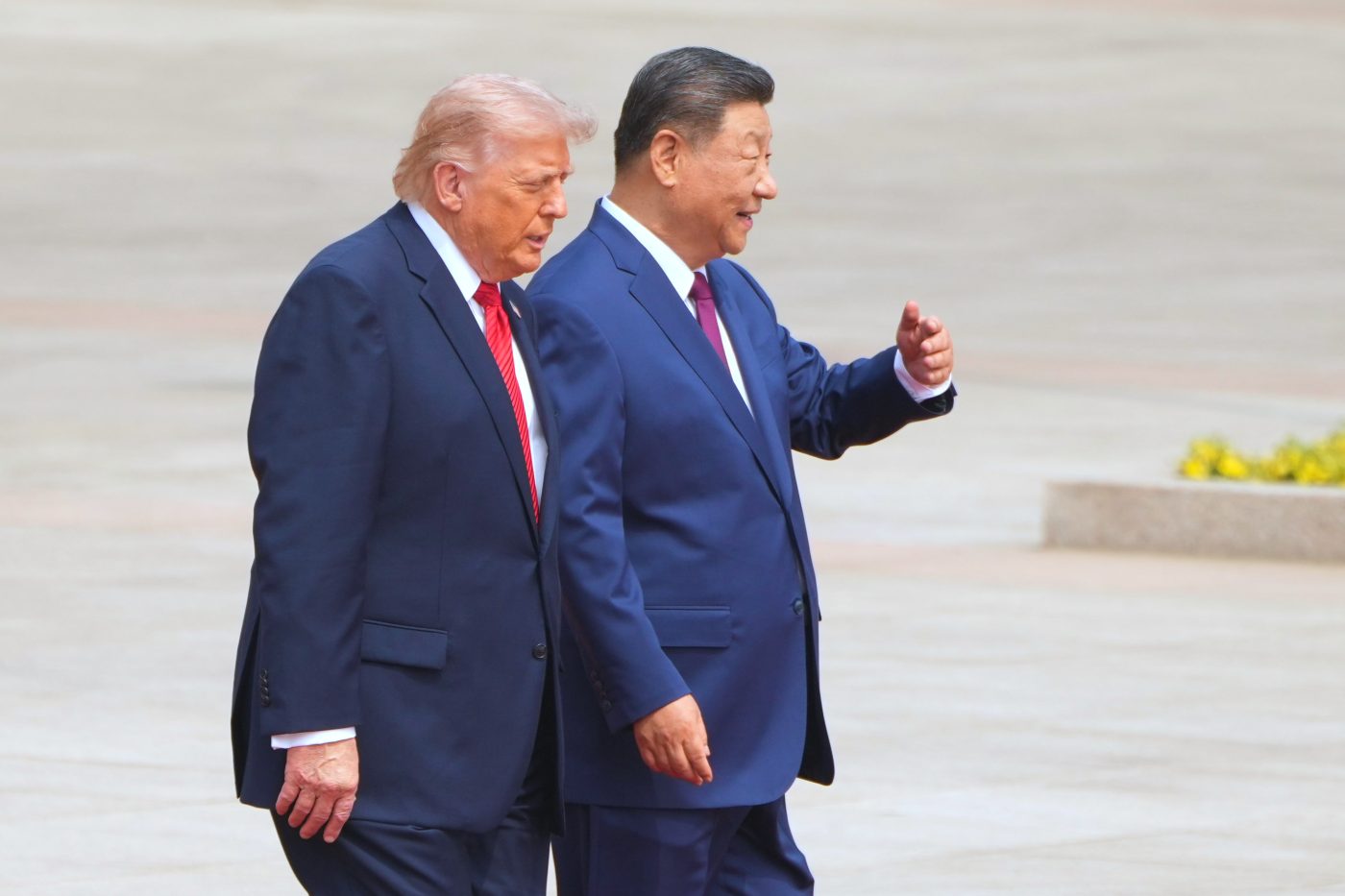
President Donald Trump and Chinese President Xi Jinping opened their bilateral meeting in Beijing on Thursday with a display of mutual admiration and broad calls for cooperation, but the high-profile summit produced no immediate breakthroughs on trade imbalances, technology competition, or geopolitical flashpoints.
Trump, seated at a long table in the Great Hall of the People, signaled his eagerness to strike business deals with China and repeatedly highlighted his personal rapport with Xi. He boasted about the size of his delegation, which included top executives from Apple, Tesla, Nvidia, Boeing, and BlackRock. “We have the greatest business and the biggest, I guess. Best in the world. Amazing people, and they’re all with me,” Trump said. “We asked the top 30 in the world. Every single one of them said yes.” He added that the executives came “to pay respects to you, China and they look forward to trade and doing business.”
The president went on to call the meeting “maybe the biggest summit ever” and described his relationship with Xi as “fantastic.” He noted that they had resolved past difficulties through direct calls. “We’ve gotten along when there were difficulties, we worked it out,” Trump said. “Whenever we had a problem, people don’t know, we worked it out very quickly.” He joked that critics dislike when he calls Xi a “great leader,” but insisted, “I say it anyway, because it’s true.” Trump concluded his opening remarks by declaring, “The relationship between China and the USA is going to be better than ever before.”
Secretary of State Marco Rubio, who has been gaining attention in 2028 GOP primary polls, and U.S. Ambassador to China David Perdue were seated on either side of the president.
Xi, in his response, acknowledged the global significance of the meeting. “The whole world is watching,” he said. He noted that “transformation not seen in a century is accelerating across the globe, and the international situation is fluid and turbulent.” The Chinese leader raised the concept of the “Thucydides Trap,” a theory describing how power struggles between an established and a rising power often lead to war. He posed a series of pointed questions: “Can China and the United States overcome the Thucydides trap and create a new paradigm of major country relations? Can we meet global challenges together and provide more stability for the world?” Xi called for the two nations to be “partners, not rivals,” and framed the answers to these questions as vital to history and the world.
Despite the lofty rhetoric, neither leader provided specifics on contentious issues such as tariffs, technology restrictions, or China’s human rights record. The House recently passed a resolution demanding stronger action on China detainees, and a bipartisan Senate coalition has warned against unilateral shifts in Taiwan policy. Those tensions remained unaddressed in the public opening statements.
The meeting comes amid a broader push by the Trump administration to reshape international trade and security dynamics. The White House has also faced scrutiny over its domestic agenda, including a Senate GOP move to block efforts to halt the administration’s Consumer Financial Protection Bureau rollback and a federal judge blocking Trump sanctions on a UN rights investigator. However, the Beijing summit’s focus on personal diplomacy and general cooperation suggests that both leaders are prioritizing a stable public relationship over immediate confrontation.