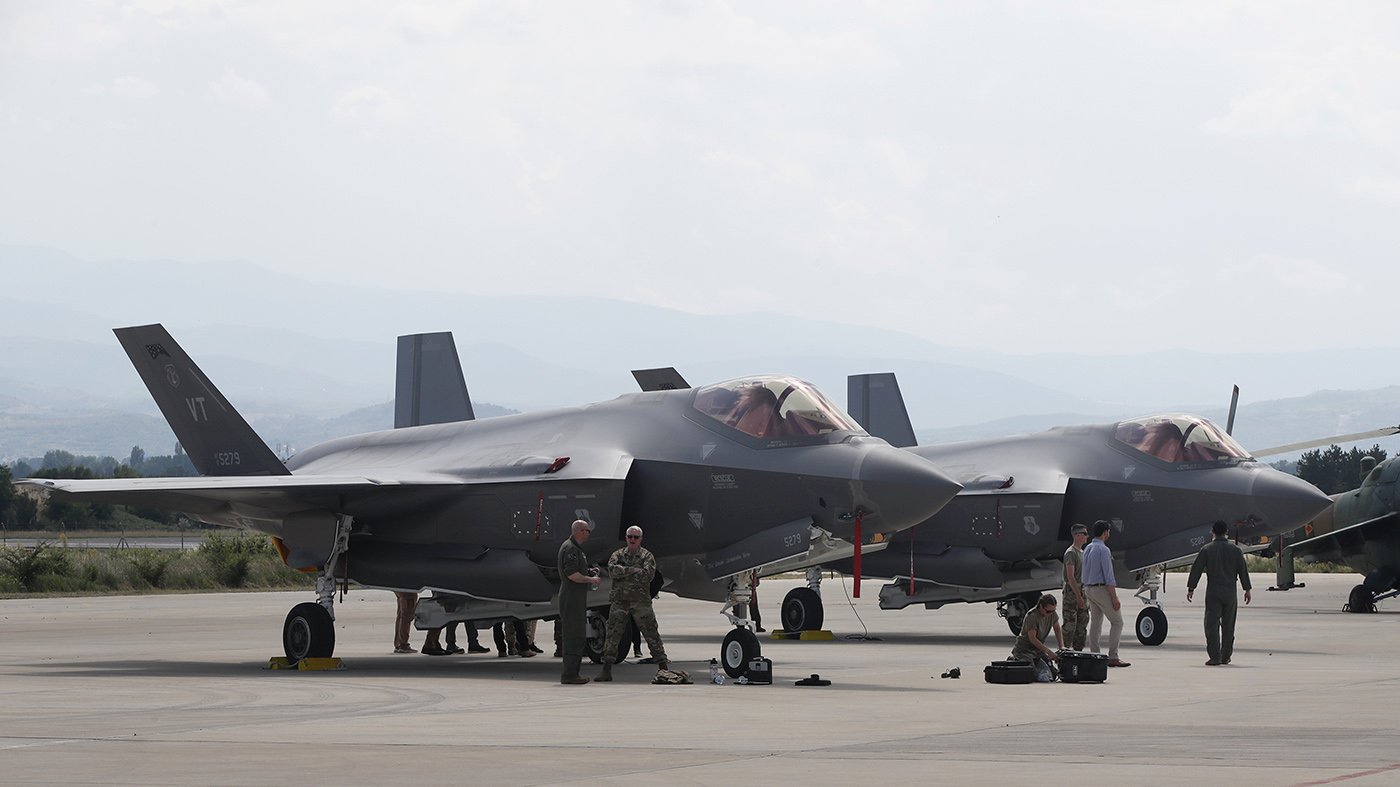
President Donald Trump is heading toward a confrontation with lawmakers and key allies after declaring Tuesday that he would remove sanctions on Turkey and possibly allow the country back into the F-35 fighter jet program, despite Ankara's refusal to give up a Russian air defense system.
A growing number of Republican and Democratic legislators are opposing the move, arguing that Turkey must first neutralize its Russian-made S-400 system, as required by two federal laws—the Countering America's Adversaries Through Sanctions Act (CAATSA) and a provision in the 2020 National Defense Authorization Act. Those statutes mandate a presidential certification that the Russian equipment is no longer a threat before Ankara can regain access to advanced U.S. stealth fighter technology.
Speaking alongside Turkish President Recep Tayyip Erdoğan in Ankara, Trump told a reporter, “I can tell you we’re going to be taking the sanctions off. OK? I don’t want him to waste his time answering that question.” The next day, however, he appeared to hedge on the F-35 issue, stating, “I haven’t totally made up my mind, but my inclination is to say, look, he’s done everything,” adding that Erdoğan had helped the U.S. in many ways, and that “you know who else has been good to us? China.”
The president’s signals drew immediate criticism from Israeli Prime Minister Benjamin Netanyahu, who warned in a CNN interview that handing such advanced technology to a “radical regime” like Erdoğan’s would fuel aggression. Israel's ambassador to Washington, Yechiel Leiter, convened an emergency meeting with Greek and Cypriot envoys, along with military attachés and faith leaders, to discuss regional stability, highlighting how Turkey’s neighbors view Ankara as an unreliable security partner despite its NATO membership.
On Capitol Hill, Rep. Nicole Malliotakis (R-N.Y.) issued a blistering statement opposing Turkey’s return to the F-35 program, saying Erdoğan “has aligned himself with Iran and Russia, harbored Hamas, refused to sanction Russia, undermined American counter-ISIS operations, continues to illegally occupy part of Cyprus, and has repeatedly directed illegal military jet overflights above the Greek Islands, and called for the destruction of Israel.” She added, “Providing Turkey with our most advanced fighter jet would jeopardize U.S. national security, risk sensitive technology falling into the wrong hands, and endanger our allies in the Eastern Mediterranean and Middle East.”
Malliotakis was among six House Republicans who co-signed a July 2 letter to Trump warning against granting Turkey F-35 access without addressing its aggression and S-400 possession. In a joint op-ed in Greece’s Kathimerini, Reps. Gus Bilirakis (R-Fla.) and Brad Schneider (D-Ill.) wrote, “Any consideration of Turkey’s return to the F-35 program must therefore be tied to full compliance with US law and meaningful resolution of the concerns that led to its removal.”
Rep. Dina Titus (D-Nev.) sent a letter Monday to House leaders urging them to introduce a joint resolution of disapproval to block what she called an “illegal” sale of F-35s to Turkey, backed by 17 other House Democrats. The letter argued that CAATSA was passed with overwhelming bipartisan support precisely to ensure Congress retains a check on rewarding adversary-aligned behavior with American military technology. “The integrity of that framework and the signal it sends to every country weighing whether to purchase Russian arms depend on Congress being willing to enforce it,” the letter read.
Sen. John Cornyn (R-Texas) posted the text of the NDAA provision on X, responding to reports of Trump’s plan by saying, “I hope this is wrong.” Meanwhile, lawmakers at the NATO summit tried to balance welcoming Turkey as a key ally while insisting on S-400 disposal. Rep. Mike Turner (R-Ohio) described details shared with lawmakers as “promising,” but Sen. Chris Coons (D-Del.) cautioned that merely moving the S-400 to another location would not satisfy legal requirements. The fight underscores the deepening tensions between the White House and Congress over how to handle Erdoğan’s increasingly authoritarian rule and his threats to neighbors, including Greece and Cyprus.