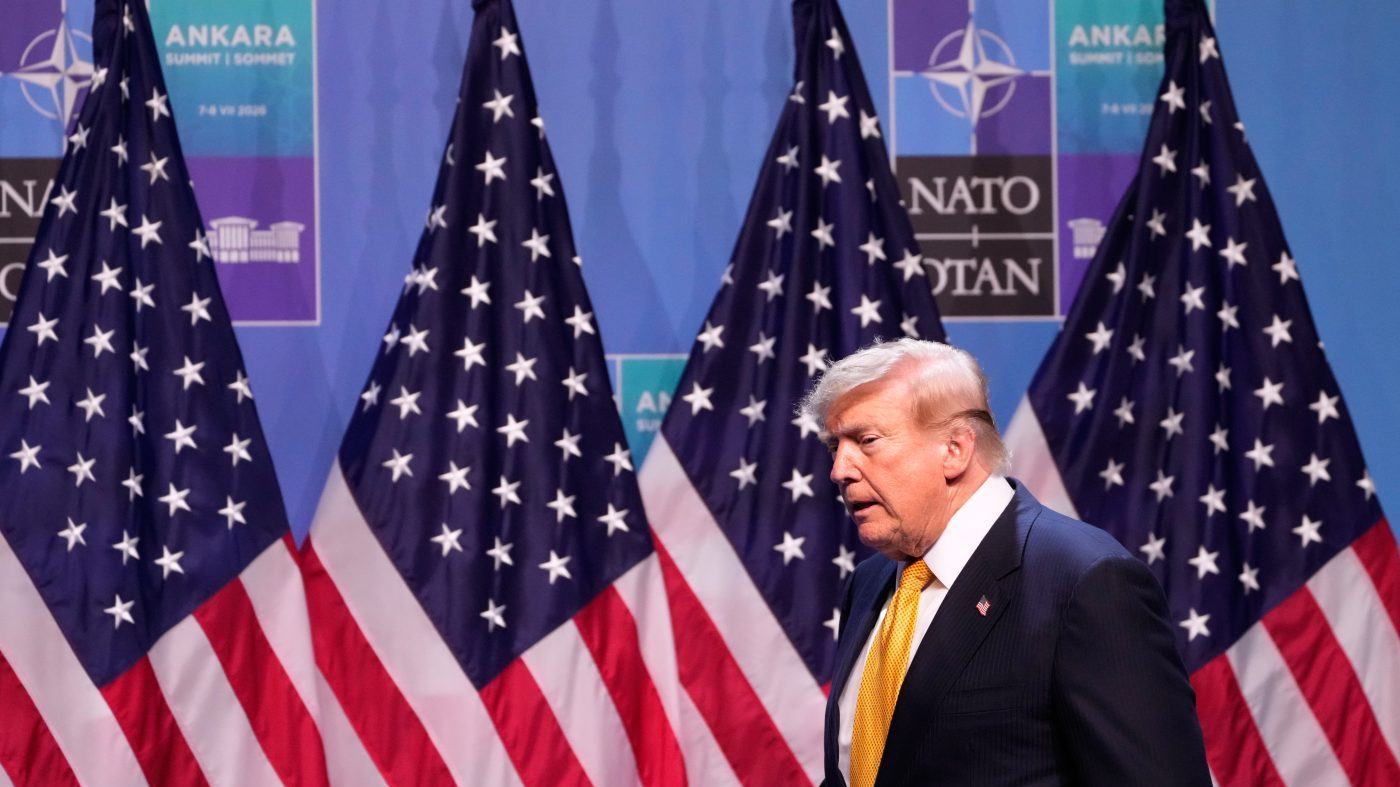
President Donald Trump stunned allies Wednesday by declaring the United States will cut off all trade with Spain, a move that would sever economic ties with one of America's top 25 trading partners and disrupt billions of dollars in annual commerce.
Speaking alongside NATO Secretary-General Mark Rutte at the alliance's summit in Ankara, Turkey, Trump said, "Spain is a wasted cause. We don't want to do any trade business with Spain anymore by the way." He later instructed Treasury Secretary Scott Bessent, who was present, to "Cut off all trade with Spain, please, including visits."
The potential embargo would freeze a trade relationship that saw the U.S. export more than $2.2 billion in goods to Spain in May, while importing over $1.8 billion, according to U.S. Census Bureau data. That surplus marks a reversal from the 2012-2021 period, when the U.S. consistently ran a trade deficit with Madrid.
Top U.S. exports to Spain include crude petroleum, petroleum gas, and medical products such as vaccines, blood, antisera, toxins, and cultures, per the Observatory of Economic Complexity. Petroleum gas shipments alone fell nearly 60% in April compared to a year earlier. On the import side, Spain sends the U.S. paintings, electrical transformers, and packaged medicaments.
Beyond goods, the financial stakes are significant. Spanish direct investment in the U.S. topped $87.4 billion in 2024, making Spain the ninth-largest European investor in America. By contrast, U.S. direct investment in Spain stood at less than $33.9 billion that year.
Trump has the legal authority to impose such an embargo under the International Emergency Economic Powers Act, but only if he declares a national emergency regarding Spain. Past presidents have used IEEPA to sanction Cuba and North Korea. Trump previously invoked the law for his sweeping "Liberation Day" tariffs, but the Supreme Court ruled that use unlawful in February. In a dissenting opinion, Justice Brett Kavanaugh wrote that IEEPA does authorize presidents to impose quotas or embargoes on foreign imports, saying "a President could completely block some or all imports."
The announcement comes amid broader tensions at the NATO summit, where Trump also granted Ukraine a Patriot missile license and escalated rhetoric against Iran. The president's remarks on Spain caught many delegates off guard, as the country is a key NATO ally hosting U.S. naval bases at Rota and Morón.
If enacted, the embargo would mark the most aggressive U.S. trade action against a European ally in decades, potentially rippling through energy markets already strained by instability in the Strait of Hormuz and renewed U.S. strikes on Iran. Spain, a major importer of American liquefied natural gas, would be forced to seek alternative suppliers, while U.S. pharmaceutical and energy exporters would lose a significant market.
Critics on Capitol Hill are already raising alarms. Senate Majority Leader Chuck Schumer, who has previously condemned Trump's handling of Iran policy as a "total, utter disaster," is expected to challenge the legality and wisdom of the Spain embargo. The move also puts pressure on European allies already grappling with the fallout from Trump's tariff policies and his unpredictable diplomatic style.