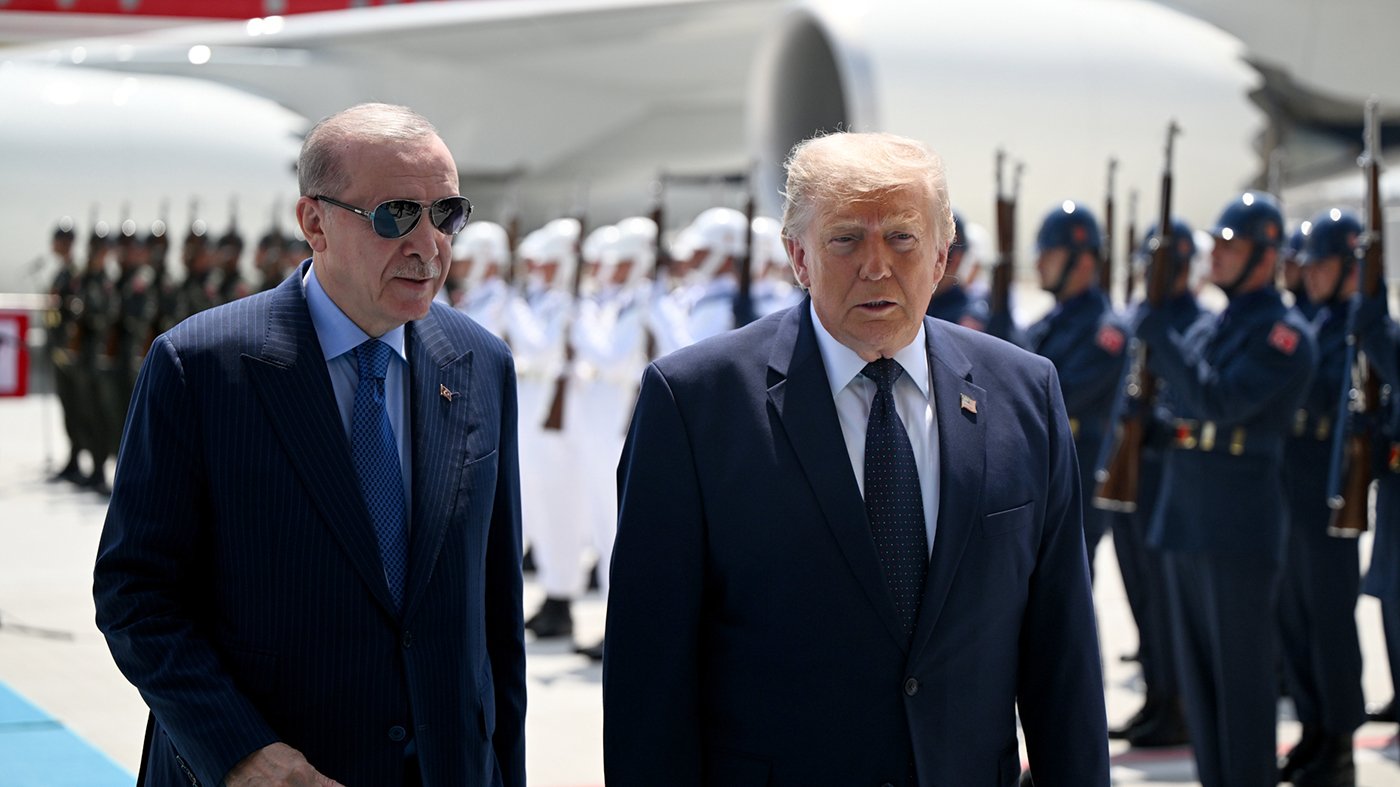
President Trump and fellow world leaders are gathering in Ankara, Turkey, this week for a NATO summit fraught with tension, confronting a series of contentious issues that threaten to strain the alliance. Trump's relentless campaign to force member nations to boost defense spending will dominate the agenda, alongside debates over U.S. troop deployments in Europe and collective support for Ukraine.
The alliance is also closely watching Trump for signals on whether he will allow Turkey back into the F-35 fighter jet program or lift remaining sanctions on Syria. Here are five critical flashpoints at this week's summit:

Potential U.S. Sale of F-35 Fighter Jets to Turkey
Bipartisan lawmakers are pushing back against Trump's apparent momentum toward reversing his first-term ban on selling F-35 fighter jets to Turkey. During a bilateral meeting with Turkish President Recep Tayyip Erdoğan, Trump told reporters he had no concerns about selling the jets and planned to lift sanctions blocking the transfer. However, critics in Congress warn Ankara could share sensitive technology with U.S. adversaries Russia and China, noting Turkey has not met the criteria for sanctions relief—including its continued use of Russian S-400 missile defense systems. Congress blocked any F-35 transfer to Turkey while it possesses the Russian system, a condition codified in the 2020 National Defense Authorization Act. The administration can issue a waiver by confirming with lawmakers that Turkey no longer holds the equipment. The potential move is drawing resistance from both Republican and Democratic lawmakers, as well as Israel. In a July 2 letter, a bipartisan group wrote to Trump expressing deep concern about any F-35 sale, citing Erdoğan's aggression toward U.S. partners and troubling defense partnerships with adversaries. Israeli Prime Minister Benjamin Netanyahu also signaled his concern in a Fox News interview Sunday, saying he does not believe Turkey should receive F-35s or engines for their fighter jets.
Patriot Air Defense Systems for Ukraine
Ukraine's urgent request for Patriot missiles from the U.S. and European allies grew more pressing after a massive Russian attack on Kyiv on Sunday, which included 68 missiles and 351 attack drones. President Volodymyr Zelensky said Monday that Ukrainian forces intercepted drones and cruise missiles but failed against Russian ballistic missiles due to insufficient interceptor missile supplies. Zelensky has recently asked for U.S. permission to domestically produce Patriot missiles, manufactured by American defense contractor Raytheon. Finnish President Alexander Stubb urged NATO countries to provide more Patriots for Ukraine in a Bloomberg Television interview Tuesday. Trump is set to meet Zelensky bilaterally at the summit, weeks after their meeting at the Group of Seven summit in France. Trump told reporters Tuesday he spoke with Russian President Vladimir Putin and believes both leaders want a deal to end the war, but offered no sign of new concessions.
Path to 5 Percent Spending Target
Trump has pressed for NATO countries to hit a defense spending goal of 5 percent of GDP, despite the alliance agreeing on a 3.5 percent target by 2035. Only five of 32 NATO members are projected to meet the 3.5 percent goal this year, according to updated alliance data. To reach the 5 percent Trump insists on, members have agreed to invest an additional 1.5 percent on defense-adjacent issues like cybersecurity and infrastructure by 2035. NATO Secretary General Mark Rutte touted defense deals worth billions of dollars signed at the summit, including a plan to procure five high-end uncrewed aircraft from Northrop Grumman and $40 billion for drone capabilities over five years. Trump has repeatedly called on NATO countries to pay their fair share, as the U.S. made up nearly 62 percent of the alliance's total spending in 2025. Most members have increased defense dollars in recent years, spurred by Russia's invasion of Ukraine in 2022, with Poland, Lithuania, Latvia, and Estonia surpassing the U.S. in defense spending as a percentage of GDP.
U.S. Troop Commitments in Europe
The future of U.S. troop deployments in Europe remains a flashpoint, with allies anxious about potential reductions under Trump. The U.S. currently maintains about 100,000 troops in Europe, but Trump has signaled a desire to reassess commitments, arguing European nations should shoulder more of the burden. This has sparked concerns among Baltic states and Poland, which rely heavily on the U.S. military presence as a deterrent against Russian aggression. NATO officials are pushing for a long-term commitment to maintain current force levels, but Trump's unpredictability keeps the issue tense.
Greenland Purchase Push Strains Alliance
Trump's renewed push to purchase Greenland, first floated in 2019, has resurfaced at the summit, straining relations with Denmark and other allies. The proposal, which Trump revived in bilateral talks, has been met with ridicule and resistance from Danish officials, who insist Greenland is not for sale. Critics say the move distracts from pressing security issues and undermines alliance cohesion. The episode highlights Trump's unconventional diplomacy and its potential to fracture NATO unity.