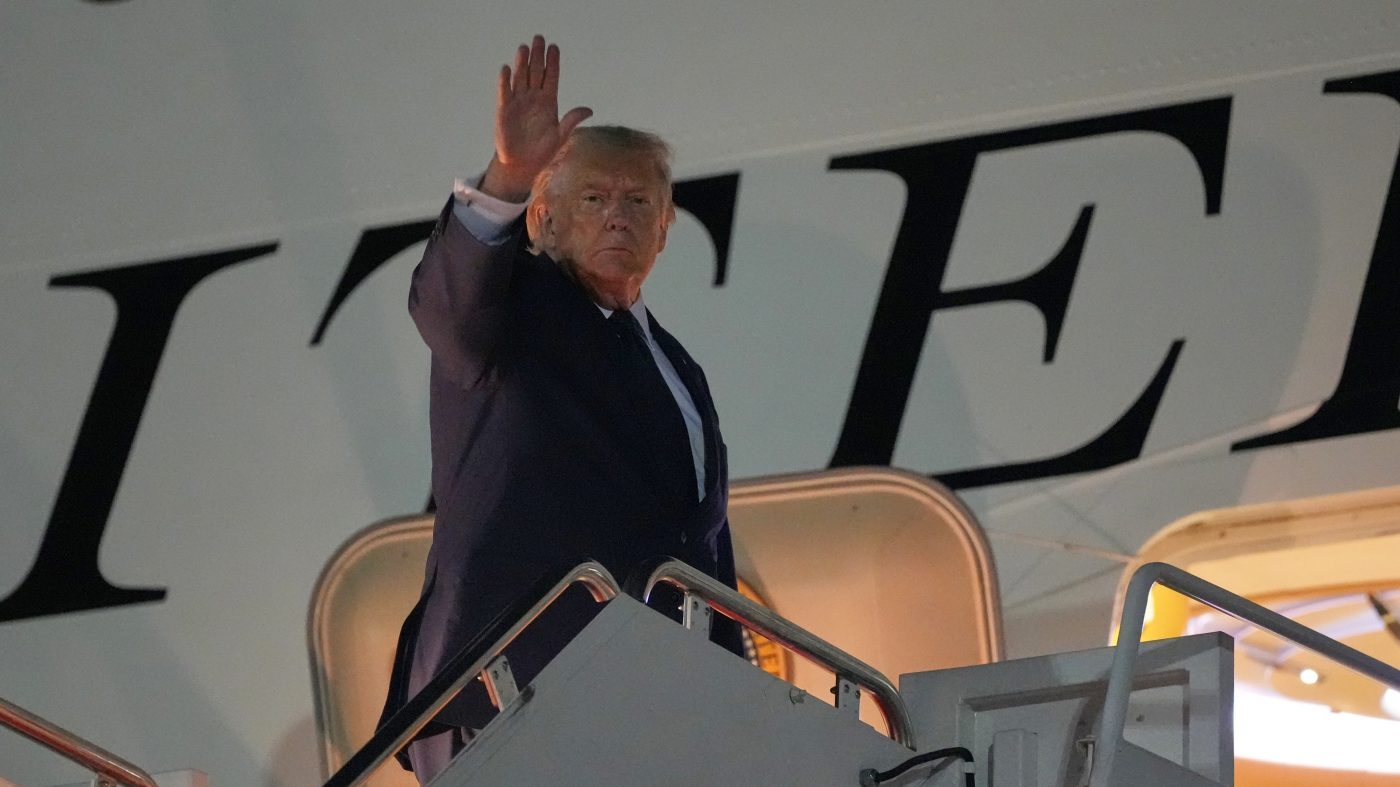
President Trump confirmed Wednesday that he will return to the United States aboard the older Air Force One aircraft from Turkey, sidestepping questions about potential security vulnerabilities linked to the newer, Qatari-donated model. Speaking at a press conference in Ankara before departing the NATO summit, Trump acknowledged he is Iran's “number one target” but dismissed any connection to the switch in planes.
“I’m number one on the kill list for Iran,” Trump told reporters, adding, “I don’t really care, because I’m doing my job.” He joked that he would rather be “number one on TikTok,” but reiterated, “But I’m number one on the list for killing.”
When pressed on why he wasn’t taking the new plane, Trump explained it would be routed through Europe to military bases for display. “And we’ll be going home by normal methods,” he said. “But we have it going to Europe to a couple of bases, actually one in particular, but it’s going to a couple of bases so the soldiers can see it because it’s truly magnificent.”
Earlier Wednesday, Trump announced on Truth Social that the new aircraft would be sent to Mildenhall Air Force Base in the United Kingdom. He wrote, “To honor our brave men and women of the Military, we are sending the brand new, and truly spectacular, Air Force One to Mildenhall Air Force Base, in the United Kingdom, to give them a chance to tour the Aircraft — Everybody is so excited, and we thought that they should be the first.” He added, “For old time’s sake, we’ll be taking the former Air Force One, from Turkey to Mildenhall, a short trip that is totally worth doing in order to give our Great Military Heroes a chance to appreciate our beautiful new addition to the Air Force Fleet!”
Throughout the summit, Trump repeatedly referenced the threat from Tehran. “They had leaders; they’re gone, and they had another set of leaders; they’re gone,” he said. “Now they have another set of leaders, they may be gone, who knows, and you know what, I may be gone too, because I’m their number one target.” This rhetoric aligns with his administration's aggressive posture toward Iran, as seen in renewed threats of strikes and a naval blockade.
The retrofitted Qatari plane, unveiled last month, is intended as a “bridge” aircraft between the aging Boeing 747-200s used for over two decades and two new Boeing planes originally expected in 2024 but now delayed until 2028. The U.S. Air Force reported spending less than $400 million on security upgrades for the plane, but the Associated Press noted last week that the new aircraft appears to lack some missile detection and countermeasure systems found on older models. One expert described it as better suited for domestic trips.
The new plane had completed one domestic flight to North Dakota last week and was used by Trump to fly to Turkey. The decision to use the older aircraft for the return journey, amid heightened tensions with Iran, has drawn scrutiny. Critics, including Senate Minority Leader Chuck Schumer, have slammed Trump's handling of Iran policy, calling the collapse of peace efforts a “total, utter disaster,” as reported in Schumer's sharp rebuke.
Trump's comments come as oil prices hit $78 a barrel following his decision to scrap the Iran ceasefire, further escalating economic pressure. The president has signaled an end to containment, labeling Iran's regime a “cancer,” and has vowed to target the regime directly. While Trump downplayed security concerns about the plane swap, the juxtaposition of his Iran threat assessment and the choice of aircraft underscores the high-stakes environment surrounding his administration's foreign policy.