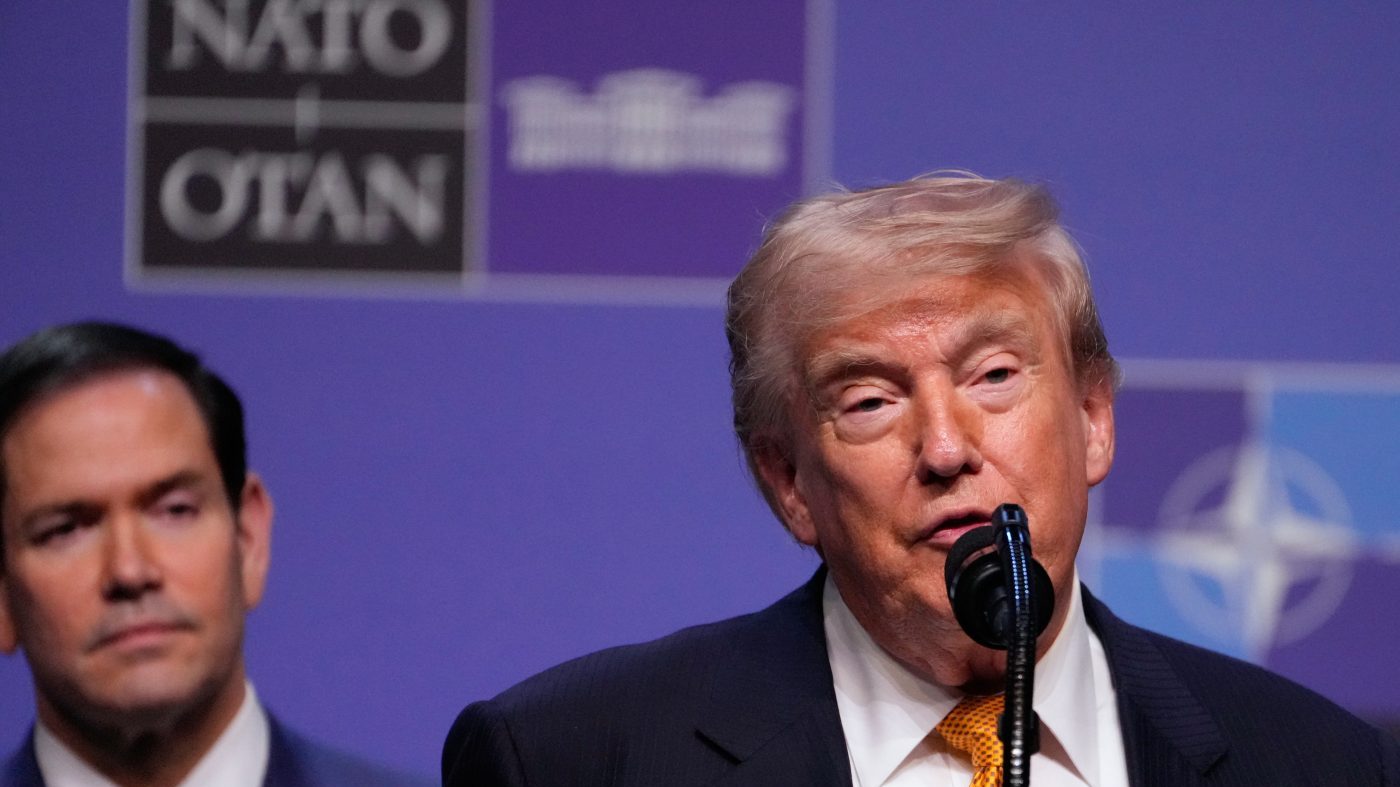
President Trump's comments on the sidelines of the NATO summit in Ankara may represent the most significant shift in U.S. strategic language toward Iran since the 1979 revolution. By warning of a severe response to any new Iranian attack and describing the regime in stark terms, Trump signaled that Washington might no longer view the Islamic Republic as a problem to contain, but as a system inherently generating instability.
For over four decades, U.S. policy toward Iran has oscillated between containment and deterrence. Even during periods of heavy sanctions, the assumption remained that Tehran's behavior could be managed through a mix of costs and incentives. Trump's rhetoric suggests a different premise: the issue is not just what Iran does, but what Iran is.
This distinction is critical. Iran's regime has not stumbled into confrontation accidentally. Hostility toward the U.S., calls for Israel's destruction, proxy militia expansion, and exporting revolutionary instability are core to its identity. Resources have been funneled into missiles, nuclear enrichment, and foreign militias, while ordinary Iranians face inflation, corruption, and declining living standards. The regime has externalized its crises, building a regional architecture of coercion through the IRGC, Quds Force, and proxies from Lebanon to Yemen.
That strategy has created leverage but also vulnerability. What was once strategic depth has become a liability, exposing Iran to escalation and isolation. Trump's description of Iran as a “cancer” implies that management is no longer viable; the metaphor suggests a structural problem requiring removal at the source. This doesn't necessarily mean full-scale war, but a more integrated doctrine combining diplomacy, intelligence, cyber operations, financial pressure, and calibrated force to degrade the regime's capacity to regenerate threats.
Such an approach would depart from the belief that Iran can be moderated. The regime has used negotiations to buy time, sanctions relief to rebuild, and ceasefires to reconstitute networks. This pattern has led many analysts to conclude the problem is a durable system built to survive by producing conflict. As Senator Schumer criticized the collapse of Iran peace efforts, the stakes are clear.
Any new doctrine must confront what comes next. The Middle East is littered with examples where removing a threat created a vacuum—Iraq after Saddam, Libya after Gaddafi. Iran is not a normal authoritarian state; it is a layered power structure where ideology, coercion, finance, and military force are interwoven. A surgical approach must include a strategy for political transition and institutional continuity.
There is also a moral distinction between the Iranian people and the regime that has victimized them. Iranians have paid for a system that invested in regional confrontation over domestic development. Oil prices have surged as Trump scraps the Iran ceasefire, highlighting economic impacts. A durable strategy cannot just punish Tehran; it must prevent the regime from reconstituting itself while opening space for a different future.
Trump's remarks may reflect a broader shift toward systemic change rather than behavioral adjustment. The question is no longer whether the U.S. can pressure Iran into better conduct, but whether the regime's capacity to generate instability can be dismantled. Trump's threats of renewed strikes and a naval blockade underscore this new posture. Erfan Fard, a counter-terrorism analyst based in Virginia, contributed to this analysis.