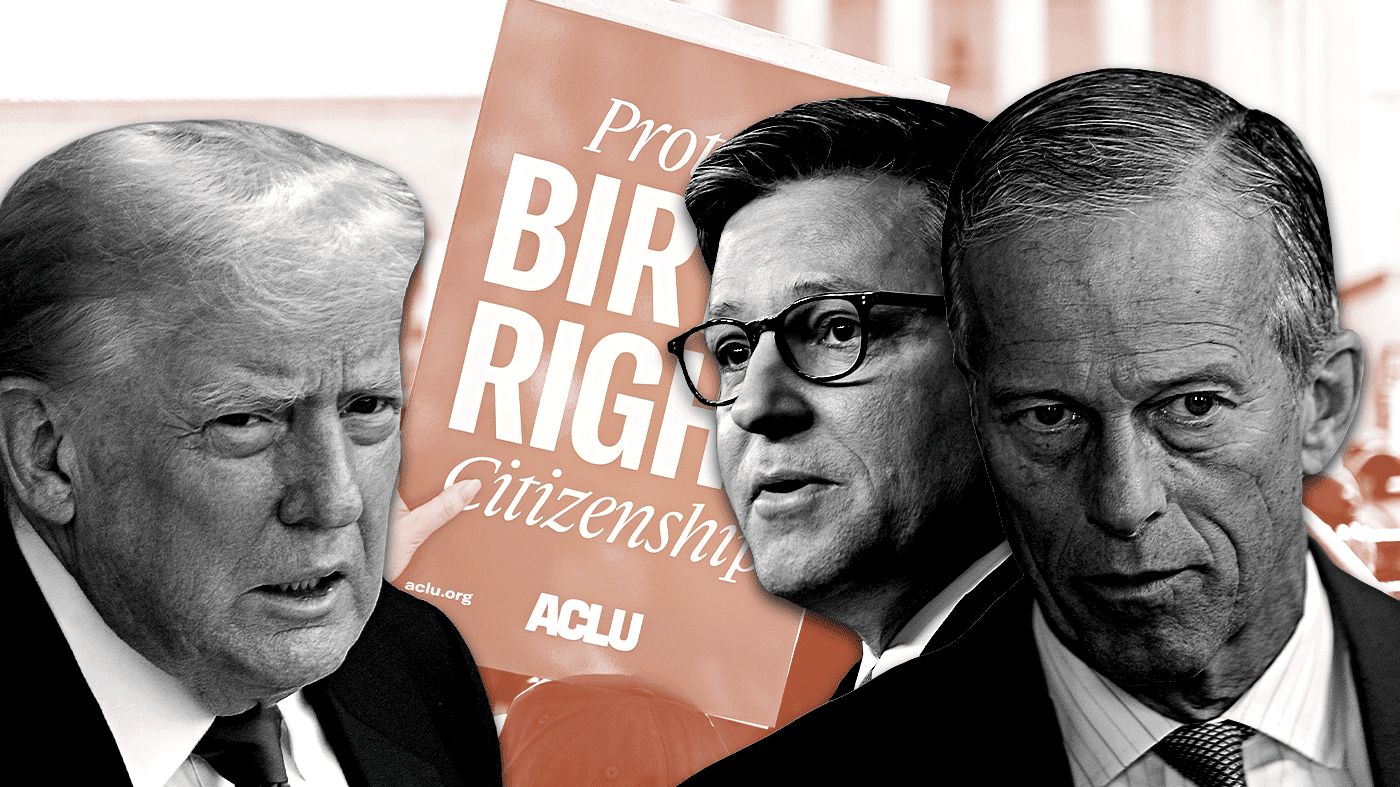
President Trump's renewed demand that Congress pass legislation to restrict birthright citizenship is stirring internal conflict among Republican leaders, who must balance the president's political ambitions with the practical realities of a divided caucus.
Senate Majority Leader John Thune (R-S.D.) and Speaker Mike Johnson (R-La.) now face the delicate task of managing a push that even its proponents admit is unlikely to reach Trump's desk. The Supreme Court recently struck down Trump's executive order limiting birthright citizenship, but the president declared that Congress could "easily" address the issue through legislation.

But immigration experts and GOP lawmakers alike caution that passing such a bill would be anything but straightforward. Mark Krikorian, executive director of the Center for Immigration Studies, a group favoring lower immigration levels, said bluntly: "I don't think anything's going to actually reach the president's desk."
Krikorian described the legislative push as primarily a messaging exercise ahead of the midterm elections. "The bills are not intended to actually pass—although obviously the supporters would be delighted with that. They are likely to be used more as political messaging," he said. "The legislative activity is necessary to specify what it is you're for but everyone understanding it's highly unlikely to pass."
The internal GOP rift mirrors another leadership headache: repeated votes on the SAVE America Act, pushed by Trump allies like Sens. Mike Lee (R-Utah) and Rick Scott (R-Fla.), despite the bill lacking the votes to pass. Some senators have grown frustrated with the relentless floor action.
Chris Chmielenski, president of the Immigration Accountability Project, argued that the House could pass a birthright citizenship bill, but only with significant arm-twisting. "I think there's a chance in the House. Who knows in the Senate," he said. "Speaker Johnson went out this weekend and said that he'd like to see legislation come forth that would end birthright citizenship."
Republican lawmakers are divided over the issue. Rep. Mike Lawler (R-N.Y.), one of the most vulnerable incumbents, criticized Trump's executive order as a misuse of power and praised the Supreme Court's ruling as "well-reasoned and thought out." He called for Congress to handle the matter through the legislative process. Rep. Elvira Salazar (R-Fla.) also backed the court, saying, "The Constitution is clear, and we must always respect the rule of law."
Trump allies are nonetheless pressing ahead. Sen. Lindsey Graham (R-S.C.) introduced the Birthright Citizenship Act, which would redefine the 14th Amendment's language to exclude children of illegal immigrants and temporary visitors. Rep. Brian Babin (R-Texas) offered a House companion bill. Sen. Bernie Moreno (R-Ohio) also reintroduced a bill last week that would eliminate birthright citizenship and make it a federal crime for non-citizens to vote in federal elections.
Neither Graham's nor Moreno's measure is expected to clear the 60-vote threshold needed to advance in the Senate, leaving Thune reluctant to schedule a vote. A constitutional amendment, requiring two-thirds support in both chambers and ratification by the states, remains a long-shot alternative.
The push comes as Trump also escalates other battles, including reviving a controversial effort to purchase Greenland at NATO summits, straining alliances. Meanwhile, the White House has slammed the Smithsonian for what it calls "extreme political activism," as Trump intensifies his history wars.
For now, Republican leaders are treading carefully, aware that a high-profile failure on birthright citizenship could complicate other priorities like the defense authorization bill and annual spending measures. The president's demands may define the GOP's midterm message, but they also threaten to expose the party's deepest internal fractures.