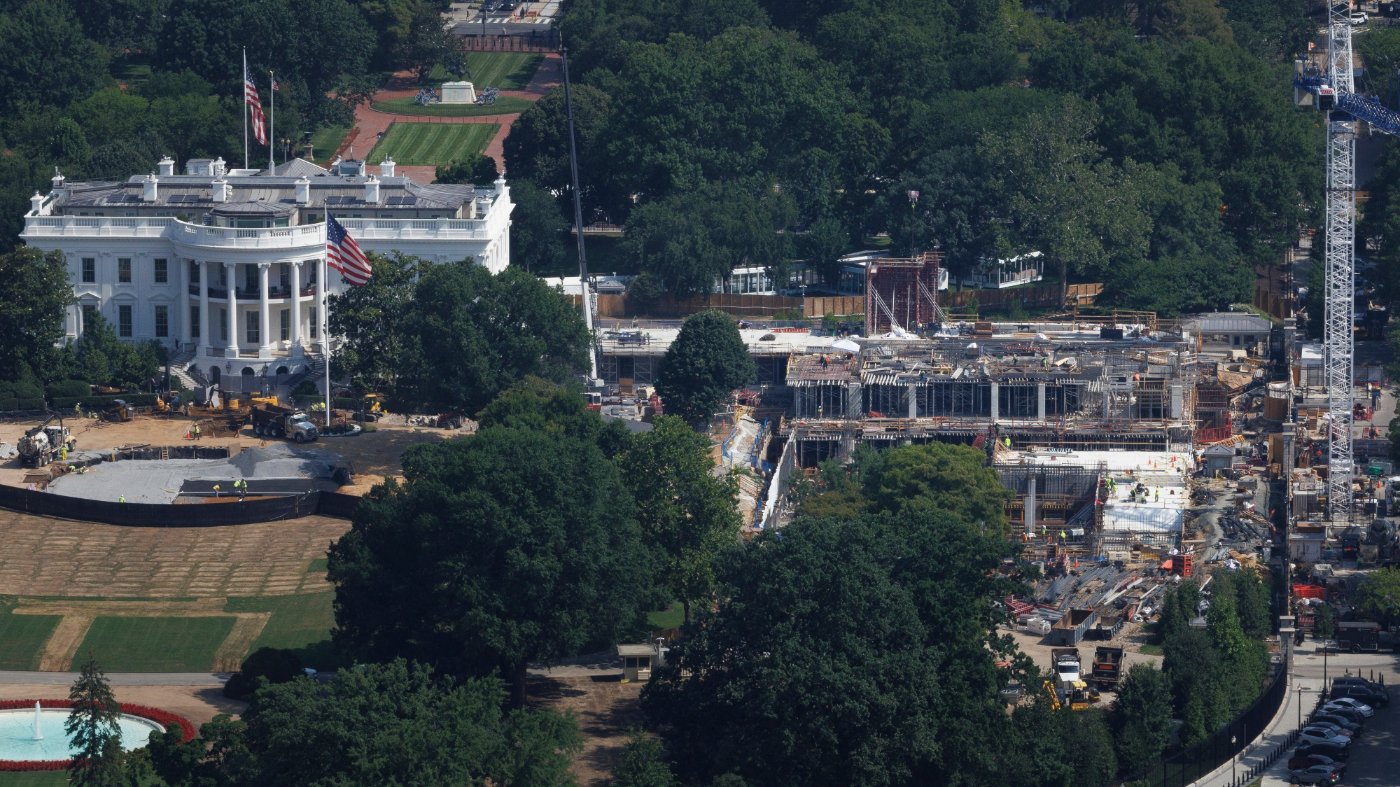
President Trump's ambitious plan to construct a nearly billion-dollar ballroom and underground military complex at the White House has reached the Supreme Court, setting up a high-stakes constitutional clash over the limits of executive authority. The administration has asked the justices to allow construction to proceed, arguing that national security demands it, while opponents contend the project is an unconstitutional power grab that bypasses Congress.
The project, which includes a 90,000-square-foot ballroom in the East Wing and a five-story-deep military bunker, was temporarily halted by lower federal courts. The government's emergency appeal to the Supreme Court last week seeks to lift those blocks, with Solicitor General D. John Sauer telling the justices that the project is "vitally required for national security" and is already 65 percent complete, with a 250-person crew working around the clock.
Constitutional battle over the People's House
At the heart of the dispute is whether the president can unilaterally undertake major renovations to the White House without congressional approval. The U.S. Court of Appeals for the District of Columbia ruled two-to-one that the Constitution gives Congress—not the president—the authority to decide when such dramatic changes may proceed. "Congress has not ceded unfettered authority to the executive branch to dramatically redesign, reshape and reconstruct the White House—the People's House—to fit a particular president's desires," the appellate court declared.
Trump, however, has insisted that congressional approval is unnecessary, comparing his plans to more modest renovations by previous presidents. He has also framed the project as a personal legacy, telling Fox News host Jesse Watters, "It's a monument. I'm building a monument to myself—because no one else will." That remark has fueled critics' fears that Trump is using national security as a pretext for self-aggrandizement.
Legal challenges and funding controversies
The National Trust for Historic Preservation, a congressionally chartered nonprofit, sued to stop the project, asserting that Trump had resisted oversight in violation of federal law. In April, U.S. District Judge Richard J. Leon ruled that the ballroom exceeded the scale of traditional presidential changes and required congressional approval, though he allowed underground security upgrades to continue. His ruling, upheld by the appeals court, would halt above-ground construction but permit the bunker work to proceed.
However, Judge Leon permitted construction to continue both above and below ground while litigation played out, a decision that critics say allowed the administration to create a fait accompli. The project is partly funded by private donations, raising conflict-of-interest concerns because many donors have received favors from the federal government. In June, the administration transferred roughly $350 million from the Secret Service budget to cover security upgrades, a move that drew bipartisan criticism.
Seven Republican senators joined Democrats in June in voting to block construction until Congress formally authorized it, but the measure failed. The administration's push to the Supreme Court comes amid broader concerns about executive overreach, as Trump has already faced legal battles over immigration, tariffs, and other policies. As approval ratings slide, the ballroom case has become a flashpoint for debates about checks and balances.
National security or self-monument?
Sauer cited assassination attempts against Trump in arguing that the underground military complex is essential for the president's safety. But critics note that the ballroom itself—a venue for state dinners and events like the Ultimate Fighting Championship—has little to do with security. They see the project as a symbol of Trump's disregard for constitutional norms, and they worry the Supreme Court, which has often sided with the administration, may bless it.
King Charles, in his address to a joint session of Congress last April, reminded lawmakers of the "ideals which had an even deeper history in English common law and Magna Carta," including "the principle that executive power is subject to checks and balances." Those ideals, critics say, are being swept aside by Trump's eagerness to build a monument to himself.
The case also intersects with other contentious issues, such as military readiness and foreign policy, but the core question is simple: Can a president unilaterally reshape the People's House? The Supreme Court's answer could redefine the balance of power for years to come.