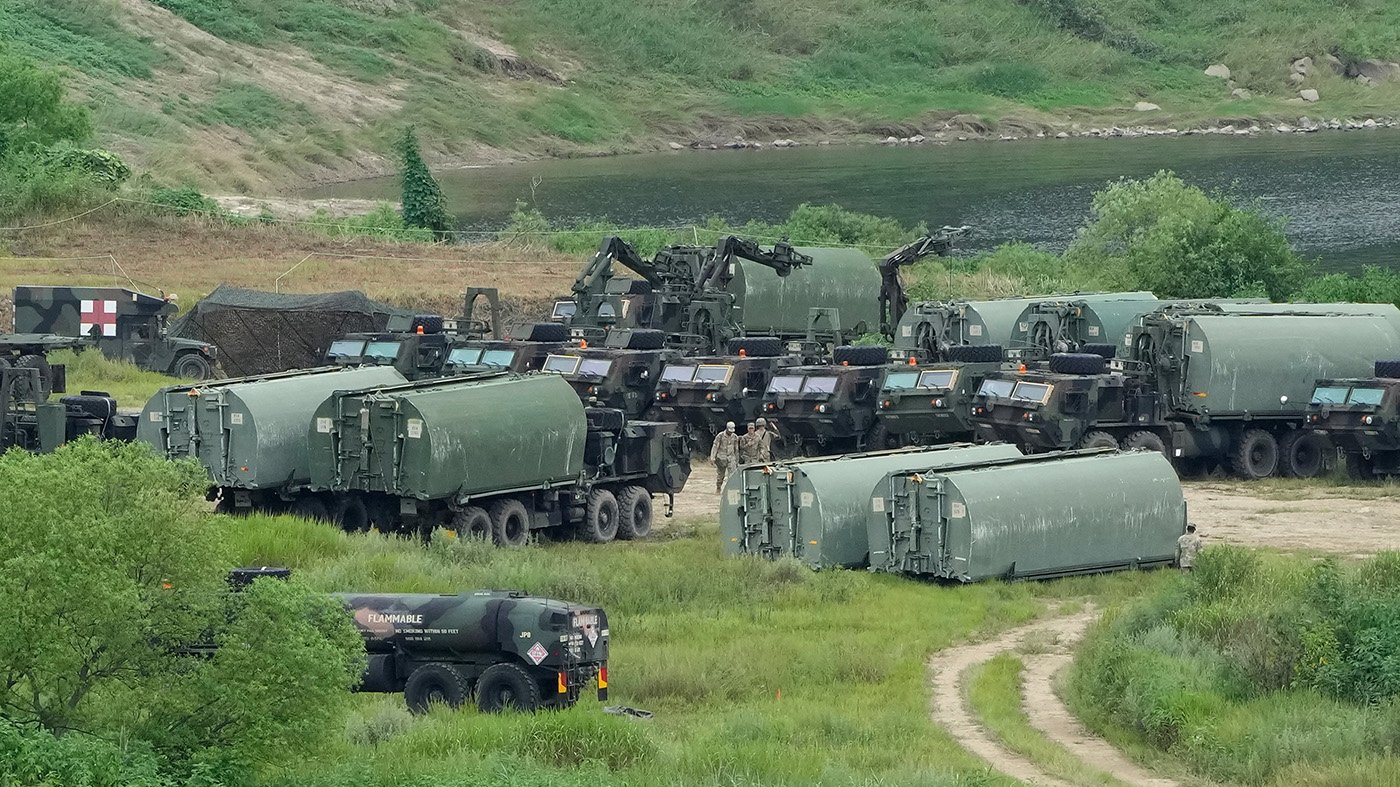
President Trump has ordered a significant reduction in joint military exercises with South Korea, a move that has drawn sharp rebukes from Democrats and deepened anxieties among allies already wary of his commitment to long-standing defense pacts. The decision, announced Sunday, came just one day before the scheduled start of the Ulchi Freedom Shield drills, which Trump described as costly and provocative.
In a post on Truth Social, Trump said it was too late to fully cancel the exercises but directed the Pentagon to "substantially reduce" them. The war games are a cornerstone of the mutual defense treaty between Washington and Seoul, designed to deter potential aggression from North Korea. Trump's announcement also took a swipe at Seoul for declining to support U.S. military action against Iran, adding another layer of tension to the alliance.
This is not the first time Trump has targeted the exercises. In 2018, he suspended them following a summit with North Korean leader Kim Jong Un. However, analysts warn that curtailing the 10-day drills could alienate key partners and undermine regional security. "Watering down U.S.-South Korea military exercises is a risky move that lowers coalition readiness and puts U.S. forces at risk with no real tangible benefit to the United States," said Rear Admiral (Ret.) Mark Montgomery, a senior fellow at the Foundation for Defense of Democracies.
Montgomery also criticized Trump's approach to North Korea, stating, "He does not seem to understand that North Korea is part of the 'bad guys' team. North Korea threatens key American allies and trade partners — South Korea and Japan — daily. Kim Jong Un is not America's friend, he cannot be reasoned with, and he won't give up his nuclear weapons. There is no Nobel Prize in Pyongyang."
Trump, however, has touted his "very good relationship" with Kim and argued that the exercises send an unnecessarily hostile signal. "These exercises are not only costly, with much of these costs paid for by the United States of America (as usual!), but send a signal that is totally inappropriate and hostile, to a Country that, as long as Donald J. Trump has been President, has been unthreatening and respectful," he wrote.
The president also linked the drill cuts to Seoul's refusal to participate in the U.S. campaign to denuclearize Iran. In a Monday Oval Office appearance, Trump recounted a phone call with South Korean President Lee Jae Myung, in which he asked for "a little hand" with Iran. According to Trump, Lee declined, prompting Trump to respond, "Wait a minute. We have 39,000 soldiers over there, guarding you from Kim Jong-un, your next-door neighbor, and you're not going to help us on a very easy military operation in Iran. That's strange." Trump added, "We can't go around and protect all of these countries, especially when they're not there to help us."
Observers say Trump's frustration with allies over Iran is palpable. "Trump obviously he's got his mind fixed on Iran right now, and it's pretty clear that he still holds some frustration toward American partners and allies whom he asked for help and rebuffed him, and South Korea is on that list," said Michael Sobolik, a senior fellow at the Hudson Institute. Sobolik also noted Trump's long-held view that South Korea is not contributing enough to the alliance, recalling his first-term efforts to withdraw U.S. troops from the peninsula. "I think he has locked in this distrust not just of the Koreans but of the value that America being there actually has," he told The Hill.
The decision has also sparked bipartisan criticism in Congress. Sen. Jack Reed (D-R.I.), ranking member of the Senate Armed Services Committee, warned, "China and Russia are watching how easily this President abandons America's allies, and they will remember it the next time they test us." Sen. Mark Kelly (D-Ariz.) called the move "shortsighted [and a] mistake," noting that "North and South Korea are still technically at war. Our ability to help defend our ally against the North Koreans is because our forces are well trained and able to coordinate with the South Koreans. Hollowing out these joint exercises is shortsighted and a mistake." Sen. Thom Tillis (R-N.C.) also voiced concern, saying the reduction "does nothing more than free up thousands of..."
As the administration continues to navigate tensions with Iran and North Korea, the decision to scale back the drills marks a significant shift in U.S. defense posture in the Indo-Pacific, raising questions about the reliability of American security guarantees in the region. For more on the administration's foreign policy moves, see the escalating Iran standoff and Trump's linking of the two issues.