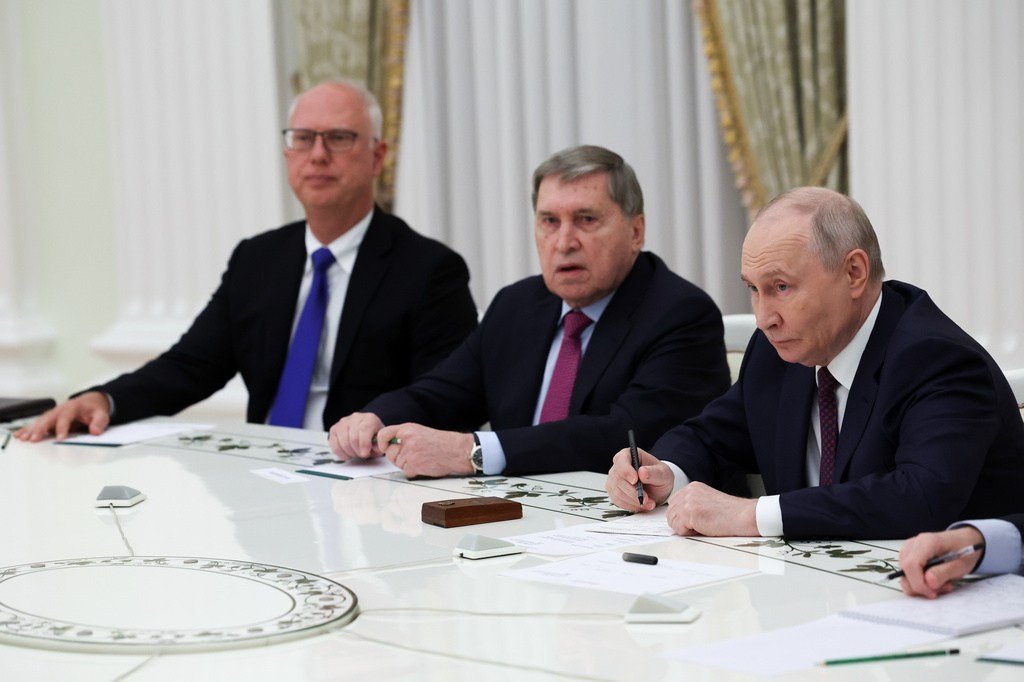
Russian President Vladimir Putin, an indicted war criminal, has a curious fixation: not peace, but the theater of peace talks. He approaches them with the enthusiasm of an arsonist attending a fire-safety seminar. Last week's Abu Dhabi meetings were a case in point—a diplomatic pantomime where Moscow performed negotiation and Washington played mediator. The only concrete result was a promised prisoner exchange.
The rest was detached from reality. Russia invaded Ukraine; the aggressor could end the war tomorrow by withdrawing. Ukraine has already agreed to an unconditional ceasefire—in March 2025, it took Kyiv less than 24 hours to accept. Moscow still hasn't. Instead, the Kremlin floated vague notions of “revisiting European security architecture,” a familiar sleight of hand.
The claim that NATO threatens Russia is a fabrication the Kremlin doesn't believe. When Finland joined in 2023, adding 830 miles to NATO's border, Russia responded by redeploying most of its troops from that frontier to fight in Ukraine. On the eve of the talks, Ukraine reported a record 3,000 Russian casualties in a single day. NATO Secretary General Mark Rutte noted Russia loses nearly as many troops monthly as the U.S. lost in 14 years of Vietnam.
Russian negotiator Vladimir Medinsky reiterated Moscow's eliminationist goal: “every inch of Russian land will be returned to Russia, one way or another.” This, after Russia twice signed treaties recognizing Ukraine's borders—in 1994 and 1997. The analogy is stark: a burglar kills two children, occupies their room, and then demands the family discuss his security concerns.
Real security for Russia would begin with accountability. Instead, Steve Witkoff, a U.S. envoy, told Putin, “You are a humanitarian also, sir, and I salute that.” Nobel Peace Prize laureate Oleksandra Matviichuk, who documents Russian war crimes, insists occupation is not peace—it's another form of war. Pressuring Ukraine to cede territory is the opposite of progress.
Meanwhile, as envoys flew from Abu Dhabi to Moscow, Ukrainian President Zelensky reported disruptions to Starshield, the SpaceX-backed satellite system, over Ukrainian territory—a worrying development for battlefield communications.
Diplomacy must be judged by results. Talks that yield no ceasefire erode U.S. credibility and delay the decisive action that could compel Moscow to end its war. Congress can change that. A proposed plan: $10 billion in weapons for Ukraine immediately, then $20 billion four months later, $30 billion after that, and $50 billion annually—each tranche contingent on Russia continuing to fire. If the guns fall silent, aid stops.
Congress has precedent. In 2017, it voted overwhelmingly to bar any president from easing Russia sanctions without review. For the U.S. economy, $50 billion a year is a rounding error—a fraction of one percent of GDP. But if Russia's aggression spreads, the Pentagon's trillion-dollar budget could double or triple. Worse, if Ukraine's surrender of its nuclear arsenal in 1994 is seen as a mistake, nonproliferation collapses.
As talks concluded, Russian drones killed two in Odesa and set a Kyiv hospital ablaze. A bill could achieve what negotiations couldn't: make the Kremlin want peace, not just peace talks. For more on the diplomatic backdrop, see the upcoming three-way summit plans and how Witkoff's approach may have backfired.