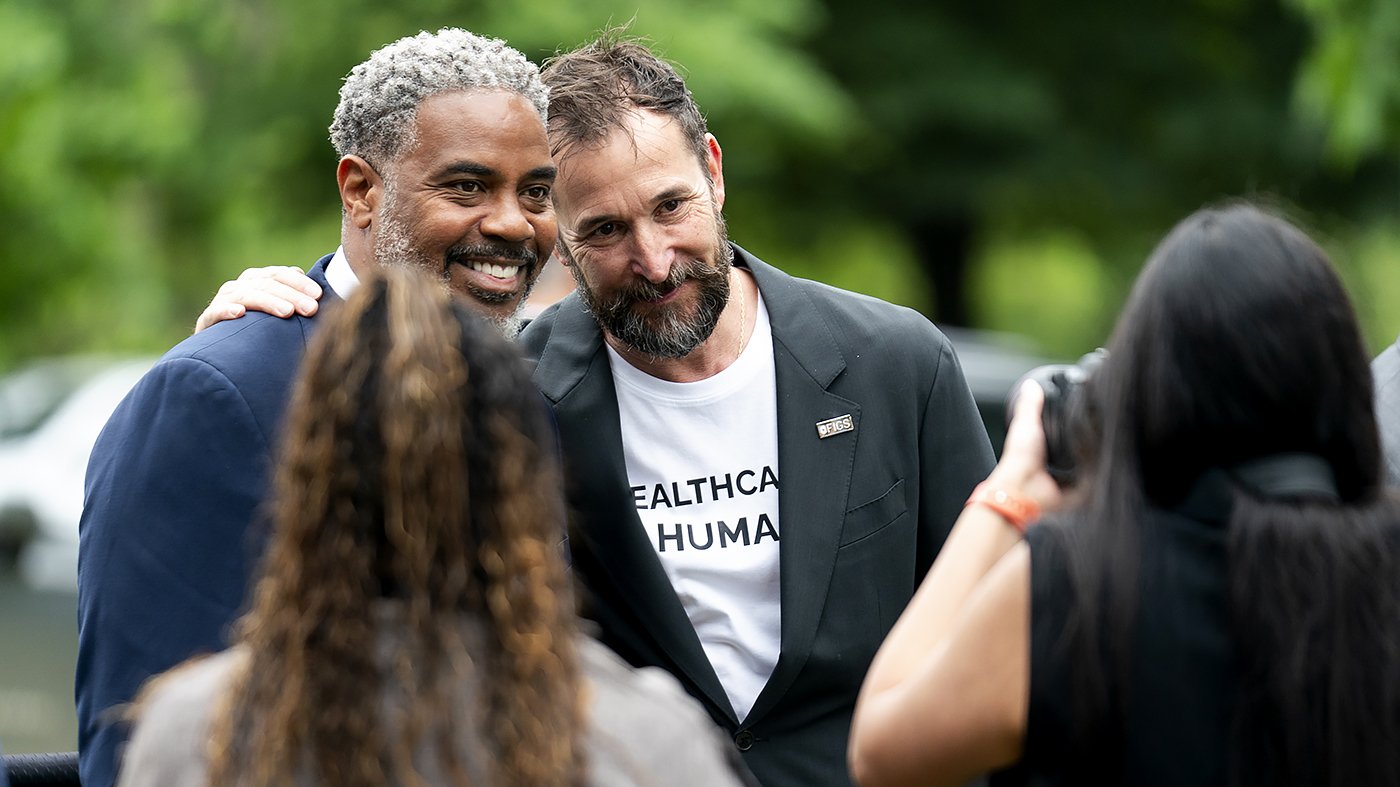
Actor Noah Wyle, best known for his role as Dr. Michael "Robby" Robinavitch on HBO's medical drama "The Pitt," traded the set for the Capitol steps Thursday, joining hundreds of doctors, nurses, and other medical professionals in a push for legislation aimed at easing the healthcare worker crisis.
"Every major change in healthcare has started with somebody brave enough to say this is not working, it can be better," Wyle told the crowd at the rally, organized by healthcare apparel company and advocacy group FIGS. The actor, whose mother spent 50 years as a nurse, made clear he was not speaking as a medical expert. "I am an actor. I'm the son of a nurse who spent 50 years caring for other people, and I've spent decades trying to do justice to what she and the rest of you actually do. That is the only credential I am claiming today."

Wyle was joined by his mother, Marty Wyle, Senator Tim Kaine (D-Va.), and Representatives Claudia Tenney (R-N.Y.), Steven Horsford (D-Nev.), and Buddy Carter (R-Ga.)—a bipartisan lineup that underscored the broad appeal of the proposed measures. The centerpiece of the rally was the Healthcare is Human Act (H.R. 7884), which would provide a federal tax credit of up to $6,000 a year for healthcare professionals serving in areas with workforce shortages.
Tenney described the credit as "a real financial incentive on the table," adding, "It's a direct, tangible tax credit that says we value what you do, and we want you to stay." Horsford framed it as a matter of priorities: "Instead of giving tax credits to billionaires, let's give it to the healthcare professionals that provide the care that people need." The legislation is part of a broader push to address burnout and staffing gaps that have worsened since the pandemic.
Bipartisan Calls for Action Amid Partisan Gridlock
Senator Kaine, who helped pass the Dr. Lorna Breen Health Care Provider Protection Act—a mental health support law Wyle urged to reauthorize last year—warned that the issue will only intensify. "We have to every year go to bat with the appropriators to try to get more funding," Kaine said. "This issue is not going to get less important. The issue is going to get more important as healthcare needs increase, Medicaid cuts and things like that are doing nothing but raising anxieties."
Representative Carter, a longtime pharmacist, acknowledged Capitol Hill's partisan climate but argued healthcare remains a rare unifying force. "I would submit to you that healthcare is the one area where we work together, because after all, we all want the same thing. We want accessible, affordable, quality healthcare. Everyone wants that, whether you're Democrat or Republican."
Wyle echoed that sentiment, telling the crowd, "Cancer is not partisan, a stroke is not partisan, a kid with a fever in the middle of night is not partisan. The healthcare professional who shows up for that patient should not have to beg for basic support from a system that they hold together." His remarks come amid broader concerns over healthcare worker shortages, as 25 states sue the Education Department over graduate loan caps, warning the caps could worsen the shortage.
A Second Trip to Washington, With a Promise to Return
This was Wyle's second visit to the Capitol in a year. Last June, he participated in a panel discussion to boost mental health services for healthcare workers. He noted that the success of "The Pitt" has opened more doors this time around. "With 'The Pitt's' success, it was a lot easier to get doors open this time around. I think people were a lot more willing to sit down with us. These issues are now on the forefront of a lot of people's attention because of the show."
Wyle said he plans to return annually, aiming for "slow but incremental progress." When asked which has more drama—"The Pitt" or Washington—he grinned and replied, "A different kind of drama. There's more teamwork on 'The Pitt.'"