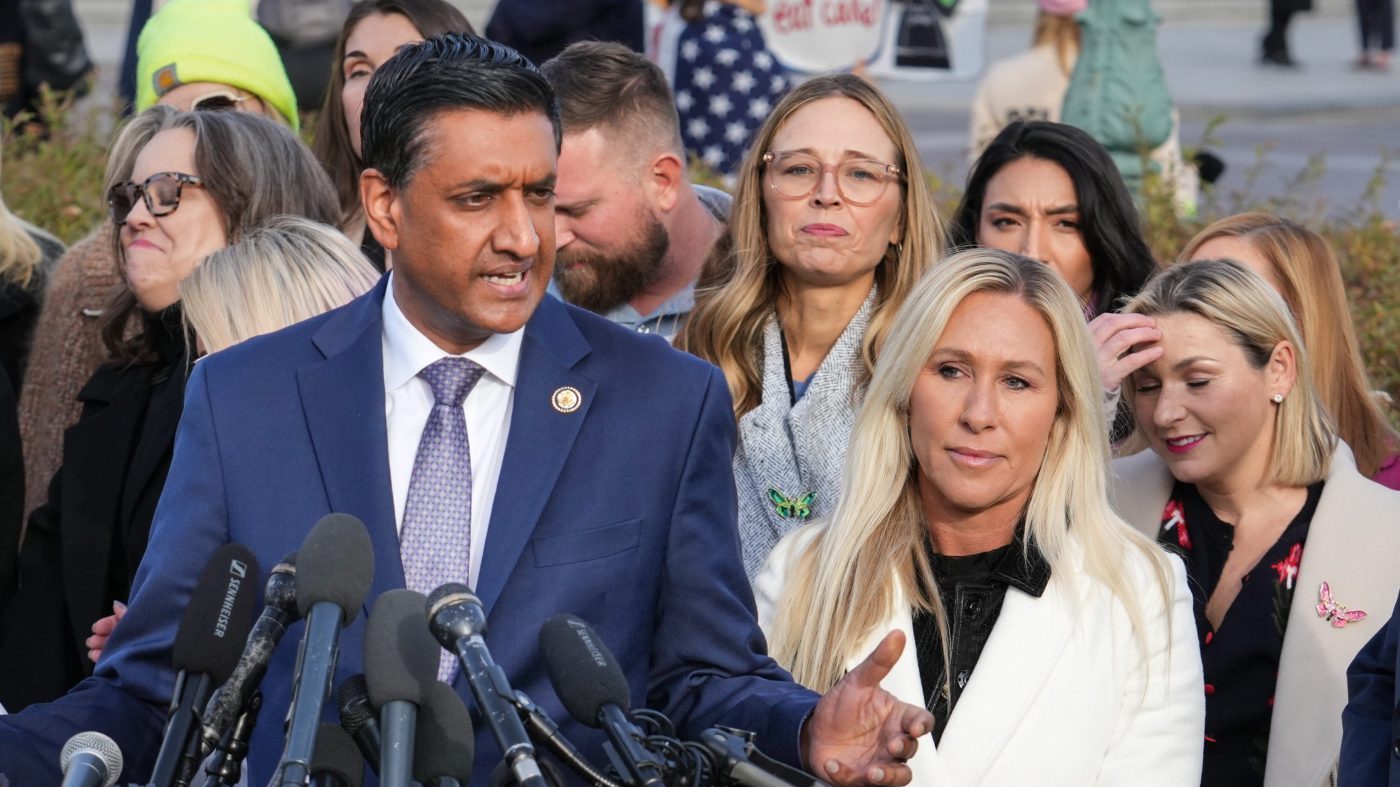
In a notable political development, Democratic Representative Ro Khanna of California has publicly entertained the prospect of a partnership with former Republican Congresswoman Marjorie Taylor Greene. The potential alignment stems from their shared opposition to former President Donald Trump's recent threats against Iran, marking a rare moment of bipartisan agreement across a deep ideological divide.
A Foundation in Foreign Policy Opposition
Khanna's comments came in response to Trump's declaration that "a whole civilization will die tonight" unless Iran met U.S. demands, a statement the former president later walked back. In a social media post, Khanna stated his relief at the de-escalation but argued congressional influence was minimal. "This happened because of the force of the American people," Khanna asserted, "not just progressives and liberals, but conservatives like Tucker Carlson, Marjorie Taylor Greene and even Ann Coulter spoke out against the horror of threatening genocide against another people."

This foreign policy stance has created an unexpected bridge. Greene, once a staunch Trump ally, has recently distanced herself from the former president and questioned her party's direction. Following Trump's Iran remarks, she joined calls for his removal via the 25th Amendment. She responded to Khanna's post by proposing they "come together" to form a coalition, arguing it "is likely the only way to break free of the corrupt system from both sides that controls everything, constantly goes to war, and only enriches themselves while average Americans continue to lose."
From Epstein Files to a "Populist Movement"
The dialogue is not without precedent. Khanna noted his previous work with Greene and Republican Representative Thomas Massie on the bipartisan Epstein Files Transparency Act, which sought to compel the Justice Department to release documents related to convicted sex offender Jeffrey Epstein. Khanna thanked Greene for her advocacy on that issue and her criticism of Trump's Iran posture.
"Spirited debate is what this nation is about," Khanna wrote. "Look forward to a dialogue on how to stop the militarism of foreign wars of choice, hold the Epstein class accountable, and actually deliver for the millions of working class Americans who built our nation. I am game." He framed the potential collaboration as part of a necessary "broad populist social movement, anti-Epstein class, anti-war, pro-working class."
Political Ambitions and Broader Context
Khanna, who is frequently mentioned as a potential contender in the 2028 presidential race, has recently emphasized cost-of-living issues and a commitment to a "cohesive multiracial democracy." His openness to an alliance with Greene underscores a strategic willingness to engage unconventional partners to advance specific policy goals, particularly constraining executive war powers and targeting political corruption.
The episode also highlights the ongoing fractures within the Republican Party. Greene's break with Trump over his foreign policy rhetoric represents a significant shift for a figure once synonymous with the MAGA movement. Her call for bipartisan action against a "corrupt system" echoes populist themes that resonate across the political spectrum, even as her overall political platform remains firmly conservative.
For Khanna, a progressive Democrat from a state grappling with profound economic disparities, the outreach is a high-profile gamble. It aligns with his stated desire to build coalitions beyond traditional partisan lines but risks alienating segments of his own base who view Greene as a polarizing figure. Whether this dialogue translates into concrete legislative action or remains a symbolic exchange is yet to be seen, but it signals a continuing realignment in Washington's political alliances.