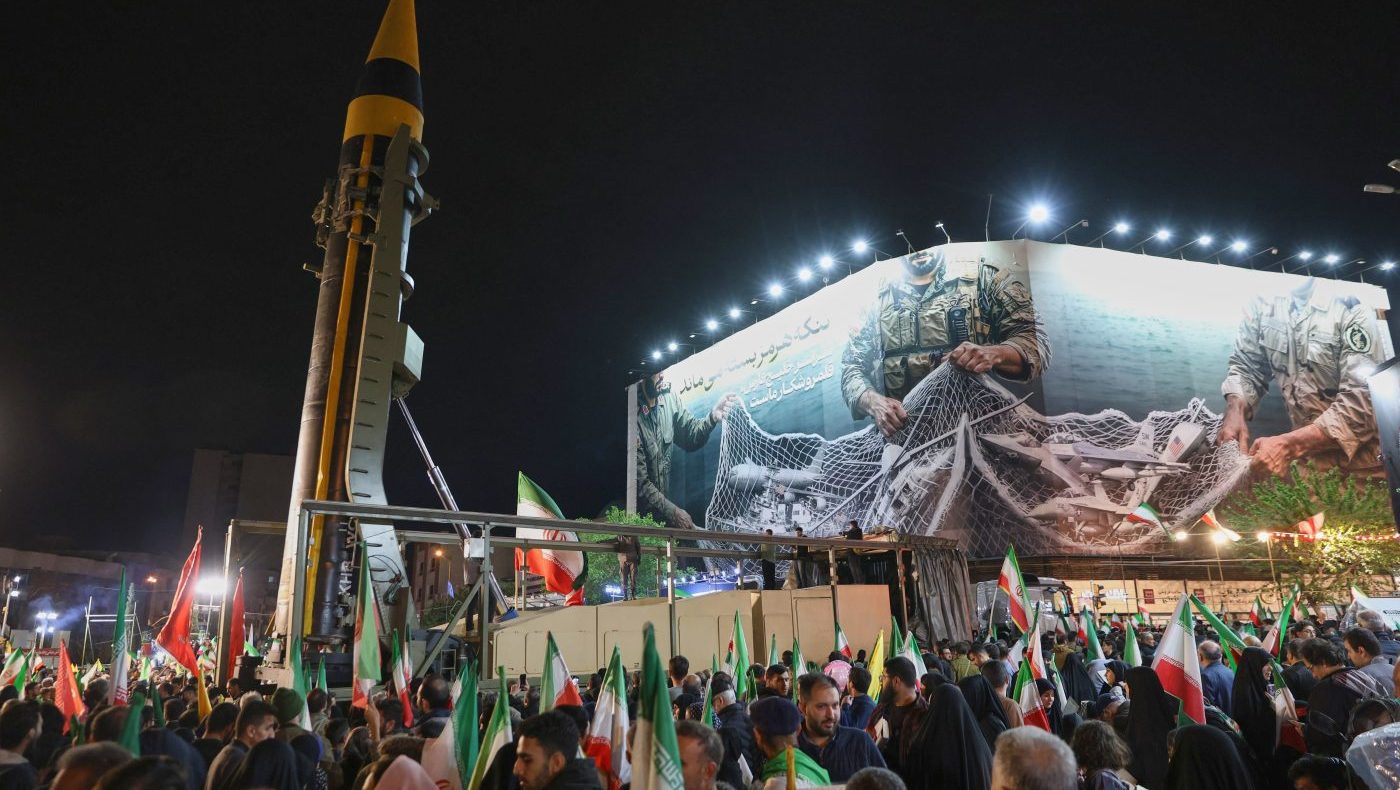
A massive banner in Tehran's Enqelab Square proclaims, “The Strait of Hormuz will remain closed; the entire Persian Gulf is our hunting ground.” That message underscores Iran's primary leverage in its conflict with the United States and Israel, and highlights what experts call President Trump's near-impossible mission to restore free navigation through one of the world's most critical maritime chokepoints.
Trump announced Tuesday he would indefinitely extend a 14-day ceasefire, delaying renewed strikes on Iran until Tehran proposes a long-term peace framework. But he maintained a U.S. naval blockade of all traffic entering and exiting Iranian ports along the strategic trade route. Alam Saleh, a senior lecturer in Iranian studies at the Australian National University, argues that blockade actually aids Iran's objectives. “This policy is not necessarily practical. It's not helping much, and it never will convince Iran to withdraw or to give up,” he said. “If Iran stops others' oil and if the United States stops Iran's oil, that means the Strait is fully closed thanks to both the United States and Iran. And it's something that makes Iranians happy. This is what they want.”
Saleh added that Tehran's strategy from the start has been to keep oil prices high and make the war costly for Washington. “What President Trump is doing is helping Iran's strategy to take place in a shorter time,” he said. The situation echoes broader tensions, as described in our analysis of Tehran's shift from theocracy to naked coercion.
Leverage Game
Within days of joint U.S.-Israeli strikes on Iran over 50 days ago, Iran's military effectively shut the 22-mile-wide Strait of Hormuz, which normally handles about 20 percent of global energy trade. After Iranian forces set several tankers ablaze, commercial traffic largely stopped. While U.S. war games long anticipated Iranian control of the strait, the speed and effectiveness of Tehran's tactics caught the Trump administration off guard. Jim Krane, a Persian Gulf energy expert at Rice University's Baker Institute, noted that before the closure, “the U.S. and Israel did not see a lot of risk in attacking Iran… Now, Iran has demonstrated that it can basically take the global economy hostage. It gives Iran a pretty strong deterrent to try and ward off future U.S. attacks.”
Iran briefly signaled it would reopen the strait after a temporary truce between Lebanon and Israel, but reversed course hours later, insisting the strait stays shut until the U.S. blockade ends. The Islamic Revolutionary Guard Corps (IRGC) navy warned over the weekend that “approaching the Strait of Hormuz will be considered co-operation with the enemy, and the offending vessel will be targeted.” The standoff's impact on global energy supplies is severe: the U.S. faces soaring gas prices, the Philippines declared a national energy emergency in March, Europe has imposed jet fuel restrictions causing flight cancellations, and farmers worldwide confront a looming fertilizer shortage.
Geography vs. Military Might
Though Trump and his military leaders tout the degradation of Iran's armed forces during a month of heavy bombing, Saleh argues that the world's most powerful military “cannot control over 3,000 kilometers of the sea, shipping and the routes, [and] hundreds of ships going and coming into the strait from different parts of the world.” Without ground forces, the U.S. cannot secure Iran's coastline. Mark Nevitt, an associate professor of law at Emory University and former U.S. Naval Academy professor, warned that Iran can launch Shahed drones from anywhere in the country to strike ships in the strait. “As long as they have the capacity to launch drone attacks, they can control the strait,” he said. Sahar Razavi, director of the Iranian and Middle Eastern Studies Center at Sacramento State University, agreed: “There's really nothing the U.S. can do to totally remove Iran's influence over the strait as long as Iran's government remains.”
The threat of Iranian mines further complicates the picture. A U.S. Defense official told Congress that clearing existing mines could take six months—an operation that can only begin after the war ends, according to The Washington Post. Meanwhile, the U.S. blockade has not completely cut off Iran's energy economy; shipping monitors report that more than two dozen Iranian-linked tankers slipped through in the first week. Saleh noted that while the U.S. can stop tankers headed elsewhere, intercepting those bound for China—which imports roughly 90 percent of Iran's crude oil—could undermine Trump's trade negotiations with Beijing. “Yes, United States can stop oil tankers that goes to somewhere else, but to China? That is a different cup of tea,” he said. For more on the naval dimension, see our report on clashes in the strait threatening the fragile ceasefire.
The standoff underscores a fundamental asymmetry: Iran's geographic position and asymmetric tactics offset U.S. military superiority. As the crisis deepens, the question remains whether Washington can find a diplomatic off-ramp or is stuck in a costly stalemate. The broader implications for global energy security are dire, with the International Energy Agency chief warning that the world is at a historic breaking point. Meanwhile, domestic political pressure mounts, as seen in Senator Fetterman's criticism of Democrats and media for a weak stance on Iran.