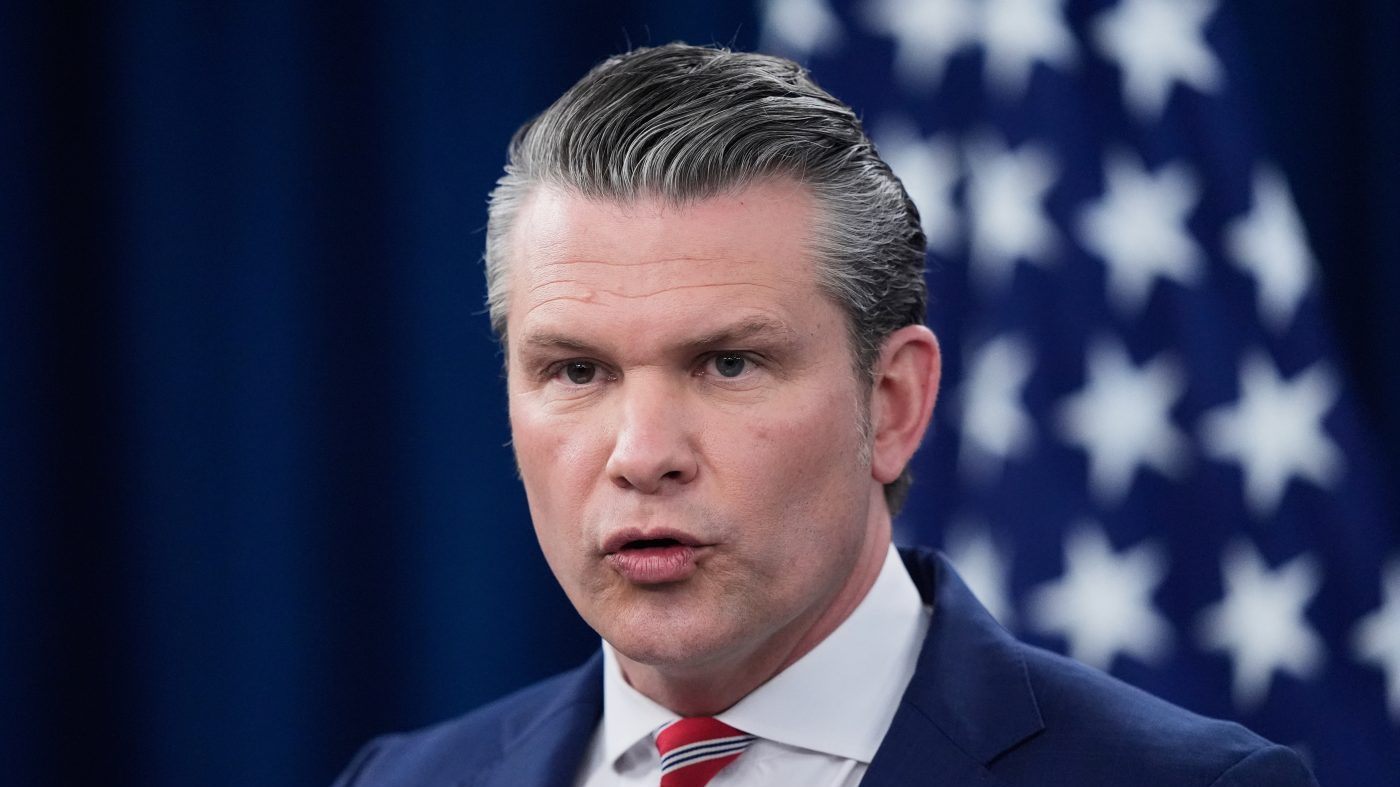
Defense Secretary Pete Hegseth declared Tuesday that the United States has thrown a "red, white and blue dome" over the Strait of Hormuz, as hundreds of commercial vessels queue to exit the waterway that Iran has largely sealed since hostilities erupted. Hegseth framed the operation, dubbed Project Freedom, as a direct challenge to what he called Tehran's "international extortion."
President Donald Trump announced the initiative Monday, deploying American warships, fighter jets, drones, and surveillance aircraft to escort tankers through the strait under the protection of U.S. firepower. The Pentagon chief told reporters at a briefing that two U.S.-flagged commercial ships, accompanied by American destroyers, had already made the passage safely, signaling that the lane was open for business.
"Right now, hundreds more ships from nations around the world are lining up to transit," Hegseth said, adding that U.S. Central Command was coordinating with vessel owners, insurers, and partner countries to facilitate the movement.
But the operation has not gone unchallenged. Iran's forces opened fire on U.S. warships and commercial vessels Monday, and Tehran issued warnings against testing its control of the strategic corridor. Six Iranian vessels were turned back, Hegseth noted, insisting the American blockade of the strait remained in effect.
Iran's top negotiator, Mohammad Bagher Ghalibaf, took to X early Tuesday to accuse Washington of breaking the truce. "The security of shipping and energy transit has been jeopardized by the United States and its allies through the violation of the ceasefire and the imposition of a blockade," he wrote. "We know full well that the continuation of the status quo is intolerable for America; while we have not even begun yet."
Despite the skirmishes—including Iranian missile strikes on the United Arab Emirates—Hegseth said the ceasefire was still holding. General Dan Caine, chairman of the Joint Chiefs of Staff, deferred to the president on whether Iran's actions had crossed into "major combat operations."
Trump has long argued the U.S. can outlast Tehran in a standoff over the strait, betting that a blockade will cripple Iran's energy-dependent economy. Yet the push to pry open the waterway this week underscores the mounting pressure on the White House to ease a global energy crisis. Gas prices in the U.S. continue to climb, and nations worldwide face severe oil and gas shortages—a theme explored in Treasury Secretary Bessent's recent pledge of relief as the national average approaches $4.50.
Caine provided a stark picture of the stakes: 22,500 mariners aboard more than 1,550 commercial vessels remain trapped in the Persian Gulf, which he referred to as the Arabian Gulf. To secure their exit, 15,000 American service members are now deployed in what the general called an "enhanced security area" on the southern side of the strait. "Out there on the surface, guided missile destroyers and other warships are detecting and defeating Iranian threats—this includes fast boats and one-way attack drones," Caine said. "In the air, more than 100 fighters, attack aircraft, and other manned and unmanned aircraft, synchronized by the 82nd Airborne Division, are in the air 24 hours a day."
Neither Hegseth nor Caine offered a timeline for clearing the backlog of vessels. But Caine predicted more transits in the coming days, warning that commercial ships will "see, hear and frankly, feel our combat power around them, on the sea, in the skies and on the radio." The operation follows renewed clashes triggered by Project Freedom, which have already tested the fragile ceasefire. As the standoff deepens, the world watches whether Trump's gamble can deliver energy relief—or ignite a wider conflict.