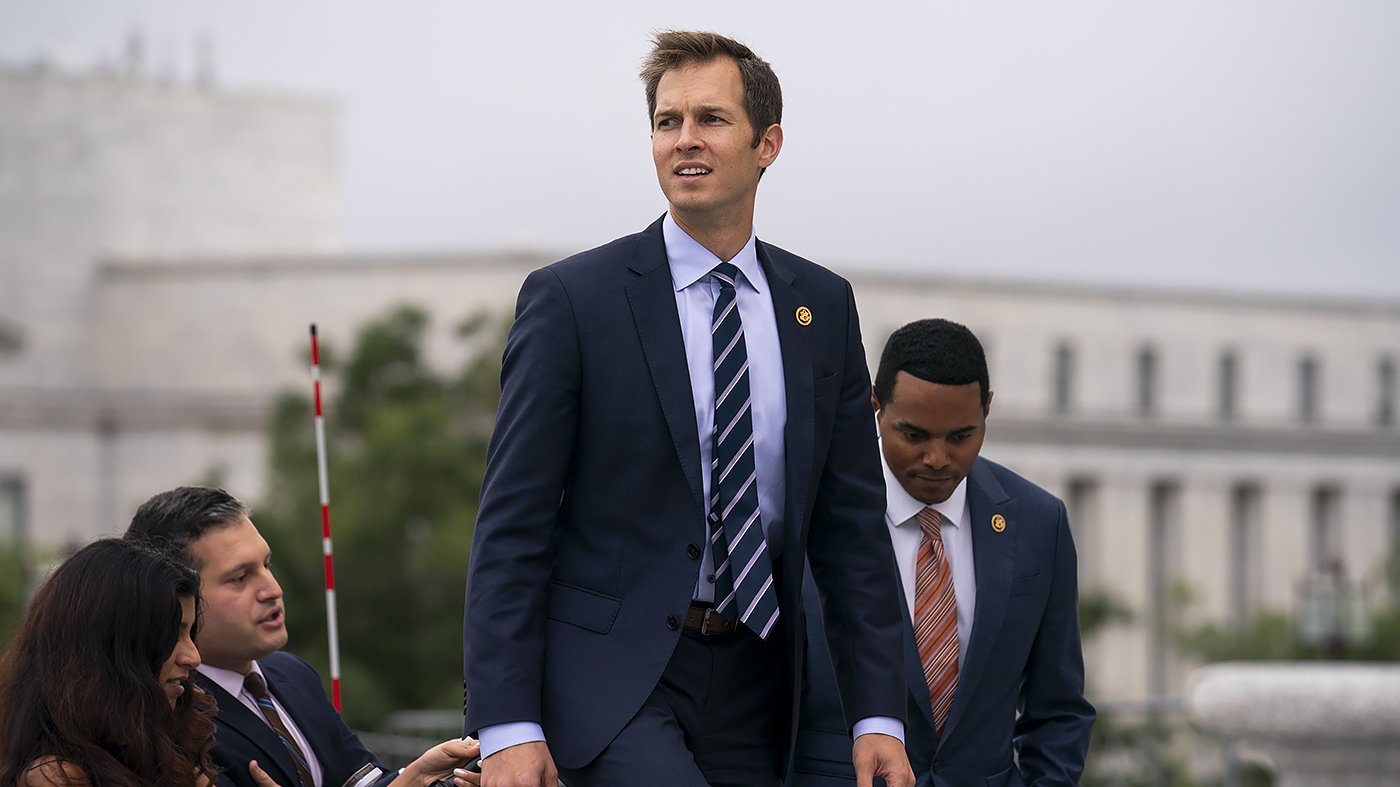
Democratic Congressman Jake Auchincloss of Massachusetts sharply criticized President Trump's Iran policy on Sunday, asserting that Tehran has secured a more powerful strategic deterrent through its control of the Strait of Hormuz than it would through developing nuclear weapons. Appearing on Fox News Sunday, the House Energy Committee member framed the administration's approach as a strategic failure that has empowered a hardline Iranian leadership.
A New Strategic Deterrent
"The failure of the president's war thus far is that he has given the new ayatollah, who is even more hard-line than his father was, a new strategic deterrent," Auchincloss told host Shannon Bream. "And that new strategic deterrent is control over the Strait of Hormuz." The lawmaker emphasized that Iran now recognizes this maritime choke point as "even more strategically vital to them than the development of a nuclear weapon."

The narrow waterway, through which approximately 20% of global oil shipments pass daily, has been closed to what Iranian authorities label "enemy" vessels. This blockade has triggered a worldwide energy crisis, with Asian economies that depend on Middle Eastern crude suffering particularly severe impacts. Auchincloss argued that Iran's decision to maintain the closure has handed Tehran significant leverage in any negotiations, giving them the "upper hand."
Trump's Escalatory Threats
President Trump responded to the standoff with characteristically bellicose rhetoric on his Truth Social platform, vowing devastating strikes against Iranian infrastructure if the strait remains closed past a Monday deadline. "Tuesday will be Power Plant Day, and Bridge Day, all wrapped up in one, in Iran. There will be nothing like it!!!" Trump wrote, demanding Iran "Open the F—in' Strait" or face catastrophic consequences.
However, Auchincloss dismissed these threats as empty "blustering," claiming the president "always backs down." The congressman attributed this pattern to a fundamental misunderstanding of grand strategy. "The nature of grand strategy is about choke point control. It is not about the raw exercise of power," he explained, drawing parallels to what he characterized as a failed trade war with China, where Beijing leveraged its dominance in critical minerals.
This criticism reflects broader Democratic concerns about the administration's foreign policy approach. As House Armed Services Committee leadership has warned, military confrontation with Iran carries severe financial and strategic risks. Meanwhile, legislative efforts to restrain presidential war powers have gained momentum amid these escalating tensions.
Strategic Implications and Energy Vulnerability
The congressman argued that Trump's kinetic actions against Iran have "blown a bunch of stuff up" while ultimately surrendering control of the critical passageway. Although the administration maintains that its strikes have degraded Iran's nuclear weapons program—a central goal of Operation Epic Fury—Auchincloss suggested this focus misses the larger strategic picture.
The crisis underscores what analysts describe as a fundamental vulnerability in U.S. and global energy policy. The dependence on Hormuz transit exposes Western economies to regional instability and gives Iran disproportionate influence over energy markets. This dynamic occurs as Democrats seek to gain ground in upcoming elections, where foreign policy and economic stability are likely to be key voter concerns.
Trump's ultimatum sets the stage for a potential military confrontation this week, but Auchincloss's analysis suggests the strategic damage may already be done. By allowing Iran to consolidate control over the world's most important oil transit route, the United States may have inadvertently strengthened its adversary's position regardless of whether strikes occur. The situation presents a complex challenge for U.S. policymakers seeking to secure energy flows while avoiding a broader conflict.