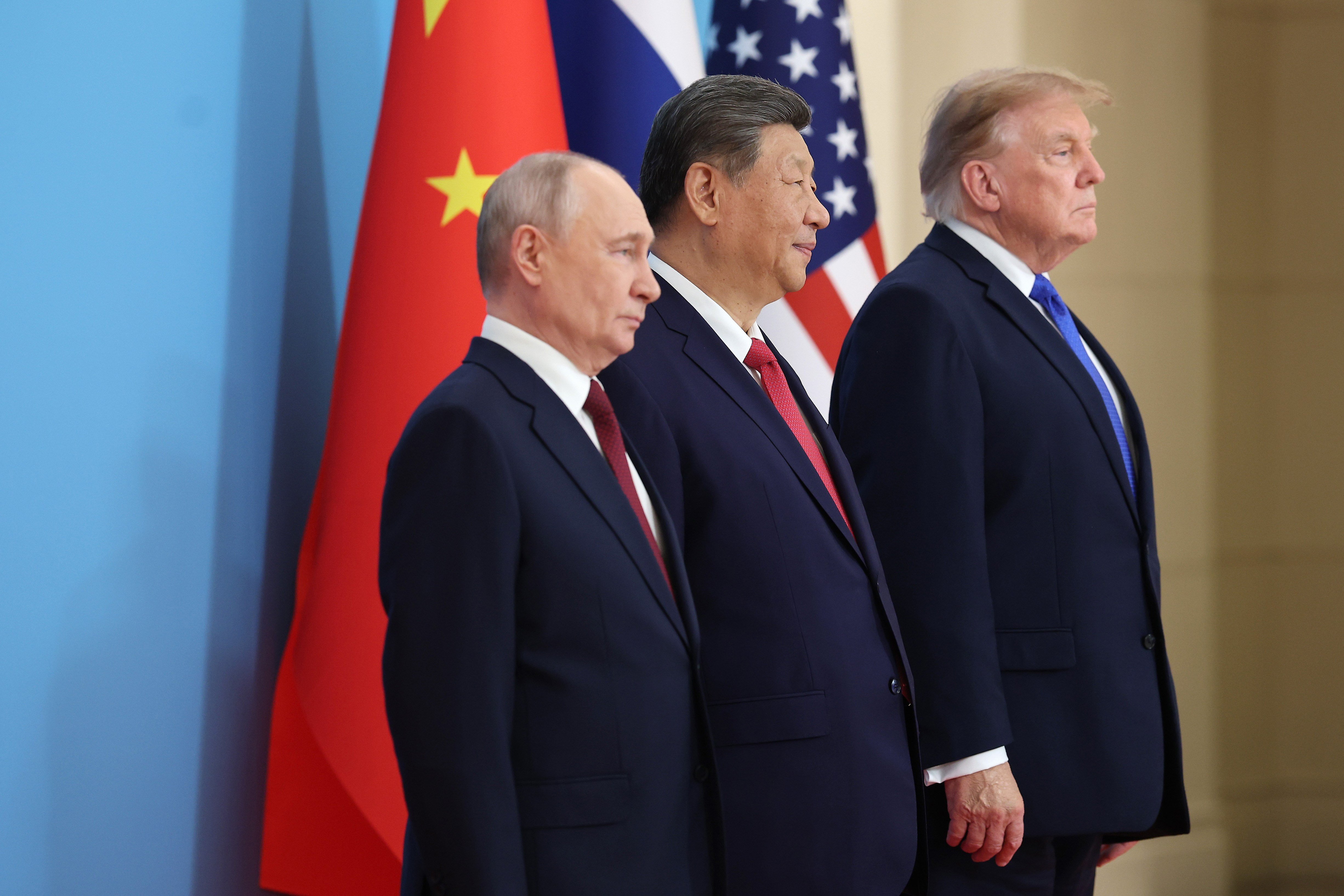
President Trump's recent visit to China has sparked sharp criticism from foreign policy experts, who draw an unsettling parallel to the 1945 Yalta Conference. At Yalta, the Allied powers—two democracies and one communist dictatorship—met to shape the post-war order after defeating Nazi Germany and Imperial Japan. But Trump's meeting in Shenzhen with Chinese President Xi Jinping and Russian President Vladimir Putin, as some analysts note, inverts that historical precedent: instead of vanquishing aggressors, the meeting appears to accommodate them.
The original Yalta Conference brought together Franklin Roosevelt, Winston Churchill, and Joseph Stalin to establish principles of non-aggression and secure borders. Yet Stalin quickly violated those commitments. In Shenzhen, Xi and Putin have already signaled, through their self-described “no limits strategic partnership,” that they will continue their separate and joint efforts to undermine the U.S.-led international order and pressure their neighbors. Trump, for his part, seemed notably deferential to both leaders, a posture that alarmed many observers.
Critics argue that the Shenzhen meeting represents a troubling shift in U.S. foreign policy, one that abandons America's traditional role as a defender of democracies and a counterweight to aggression. Joseph Bosco, a former China country director at the Pentagon and a nonresident fellow at the Institute for Corean-American Studies, described the outcome as an “abomination” that should unite congressional Republicans and Democrats in opposition. He noted that unlike at Yalta, where the goal was the total defeat of fascism, Trump's approach appears to legitimize the expansionist ambitions of Xi and Putin.
Central to the controversy is Trump's posture on Ukraine. In his post-meeting remarks, he further diluted his commitment to Kyiv's security, proposing a plan where the U.S. would sell weapons to NATO allies, who could then transfer them to Ukraine. But he also urged Europeans to halt their weapons supplies to Ukraine altogether, a move that would directly benefit Putin and Xi, who has not curtailed his support for Moscow's war effort. If the U.S. stops providing arms to European allies, the flow of weapons to Ukraine could dry up entirely.
The implications are stark. By these measures, Trump would complete a transformation of America from a supporter of democracies and a defender of victims of aggression into a willing participant in that aggression. As Trump might put it, no one has ever seen anything like this—certainly not in the 250 years of American history. The president's penchant for claiming unique achievements rings hollow when his actions evoke the darkest chapters of great-power politics.
This is not the first time Trump's foreign policy has drawn fire. His administration's approach to Iran, for instance, has remained murky, with ongoing diplomatic efforts by figures like Vice President Vance and Senator Rubio to court Qatar as a mediator. Meanwhile, domestic controversies, such as the stalled golf course takeover in Washington, continue to distract from broader strategic questions. But the Shenzhen summit underscores a more fundamental concern: the erosion of U.S. leadership on the world stage.
For America's allies in Asia and Europe, the message from Shenzhen is deeply unsettling. Traditional partners who once relied on U.S. security guarantees now face a president who seems willing to trade their interests for short-term concessions from authoritarian leaders. The freedom-loving neighbors of China and Russia—Taiwan, Japan, the Philippines, and the Baltic states—are left to wonder if Washington will still stand by them in a crisis.
As the political fallout continues, lawmakers on both sides of the aisle are under pressure to respond. Some Republicans have echoed the president's rhetoric, but others, along with Democrats, are calling for a bipartisan rebuke of what they see as a dangerous capitulation. The question now is whether Congress will assert its authority to check presidential overreach in foreign affairs, or whether Trump's Shenzhen gambit will stand as a defining moment of his presidency.
In the coming months, the administration's actions will be closely watched, particularly regarding arms transfers to Europe and the broader stance toward Ukraine. If Trump follows through on his hints to cut off supplies, the consequences could be catastrophic for Kyiv and for the credibility of U.S. commitments worldwide. The world, as Trump might say, has never seen anything like it—but not in the way he intends.