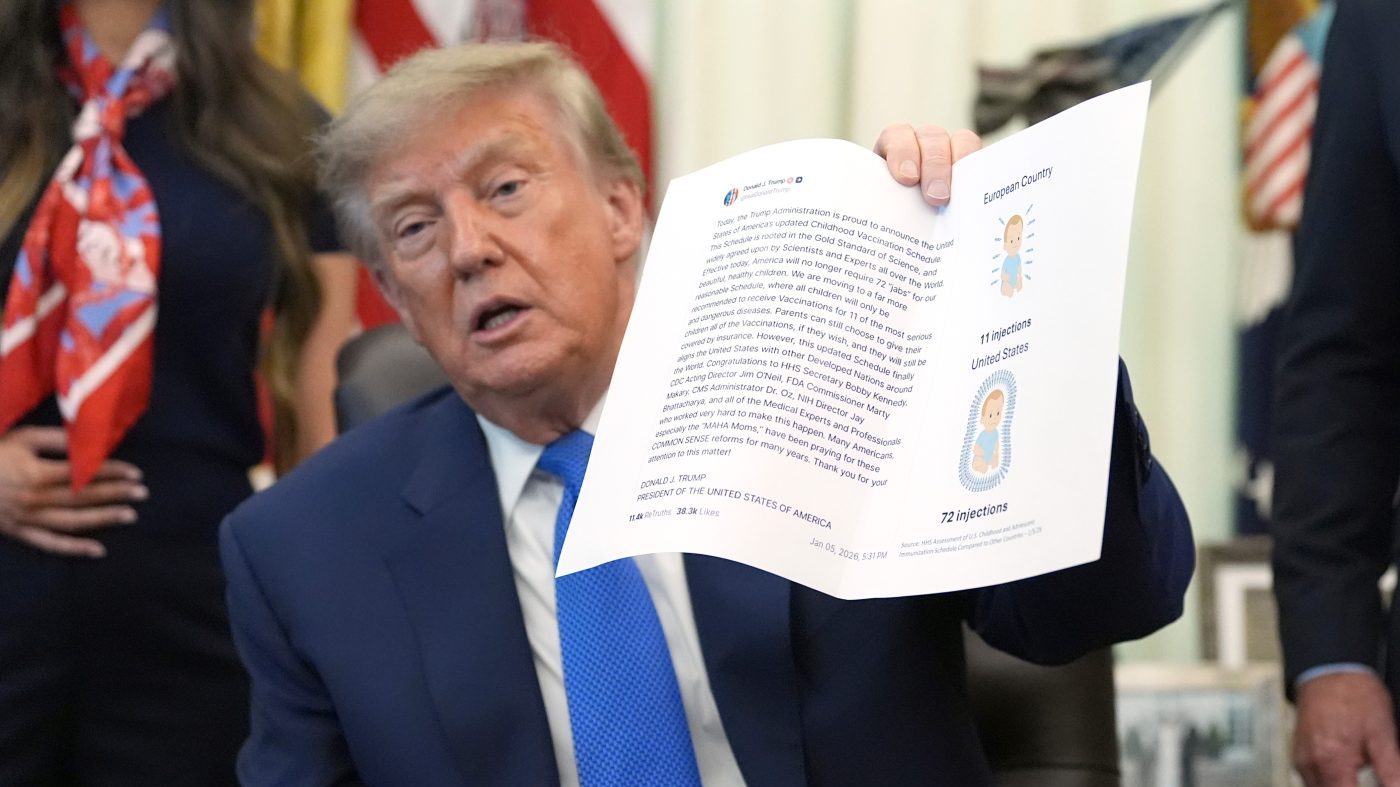
President Trump on Monday signed an executive order that would fundamentally alter the federal childhood vaccine schedule, recommending that the combined measles, mumps and rubella (MMR) shot be split into three separate visits and that only 11 core vaccinations be officially recognized as "gold standard."
The order, signed in the Oval Office, is the latest step in a broader push by Trump and Health Secretary Robert F. Kennedy Jr. to reduce the number of vaccines recommended for children. It comes just months before the midterm elections, injecting a highly charged and scientifically disputed issue into the political arena.
Trump, who has repeatedly suggested a link between childhood vaccines and rising autism rates, also directed the Department of Health and Human Services (HHS) to expand vaccine safety research. "Effective immediately, my administration is recognizing gold standard childhood vaccine recommendations for only 11 core vaccinations against the most serious and dangerous diseases, along with the MMR, which hopefully will be split up," Trump said.
He stressed that parents would retain the choice to vaccinate their children according to the existing schedule. "Parents can still choose to give their children all of the vaccinations if they wish. It's up to the parents," Trump said. "However, this updated recommendation finally aligns the United States with nations around the world. More importantly, aligns us with common sense and knowledge."
Medical experts immediately condemned the move, warning that delaying or separating the MMR components would leave children vulnerable to measles, mumps, and rubella for longer periods. Separate single-antigen vaccines for measles, mumps, and rubella are not currently licensed or available for children in the U.S., complicating any practical implementation.
The executive order closely mirrors a January HHS proposal to limit the number of recommended childhood vaccines, which a federal judge blocked in March. States set their own vaccination requirements, and several have already indicated they no longer trust federal guidance from the Trump administration, raising questions about how the order would be enforced.
Trump acknowledged the logistical burden on families, noting that splitting the MMR would require multiple doctor visits. "It's inconvenient, it's five stops, but it's something that I think will have a huge impact on autism," he told reporters after signing the order.
The move has reignited a long-running debate over vaccine safety, with public health officials pointing to overwhelming evidence that vaccines do not cause autism and that the current schedule is safe and effective. The American Academy of Pediatrics and the Centers for Disease Control and Prevention have both reaffirmed their support for the existing vaccine schedule.
As the midterm elections approach, the order is likely to become a flashpoint in key races, with Democrats and some Republicans distancing themselves from the administration's approach. The administration's handling of other contentious issues has already drawn scrutiny, and this move adds another layer of controversy.
Critics also note that the order comes amid broader concerns about the administration's credibility on scientific matters. Some legal scholars argue the order may exceed executive authority, as vaccine recommendations are typically issued by HHS and the CDC through established advisory processes.
For now, the practical impact remains unclear, as states are not obligated to adopt federal recommendations. But the symbolic weight of the order—and its potential to influence parental decisions—has alarmed public health experts who fear a resurgence of preventable diseases.