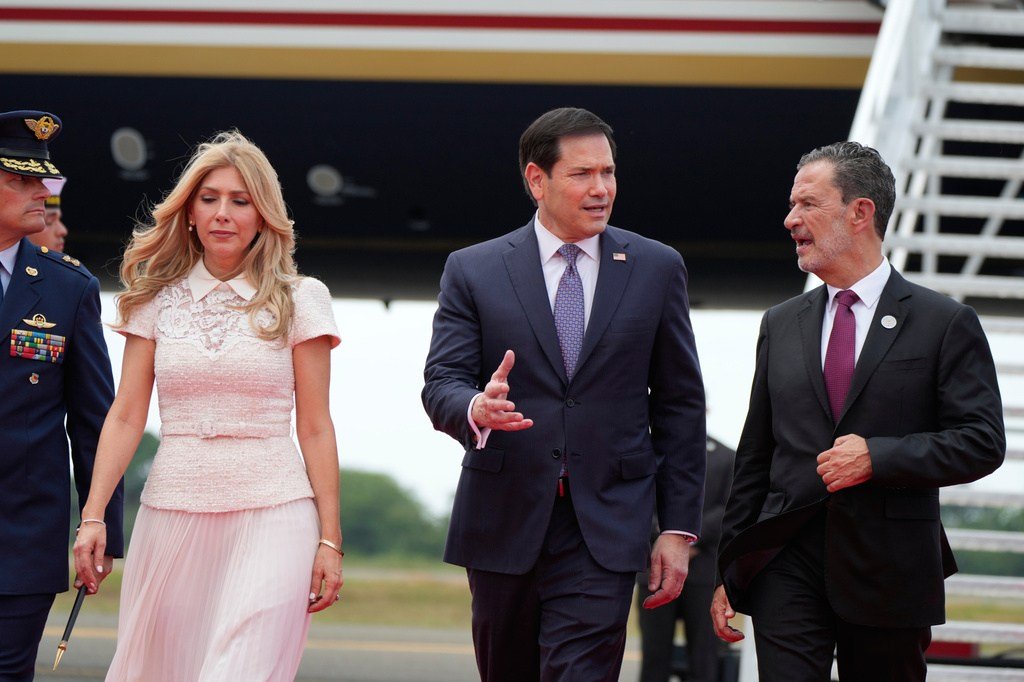
Secretary of State Marco Rubio's recent tour through Colombia, Ecuador, and Peru—his fifth swing through the region—has reignited familiar debates. Critics charge that Washington's renewed emphasis on the Western Hemisphere amounts to legal overreach, heavy-handed anti-China pressure, and a return to Cold War-style backyard politics.
Some of those tactical objections carry weight. But Rubio's instinct to prioritize this neighborhood is fundamentally correct. Foreign policy exists to safeguard Americans' safety, prosperity, and freedoms, and no other region touches those interests as directly or as broadly. For too long, Washington has "rediscovered" Latin America only when migration spikes, drugs flow north, or a rival power makes inroads. That reactive posture is exactly backwards.
Economic Stakes Are Massive
Start with the numbers: In 2024, U.S. trade in goods and services with Canada, Latin America, and the Caribbean hit $2.32 trillion—roughly a third of all U.S. trade, and more than the combined trade with the European Union and the UK. Much of that commerce moves by truck, rail, and pipeline across shared borders, making it deeply integrated into American supply chains.
Security Pressures Are Direct
The region also shapes U.S. security in concrete ways. Border encounters at the southwest border topped 2.2 million in fiscal 2024, then fell to about 444,000 a year later—but both figures underscore that events in Latin America do not stay there. More than half of all U.S. immigrants were born in Latin America, compared with only about 27% from Asia.
The drug trade follows the same geography. Mexico's Sinaloa and Jalisco New Generation cartels are the primary suppliers of fentanyl and other illicit drugs entering the U.S. In 2024, DEA analysis of seized cocaine samples showed 84% traced back to Colombian coca. Debating the legality and effectiveness of U.S. boat strikes on suspected traffickers is legitimate, but it should not obscure the core fact: these networks cannot be dismantled without coordinated action across the Americas.
Energy and Minerals Offer Strategic Advantages
Energy tells a more hopeful story. Pipelines and power lines already knit the continent together. Canada sends about 4.1 million barrels of crude oil per day to the U.S., while the U.S. ships a record 6.4 billion cubic feet of natural gas daily to Mexico. This integration cushions global shocks—Americans have felt far less pain from the Iran conflict than others because only about 2% of U.S. petroleum consumption depends on crude moving through the Strait of Hormuz, nearly 90% of which goes to Asia.
Critical minerals could become the next strategic advantage. The Americas hold vast deposits of lithium, copper, nickel, graphite, niobium, and rare earths, but China dominates mining and, crucially, processing. The International Energy Agency says China is the leading refiner for 19 of 20 key strategic minerals. The U.S. has an opportunity to link mines to refineries to factories across the hemisphere, loosening Beijing's grip on future industries.
China's Growing Footprint
Beijing is not standing still. It is already the largest goods-trading partner for Argentina, Brazil, Chile, Peru, and most other countries in the region. Chinese firms have built 37 ports, which today move containers but could in a crisis provide logistical footholds and surveillance capacity for Beijing.
Washington is right to pay attention, but it must do so with humility and consistency. Latin American nations do not want to be forced to choose between Washington and Beijing. China buys their copper, soybeans, lithium, and shrimp, and finances roads, ports, and infrastructure that Americans often declined to build. It is worth listening when neighbors express wariness about U.S. realpolitik instruments.
A Better Partner, Not a New Monroe Doctrine
The answer is not another Monroe Doctrine—a return to dominating the hemisphere. It is to compete by being the better partner: investing more, trading more, and helping build ports, power grids, and mineral-processing plants, while respecting local workers and the environment, unlike the Chinese. It is to share intelligence where interests align and strengthen local security forces, as Rubio did on this trip, rather than threatening to fight criminal gangs ourselves. Treat sovereign governments as partners, not squares on a chessboard.
America should not seek to control its hemisphere, but it can no longer afford to neglect it.
Anja Manuel is executive director of the Aspen Strategy Group and Aspen Security Forum, a former diplomat, author, and foreign policy advisor.