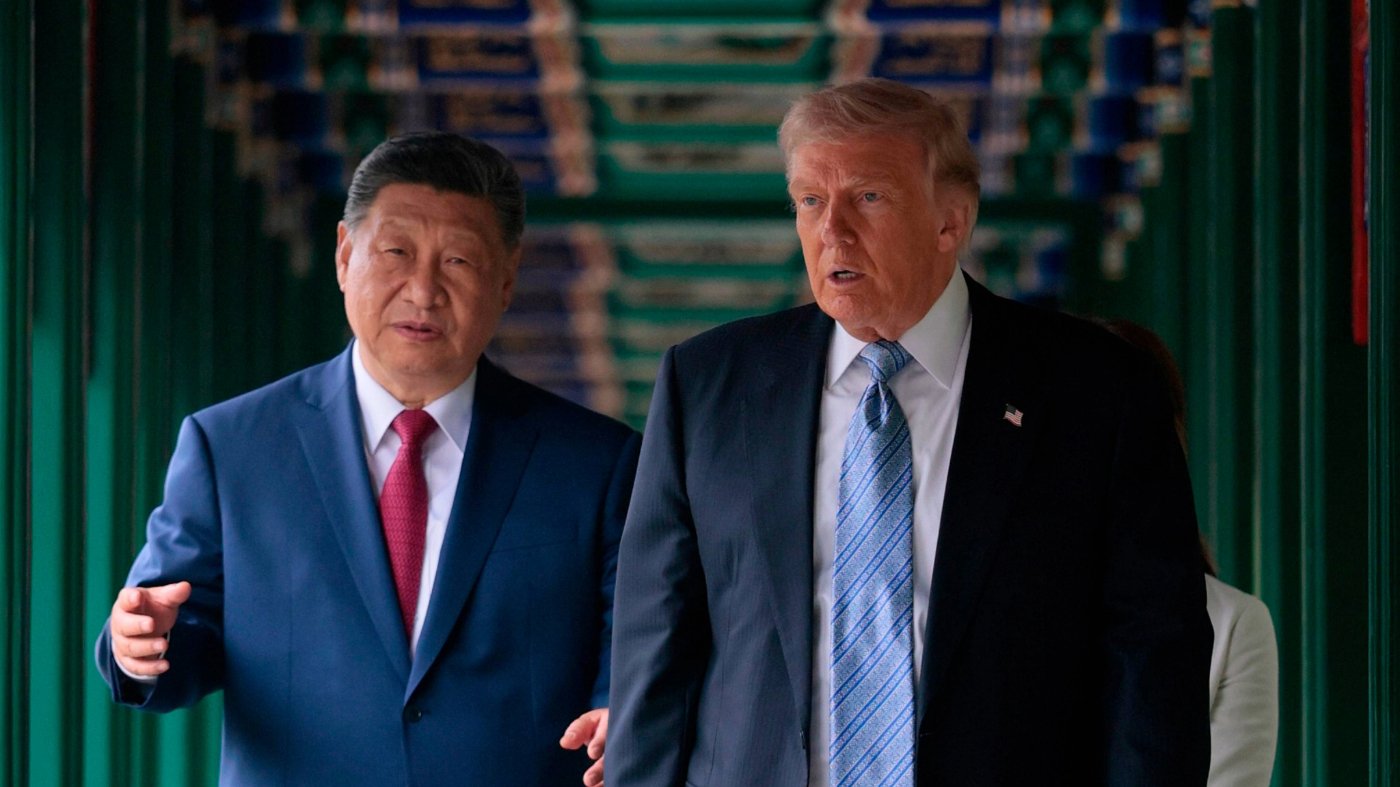
President Donald Trump wrapped up a high-stakes summit with Chinese President Xi Jinping on Friday, touting a string of new business deals that he said would benefit both nations. “We’ve made some fantastic trade deals, good for both countries,” Trump told reporters during a meeting with Xi, though his administration offered scant specifics on the agreements.
Speaking aboard Air Force One after the two-day visit, Trump described the trip as an “amazing period of time” and disclosed that China had agreed to a major purchase from U.S.-based Boeing and GE Aerospace. According to the president, the deal encompasses 400 to 450 GE jet engines and 200 Boeing aircraft, with a “promise” to buy up to 750 planes “if they do a good job.”
Neither Boeing nor Chinese officials have formally confirmed the arrangement, but if realized, it would represent a significant boost for the U.S. aerospace sector. The announcement comes as Trump continues to press for better trade terms with Beijing, a theme that has defined much of his foreign policy agenda.
Beyond aerospace, Trump said he and Xi reached an agricultural agreement. “The farmers are going to be very happy,” Trump declared, adding that China is “going to be buying billions of dollars of soybeans.” U.S. Trade Representative Jamieson Greer told Bloomberg on Thursday he anticipated a $10 billion commitment from China for U.S. farm goods.
The summit also touched on broader economic frameworks. Trump and Xi were expected to discuss creating a “Board of Investments” and a “Board of Trade” to enhance bilateral economic dialogue. Greer indicated the trade board would oversee tariff reductions on roughly $30 billion in goods, a move that could ease ongoing trade tensions.
Trump traveled to Beijing with a delegation of business leaders, including Nvidia CEO Jensen Huang. The AI chipmaker is awaiting Chinese approval to sell its high-powered H200 chip, following clearance from the Trump administration. However, Trump noted Friday that China has opted to “develop their own” chips, underscoring the competitive dynamic between the two nations in advanced technology.
The president and Xi also discussed artificial intelligence safety measures. Treasury Secretary Scott Bessent told CNBC on Thursday that the two countries would agree on a protocol “to make sure nonstate actors don’t get a hold of these models.” Trump acknowledged China’s strength in AI, saying, “We’re leading a lot, but they’re second, and they’re very strong,” and mentioned “possibly working together for guardrails.” When pressed for specifics, he offered only vague references to “the standard guardrails that we talk about all the time.”
The visit yielded no major breakthrough on Iran, despite earlier speculation that Trump might seek Xi’s help on the issue. For more on that dynamic, see our analysis of the summit’s Iran dimension. Meanwhile, the lack of concrete details on the trade deals has left analysts and industry watchers cautious, with many awaiting official confirmations from Beijing and the companies involved.