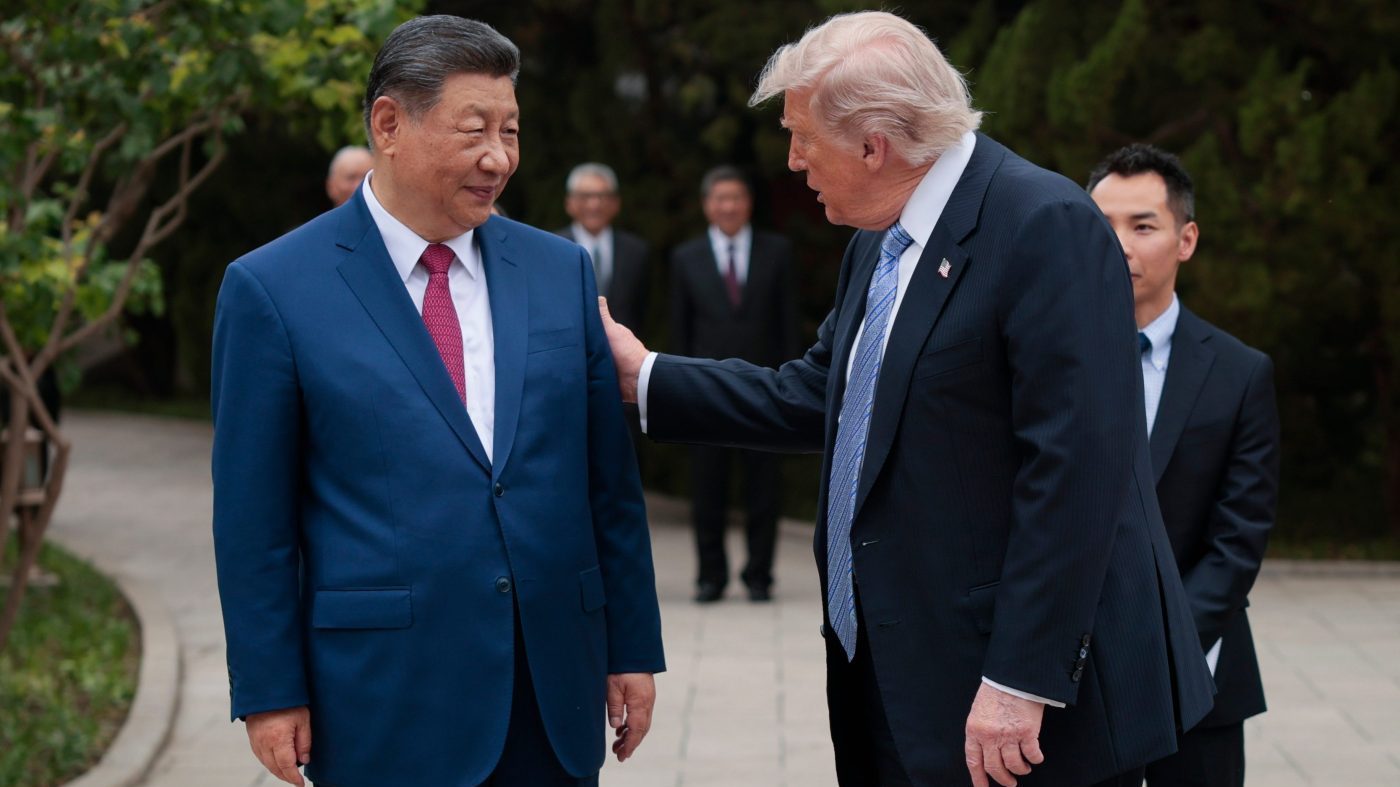
President Trump told reporters Friday that he and Chinese President Xi Jinping discussed the possibility of “working together” on guardrails for artificial intelligence, as Washington policymakers continue to debate how to handle the risks posed by the rapidly advancing technology.
“We talked about possibly working together for guardrails on AI,” Trump said aboard Air Force One after his summit in Beijing. When pressed for details, he offered little clarity, describing only “the guardrails that we talk about all the time.”
The topic of AI was widely expected to dominate the summit, given the intensifying U.S.-China competition to lead in the technology. Both nations have so far pursued a light-touch, pro-innovation regulatory approach, but the recent release of advanced models like Anthropic’s Mythos is forcing Washington to reconsider its strategy.
“AI is fantastic,” Trump said. “So many things can happen in terms of health, medicine and operations, everything … military.” He acknowledged drawbacks as well, adding, “We probably will, we’re going to work together.” When a reporter asked whether that meant biological, nuclear, or cyber risks, Trump nodded and replied, “Could be, yeah.”
Treasury Secretary Scott Bessent told CNBC on Thursday that the U.S. can engage in AI talks because it remains “in the lead” in the race with China. “The two AI superpowers are going to start talking. We’re going to set up a protocol in terms of how do we go forward with best practices for AI to make sure nonstate actors don’t get a hold of these models,” Bessent said.
White House officials had suggested earlier in the week that the summit could open a dedicated communications channel on AI between the two nations. “Like in many areas of intense focus for the U.S. and China, it’s good to have a channel of communication,” one U.S. official said Sunday. “What that channel looks like and its formality … is yet to be determined.” It remains unclear whether Trump and Xi discussed that channel, which would be a first for this administration. The Biden administration launched an official AI dialogue with China in 2023, but it had limited success as U.S. experts focused on safety while China pressed for looser export controls on AI chips.
The summit comes about a month after Anthropic released its cybersecurity model Mythos to a limited group of technology firms, Wall Street banks, and government entities. According to Anthropic, Mythos moves cyber risks from the hypothetical to the real, capable of spotting decades-old vulnerabilities that hackers could use to target U.S. banks, government software, and other critical systems. The release rattled the Trump administration, which had prioritized competitive standing over AI safety, though no consensus on how to respond has emerged.
Notably, Trump said the sale of Nvidia’s advanced H200 chips to China did not come up during the summit, contrary to some predictions. “It didn’t come up,” he said, adding that China has not approved the purchase because “they want to develop their own.” He then added, “but it did come up and I think something could happen on that.” Nvidia CEO Jensen Huang, who accompanied Trump in Beijing, has pushed back on U.S. export controls, arguing they accelerate China’s development of its own technology. Trump cleared the way late last year for Nvidia to sell its H200 chips to China for a 25 percent revenue cut.
The summit also touched on other sensitive issues, including Trump’s denial that he sought favors from Xi on Iran, and his statement that Xi is weighing the release of Pastor Ezra Jin. On Taiwan, Trump declared he made no pledge to Xi, leaving the status of U.S. arms sales uncertain. Those discussions, however, did not produce a breakthrough, as the two leaders remain at odds over strategic priorities.