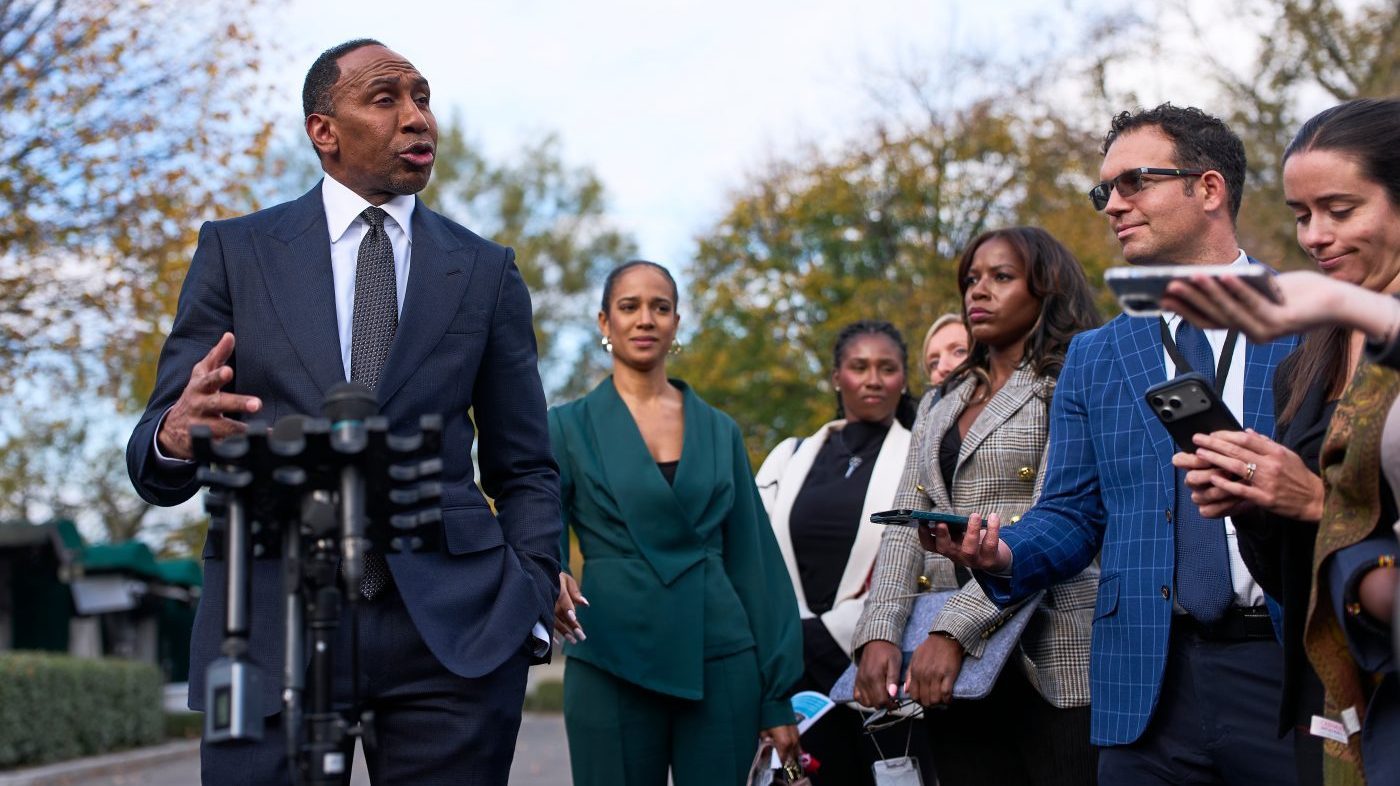
ESPN commentator Stephen A. Smith has pushed back against criticism that he failed to challenge President Trump during their recent sit-down, arguing that letting the president speak without constant interruption was a deliberate journalistic choice that served viewers.
In an episode of his podcast Straight Shooter, Smith explained that during the White House interview, he opted not to fact-check Trump's claims about his record with Black Americans in real time. Instead, he allowed the president to lay out his case in full, even as Trump touted himself as the biggest beneficiary for the Black community.
“The Black community is the biggest beneficiary of what I’ve done,” Trump said in the interview, which aired last week.
Smith addressed the backlash on Tuesday, framing his approach as a trade-off between interrogation and information. “Do I challenge him with the litany of questions that I had, that I wanted to address? Do I let people hear what that list is, or do I interrupt him?” he asked. “I decided, without trying to let him go on forever, Black folks needed to hear what he believes he has done for our community. And that’s why I let it go, at least to some degree.”
The ESPN personality also argued that aggressively pressing Trump on every dubious statement could have derailed the conversation entirely. He described the president as a master of filibustering who “doesn’t hesitate to embellish,” and suggested that a more combative approach might have cut the interview short.
“You had a lot of people that felt that I should have pushed back more. And I won’t say any names, but particularly people that have been in this industry before, that should understand by now what comes with an interview like that,” Smith said, hinting that some critics were more interested in spectacle than substance.
“You want to engage in looking the part, and looking like you’re pushing back, not recognizing the fact it’s the President of the United States, you’re inside the White House in the Roosevelt Room, and in a nanosecond he could have just got up and walked out,” he added.
Smith did, however, take time after the interview to fact-check some of Trump’s claims. He noted that Trump’s assertion that Black Americans benefited more than any other group from his policies was “unverifiable” and “his opinion.” He pointed to the Black unemployment rate, which stood at 6.6 percent in October, up from 6.2 percent when Trump returned to office in January 2025.
“And that number alone can’t prove who benefited most,” Smith said.
The interview itself was notable given Trump’s past attacks on Smith, whom he has called an “arrogant fool” and “low IQ.” Smith’s decision to let Trump speak without interruption has drawn criticism from some media observers, but he remains unapologetic, arguing that the interview provided a rare, unfiltered look at the president’s views on race and policy.
This is not the first time Smith has navigated the tricky terrain of interviewing political figures. His approach has sparked broader debate about the role of interviewers in holding power to account, especially when the subject is a sitting president. Some see his method as a missed opportunity for accountability, while others view it as a pragmatic way to extract information from a notoriously evasive interviewee.
As the 2026 midterm elections approach, the intersection of media and politics remains a flashpoint, with figures like Smith caught in the crossfire. His defense of his interview strategy is likely to fuel further discussion about how journalists and commentators balance the need for tough questions with the reality of limited access.