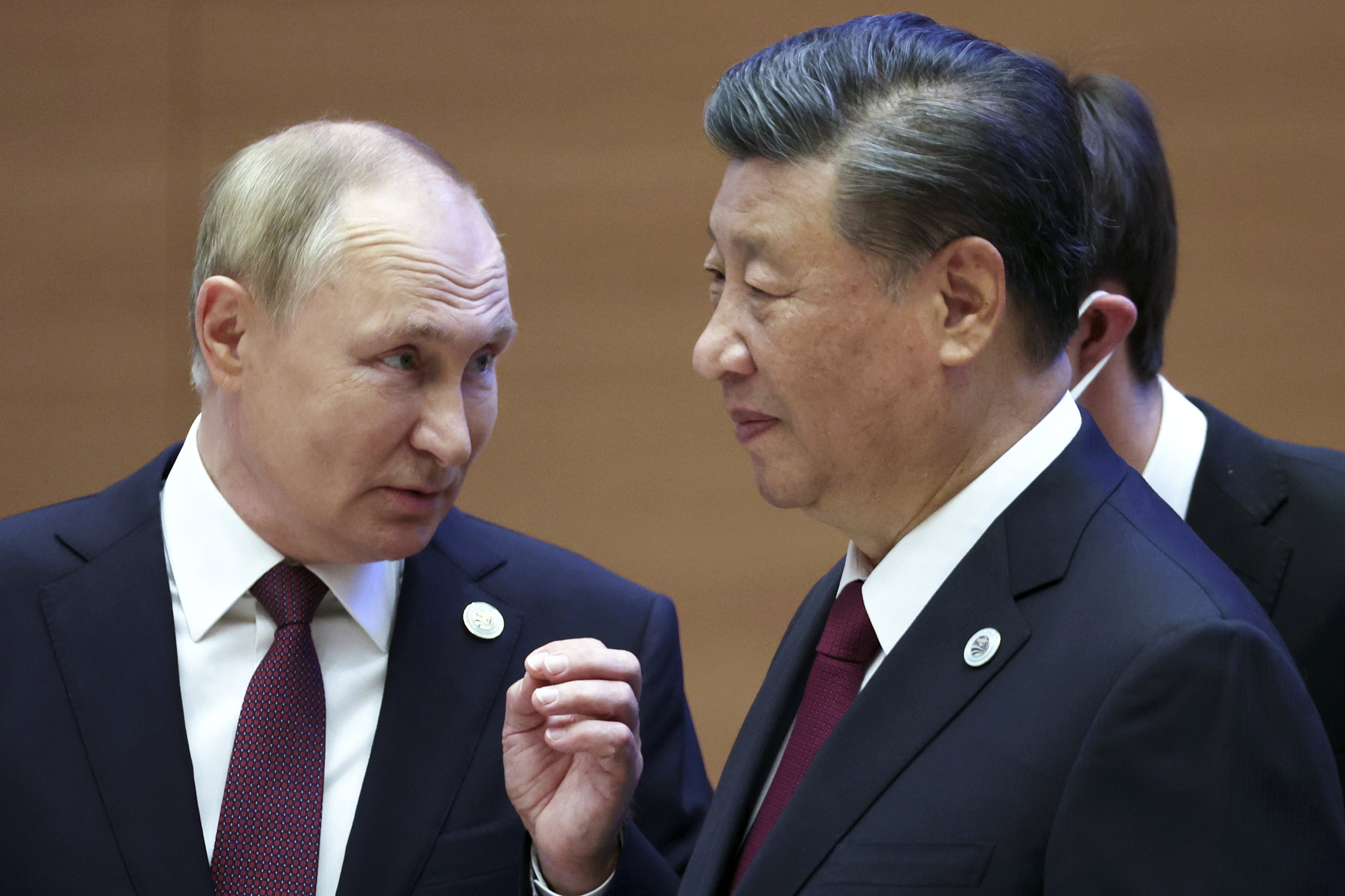
When Vladimir Putin launched his full-scale invasion of Ukraine, he framed it as a bid to restore Russia's imperial glory. But the war's trajectory has produced the opposite result: Russia is now more dependent on China than at any point in the post-Soviet era, and its status as a great power is eroding.
Putin's forces are struggling against Ukraine's drone warfare, which has imposed a logistical blockade on supply routes to occupied Crimea. As the Kremlin's battlefield frustrations mount, Russian officials have resorted to crude scare tactics, warning Washington to evacuate Americans from Kyiv and threatening to target European diplomats in Ukraine.

China's Growing Leverage
The longer the war drags on, the more Russia relies on China for economic survival. Beijing has steadily increased support for Moscow's war effort—not out of solidarity, but to keep the West bogged down in a costly conflict. In exchange, China has extracted deep discounts on energy deals like the long-delayed Power of Siberia 2 pipeline, a project critical for Russia after losing most of its European gas market.
Russia now depends on China for everything from electronics and industrial machinery to dual-use technologies that sustain its war machine. Even Russia's artificial intelligence ambitions hinge on Chinese microchips. During Putin's latest visit to Beijing, senior Russian officials publicly complained that Chinese car manufacturers were overwhelming domestic producers.
Economic Asymmetry
The imbalance extends to energy negotiations. China has refused to finalize the Power of Siberia 2 agreement, reportedly demanding steep discounts and using Russia's growing isolation as leverage. Moscow once supplied Europe from a position of strength; now it negotiates from weakness with its only remaining major buyer.
Beijing has approached the relationship pragmatically. It wants discounted energy, access to Russian resources, and greater geopolitical leverage over an isolated Moscow—not an equal partnership. As one analyst noted, China need not annex Russian territory to dominate it; economic dependency and regional integration can achieve what military conquest once sought.
Regional Vulnerability
This dependency is most visible in Russia's Far East, which has lost nearly 300,000 residents since 2010. Investment remains far below levels in Moscow and St. Petersburg, making the region increasingly vulnerable to Chinese influence. According to the Saratoga Foundation, local officials in parts of Siberia and the Russian Far East now look to Beijing for solutions Moscow can no longer provide. In Irkutsk, frustrated residents appealed to Putin to seek Chinese help building schools because, as they put it, “the Russian Federation is not in a position to do so.”
In Sakha, China's share of foreign economic cooperation rose from 27.5% in 2021 to over 45% in 2024, while Mandarin instruction expanded in local schools after 2022. Infrastructure, logistics corridors, and investment rules are being restructured to attract Chinese capital as Russia grows more isolated from Western markets.
Strategic Reversal
Putin launched the war claiming to defend Russia's sovereignty and reverse its historic decline. Instead, the conflict has accelerated that decline. Russia has suffered staggering military and economic losses while becoming increasingly dependent on a far more powerful China. Even if Russia captures more Ukrainian territory, the long-term cost may prove catastrophic: the country's best future markets, technologies, and investment opportunities historically came from Europe, not China.
By severing those ties in pursuit of imperial fantasies, Putin is binding Russia ever tighter to a relationship in which Beijing holds the upper hand. He may ultimately be remembered as the man who exhausted imperial Russia in the fields of Donbas while surrendering much of his country's strategic independence to China.
For more on how China is expanding its influence through economic leverage, see our analysis of Lula's Pivot to China Risks Brazil's Sovereignty and Economic Stability. On the military front, Ukraine's drone strategy is forcing Moscow to rethink its war plans, as detailed in Ukrainian Drone Strategy Forces Putin to Rethink War as Russia Shows Signs of Weakening.