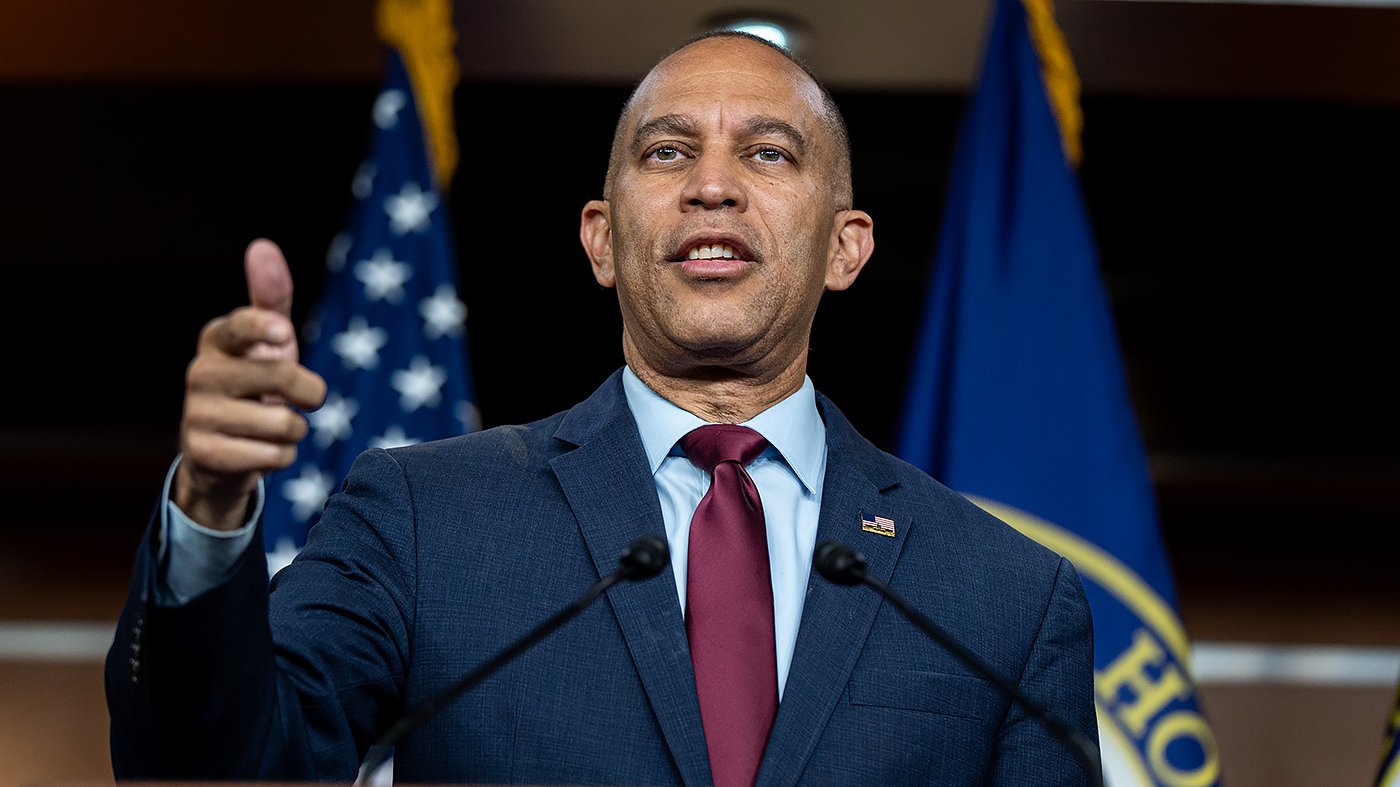
House Democratic Leader Hakeem Jeffries (N.Y.) launched his party's 100-day midterm blitz on Sunday, casting the November elections as a referendum on affordability and pledging to rein in corporate price-gouging if Democrats reclaim the House majority.
“In 100 days, you can vote for an America that is affordable and lower the cost of groceries, gas, and housing,” Jeffries said at a rally in Pennsylvania alongside Democratic House candidate Bob Brooks, a firefighter union leader challenging freshman GOP Rep. Ryan Mackenzie in a district rated a “toss-up” by the Cook Political Report. “In 100 days, you can vote for an America where affordable healthcare is available to every single citizen.”
Jeffries tied the party's economic message to a broader platform of accountability, vowing to crack down on companies he accused of price-gouging, reform the Supreme Court, and ban stock trading by the president, vice president, and members of Congress. “We are going to hold the crooks accountable,” he said. “Anyone who is stealing from the American people, screwing over the American people or short-changing the American people is going to be held accountable, beginning on day one.”
The Democratic leader also outlined other priorities if his party wins back control, including curbing the Trump administration’s immigration enforcement agenda, pressing to end the nearly five-month war in Iran, and demanding the Justice Department release unpublicized files from the Jeffrey Epstein investigation. But the core of his message—echoed by Democratic incumbents and challengers nationwide—remained economic. “In 100 days, you can vote for an America where young people have a chance to purchase a home and start a family,” he said, with the slogan “Fighting for an affordable America” displayed behind him. “In 100 days, you can vote for an America that keeps our promise to our cherished seniors by protecting your Social Security and your Medicare.”
Decision Desk HQ gives Democrats a 60 percent chance of flipping the House, where they need to net just three seats to reclaim the majority—a shift that would make Jeffries the first Black Speaker in U.S. history. The historical headwinds are favorable: the president’s party has not held the House in a midterm since 2002. Yet Republicans retain a 60 percent chance of keeping the Senate, where Democrats must flip four GOP-held seats and hold all their own to avoid a 50-50 tie broken by Vice President Vance.
Republicans have seized on recent Democratic primary victories by far-left candidates in New York City and Colorado to argue the opposition has veered too far left. Speaker Mike Johnson (R-La.) warned earlier this month that his party is fighting to prevent “communism” from taking over the country. “We’re fighting right now in Congress over whether we’re going to maintain our status as a constitutional republic or we’re going to trade that in, dismantle the foundations and go down this dark road of death to communism,” Johnson said at a press conference at the Republican National Committee.
Jeffries pushed back, framing the election as a choice between accountability and a GOP-led status quo that he said favors corporate interests. His message aligns with Democrats' broader rejection of fears about a socialist takeover, while the party also works to counter GOP leaders' spin of legislative wins as midterm bright spots. The contest in Pennsylvania’s 7th District, where Brooks is challenging Mackenzie by fewer than 5,000 votes, exemplifies the tight races that will decide control.
As the 100-day sprint begins, Jeffries’ focus on kitchen-table economics and his pledge to hold “crooks” accountable will be tested against Republican efforts to paint Democrats as out of step. The outcome will determine not only control of the House but also the direction of policy on everything from healthcare to immigration enforcement.