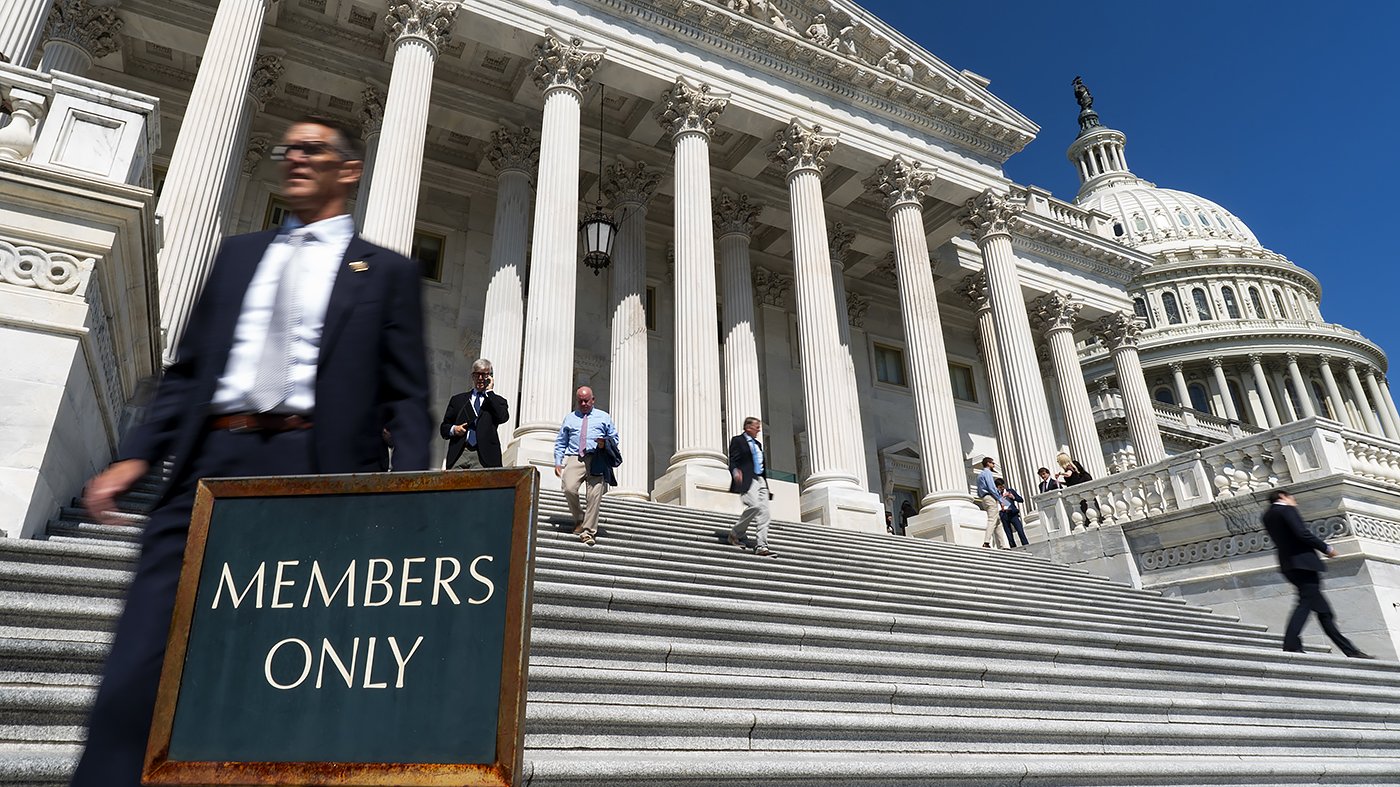
House Republicans are fanning out across the country for the August recess, trying to find silver linings in a midterm landscape that looks increasingly difficult. With just 100 days until Election Day, GOP leaders are pointing to a handful of legislative accomplishments as evidence they can defy historical trends.
Speaker Mike Johnson touted passage of a stock trading ban for lawmakers, a stopgap funding bill to avert a shutdown, the annual defense policy bill, and a third reconciliation framework that includes Pentagon funding, farm aid, and voting restrictions demanded by President Trump. “Many of you like to say that major legislating can’t happen in an election year. We just proved you wrong,” Johnson told reporters Wednesday. He expressed confidence the party would “hold and grow this majority.”
But Johnson glossed over the fact that the defense policy bill was delayed for weeks by hard-line conservatives who blocked its consideration. Republicans argue voters care more about the final product than internal Beltway squabbles. However, factors beyond their control—like gas prices and Trump’s approval rating—are likely to be decisive.
History shows the party controlling the White House almost always loses House seats in midterms, and current polling suggests that pattern will hold. Decision Desk HQ data as of Friday shows Democrats with a 4.1-point edge on the generic congressional ballot. Early in the week, some GOP strategists were encouraged by signs the gap was tightening, but that optimism faded after an Emerson poll gave Democrats an 11-point lead and a Fox News poll showed a 7-point advantage.
Republicans are trying to exploit the Democratic Party’s low approval ratings and lack of a unifying figure. House Majority Leader Steve Scalise said Thursday: “This is not your father’s Democrat Party. It’s a party that’s lost its way. They’re in a civil war with each other.” GOP leaders have seized on primary wins by progressive and Democratic Socialists of America candidates, arguing the party is drifting toward socialism—and even communism. “We had been saying that this was an election that was shaping up as a contest between common sense and crazy, and now it is literally in many sectors around the country, common sense versus communism,” Johnson said.
But rising prices and the war in Iran remain persistent headaches. Gas prices recently ticked above $4 per gallon. CNN data analyst Harry Enten noted that the Fox News poll found Democrats now hold a 10-point advantage over Republicans on handling inflation—a dramatic reversal from October 2024, when Trump had a 6-point edge over Kamala Harris on the issue. “If these numbers hold, it’s very hard to imagine that Republicans are able to hold on to the House,” Enten said. Scalise acknowledged the price volatility, saying, “You know what’s going on in Iran, and so you’ve seen some blips up and down.”
On fundraising, Republicans are more upbeat. While some incumbents in key districts are being outraised, many are holding their own or have a cash-on-hand advantage. The NRCC has $92.7 million in the bank versus $79 million for the DCCC; the RNC has $128 million compared with the DNC’s $16 million cash plus $18 million in debt. A recent Supreme Court decision striking down federal limits on party-candidate coordination could allow that cash to make a bigger impact on advertising and outreach.
Republicans have also grown more optimistic about court rulings this year that they believe could boost their turnout. But with Trump's tariff policies fueling economic fears and Democrats surging in generic ballot polls, the party faces an uphill battle to retain the House.