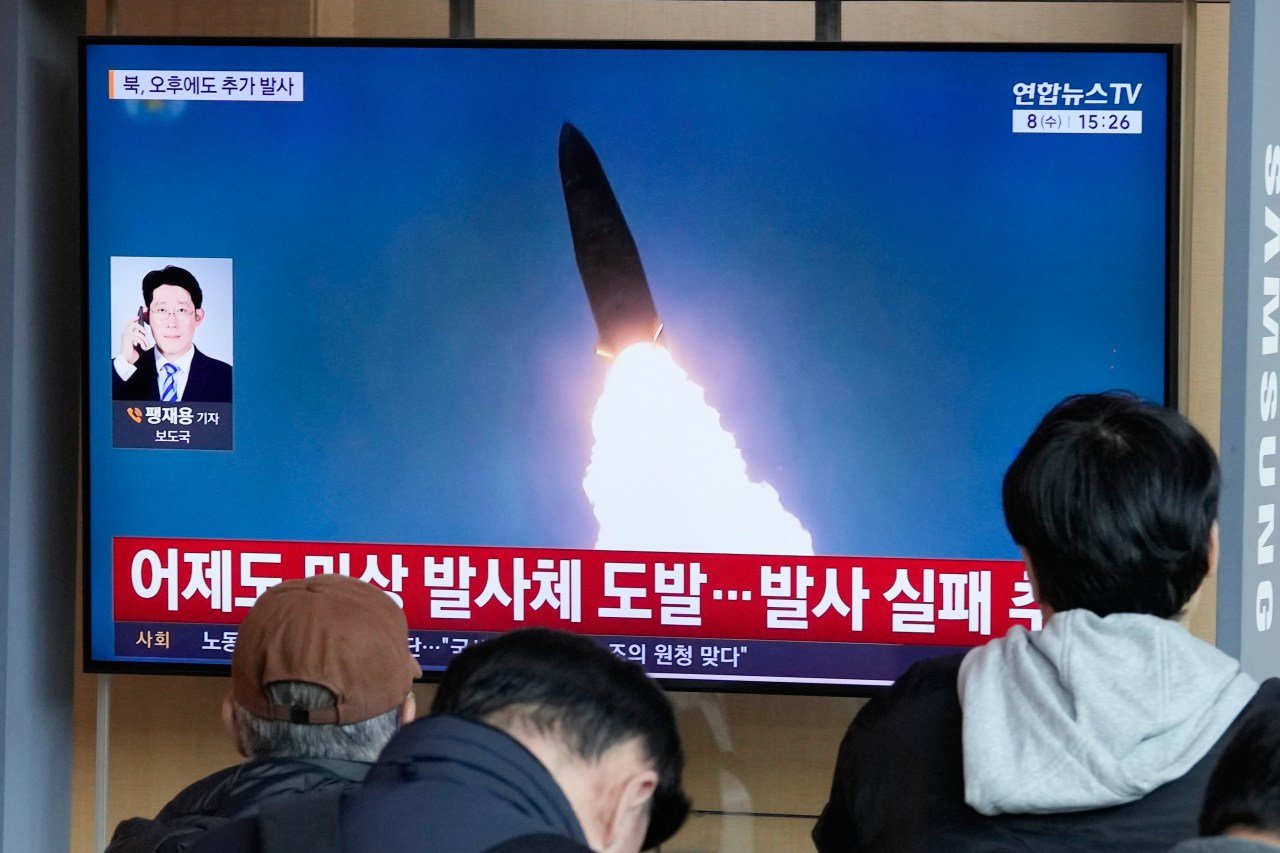
North Korea launched several short-range ballistic missiles toward the Sea of Japan on Wednesday, marking its second weapons test in as many days. The launches followed a blistering statement from a senior Pyongyang official who ridiculed South Korea's persistent efforts to restart diplomatic dialogue, calling Seoul its "most hostile enemy state."
South Korea's Joint Chiefs of Staff reported that multiple missiles fired from the Wonsan area traveled approximately 240 kilometers before landing in the East Sea. A subsequent ballistic missile launch later in the day flew over 700 kilometers, according to military assessments. Japanese authorities confirmed the projectile fell outside the country's exclusive economic zone.

Diplomatic Insults Precede Military Tests
The missile tests came just hours after Jang Kum Chol, a first vice minister at North Korea's Foreign Ministry, delivered a scathing critique of South Korean diplomacy. He derided officials in Seoul as "world-startling fools" for interpreting recent comments from Kim Yo Jong, the influential sister of leader Kim Jong Un, as a potential opening for talks. Jang asserted that Kim's statement was purely a warning, not an olive branch.
This episode highlights the deepening chasm between the two Koreas. While South Korea's liberal government continues to advocate for dialogue, Pyongyang has systematically rejected these overtures since the collapse of Kim Jong Un's diplomacy with former U.S. President Donald Trump in 2019. Instead, North Korea has accelerated its weapons development and strengthened alliances with other nations confronting the United States, including Russia and China, as part of a broader pattern of coordinated pressure on Washington.
Technical Developments and Strategic Posture
The back-to-back launches demonstrate North Korea's continued focus on advancing its missile capabilities. Earlier this week, state media reported that Kim Jong Un observed a test of an upgraded solid-fuel engine, a significant development for its strategic arsenal. Missiles using solid propellant are more mobile and can be launched with less preparation than their liquid-fueled counterparts, complicating detection and defense efforts.
South Korea's intelligence agency believes this engine test is linked to the development of a more powerful solid-fuel intercontinental ballistic missile capable of carrying multiple nuclear warheads. While experts doubt Pyongyang has fully mastered the required technology for a functional multi-warhead system, the pursuit itself signals a long-term aim to overwhelm U.S. missile defenses.
Amid these tensions, the geopolitical landscape is shifting. North Korean media announced that Chinese Foreign Minister Wang Yi will visit Pyongyang for a two-day trip, underscoring the regime's diplomatic pivot. This engagement occurs as some analysts warn that Seoul's pursuit of reconciliation could strain its critical alliance with the United States.
The United States Indo-Pacific Command stated the latest launches did not pose an immediate threat to U.S. personnel, territory, or allies. However, South Korea's military emphasized it maintains full readiness to respond to any provocation, operating in close coordination with the U.S. under their longstanding defense pact.
Tuesday's launch event, which involved a projectile fired from the capital region, appears to have ended in failure, according to South Korean media reports that cited an abnormal flight path before the object disappeared from radar. This mixed record of success and failure is typical of North Korea's aggressive testing schedule, which serves both technological and political purposes.
The repeated missile tests and vitriolic rhetoric make clear that North Korea currently sees no utility in diplomacy with Seoul. The regime is instead concentrating on military modernization and cultivating partnerships with other adversarial states, leaving inter-Korean relations at a dangerous and frozen impasse.