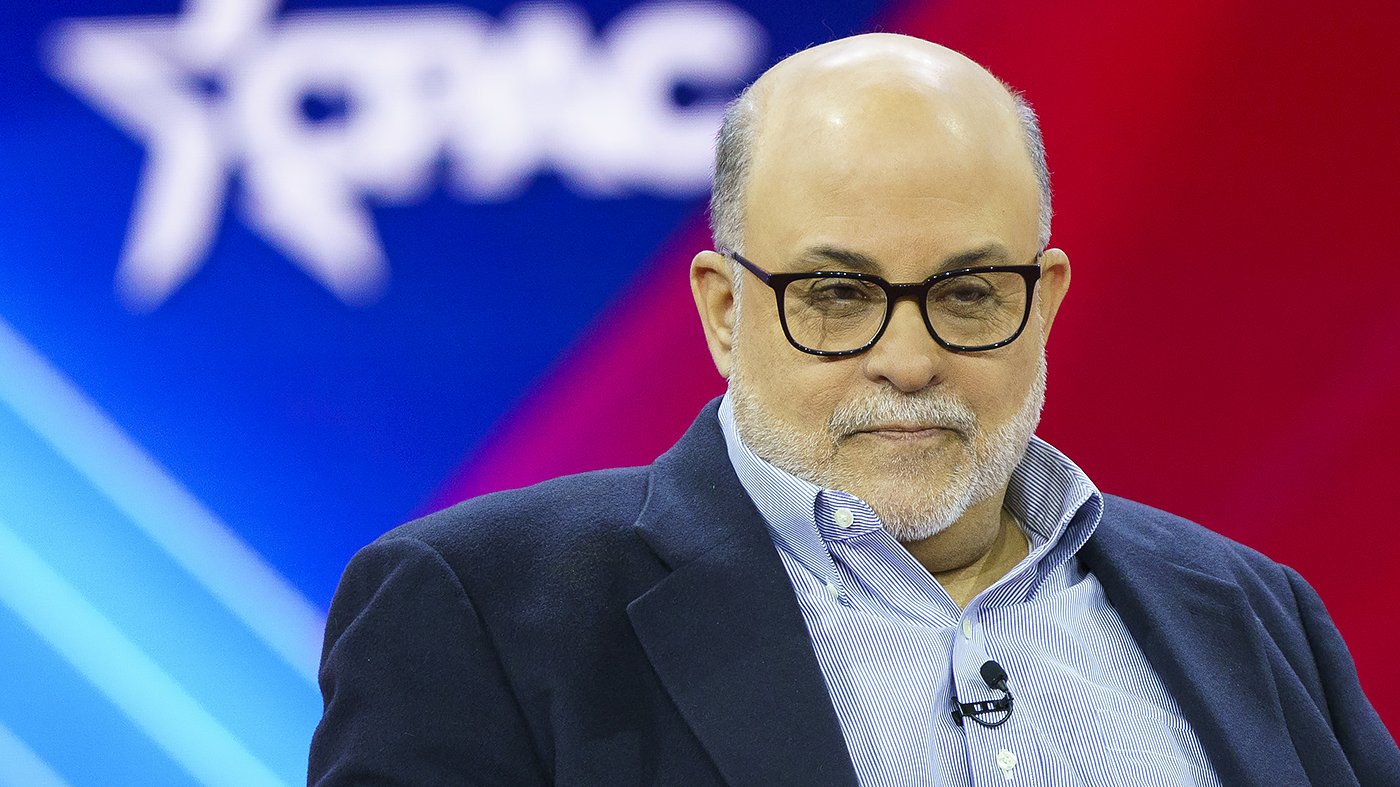
Fox News host Mark Levin unleashed a blistering critique of the Trump administration over its preliminary agreement with Iran, accusing officials of abandoning Israel and capitulating to a regime he called a terrorist state. In a 17-minute monologue on his show "Life, Liberty & Levin," the conservative commentator directly addressed officials "in and out of the administration," demanding they "stop trashing, smearing, bullying the little state of Israel."
Levin took aim at the administration's framing of Iran as a rational partner, contrasting it with what he described as the regime's recent atrocities. "Stop cozying up to and telling us that the enemy regime in Iran is now more rational, more moderate, and a regime that we can deal with, when just a few months ago, they slaughtered 50,000 people — they're still hanging young people today," Levin said. He added, "And if they had a nuclear missile today, they'd fire it into our country, as sure as I am alive."
The host argued that while the initial U.S. military response to Iranian aggression was justified, the trajectory shifted, leading to what he called a surrender of Israel's security. He questioned why the U.S. was not focused on Hezbollah militants in Lebanon, accusing Washington of doing the group's "bidding." "When Israel is being attacked by Hezbollah and the Lebanese people and the government want Hezbollah gone, it's an Iranian terrorist group that has taken over the country," Levin said. "It's a complete capitulation to the Iranian regime. Because Hezbollah is its terrorist lifeline. It's an absolute capitulation of them. And why would we do this? Why would we do it to Israel?"
Levin dismissed the $300 billion reconstruction fund for Iran as a tool that will only "strengthen the regime." He also questioned the logic of halting all military operations before a final deal, arguing it stripped the U.S. of leverage. The core problem, he said, is that Iran will never abandon its revolutionary agenda. "Any deal to them isn't worth the paper it's written on," Levin warned. "It may last for a while. That's what they're banking on. Survival and then reconstruction, and then strike. And so they'll agree to this for a period of time. They'll take all the benefits they can get."
The 14-point memorandum of understanding (MOU) between the U.S. and Iran sets a 60-day window for negotiators to finalize a broader agreement to end the conflict and determine the future of Iran's nuclear program. However, the talks have already faced delays. Over the weekend, Iran announced the Strait of Hormuz was again closed following renewed Israeli strikes on Lebanon, despite a ceasefire. Israel's far-right national security minister, Itamar Ben-Gvir, previously declared that "all of Lebanon must burn." The situation underscores the fragility of the MOU, as Iran's use of the Strait of Hormuz as leverage continues to complicate negotiations.
Negotiators, including Vice President Vance and President Trump's son-in-law Jared Kushner, met in Switzerland on Sunday. On Monday, Vance characterized the discussions as laying "a very good foundation" for a successful deal, noting that Tehran agreed to allow the International Atomic Energy Agency back into the country. Vance called this "a major milestone for the American people." But critics like Levin remain deeply skeptical, and the agreement has drawn fire from other conservatives. Former Vice President Mike Pence previously blasted the MOU as "appeasement" and a mere "plan to make a plan," reflecting growing unease within the GOP.
The deal also comes amid a broader political landscape where Trump's relationships with key allies are fraying. Trump's ongoing feud with Senate Republicans threatens to complicate his legislative agenda, including on issues like intelligence reform and FISA renewal. Meanwhile, Levin's critique echoes concerns from the intelligence community about the administration's approach. A recent analysis warned that Trump's plan to gut the Office of the Director of National Intelligence could undermine coordination on threats like Iran's nuclear program. For now, the MOU remains a flashpoint, with Levin's broadside underscoring the deep divisions over how to handle one of the world's most volatile regimes.