Nvidia CEO Jensen Huang has solidified his position as one of President Trump's most reliable allies in the artificial intelligence arena, a partnership that has intensified as the industry faces mounting scrutiny over safety and societal impact.
Huang stands apart from other tech leaders who have urged caution or a pause in AI development. While executives like Anthropic's Dario Amodei and OpenAI's Sam Altman have called for guardrails, Huang has aligned with Trump's view that AI progress should continue unabated, dismissing existential warnings as unfounded.

The relationship between Trump and Huang, though relatively new, has proven mutually advantageous. Stephen Witt, author of The Thinking Machine, a history of Nvidia, described Huang's approach as an engineer's method: adjusting inputs to achieve desired outputs. "Jensen has come to understand that the president has a bottomless need for validation," Witt said. "He shamelessly supplies him with praise, and in return, Jensen gets what he wants: no AI regulation and continued access to the Chinese market."
Nvidia, now the world's most valuable company, owes its rise to its graphics processing units (GPUs), which are essential for AI training and deployment. The company's fortunes are tied directly to the expansion of the AI sector, making the policy environment critical to its bottom line.
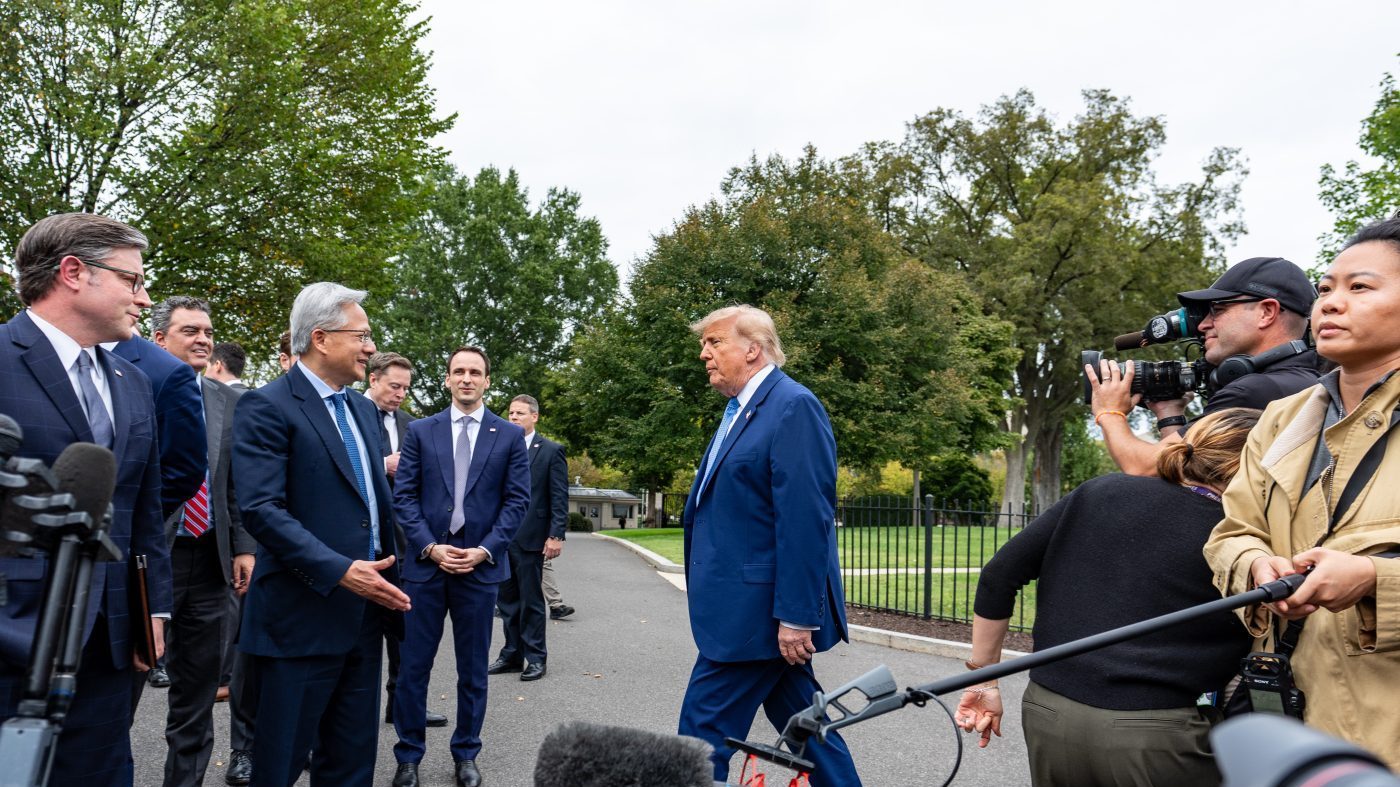
Trump has rejected calls for a national AI safety framework, preferring to rely on voluntary industry self-regulation. He has labeled warnings about AI's existential risks as a "hoax," a stance Huang echoed, calling such predictions "made up" and "not grounded in science." At a recent press event, Huang argued that AI development and safety go hand in hand, rejecting the notion that slowing down would improve safety. "Innovation and trust are not in conflict," he said.
Huang maintains that existing laws, such as those governing cybersecurity, are sufficient, and he has opposed new AI-specific legislation. This position aligns with the Trump administration's broader push to maintain U.S. dominance in the global AI race, particularly against China.
Cornell University's Sarah Kreps, director of the Tech Policy Institute, suggested that Huang's stance may not be purely self-serving. "It could be that Trump has found someone whose perspective is genuinely close to his own," she said. "Huang's company is vital to both economic and national security, making him a natural ally."
Witt, however, sees a more transactional element. "Trump wants to be close to Jensen because he's the biggest winner in capitalism right now," he said. "And Jensen wants to be close to Trump because it could boost Nvidia's stock price."
The alliance was on display at the All-In Summit, where Huang took a call from Trump on stage. Trump assured the audience, "The robots are not going to be taking over the world," to which Huang responded, "We're going to make sure that everybody wins in the AI race in America."
Nvidia's political footprint has also expanded under Trump. The company launched a corporate PAC in late March, funded by employees, and Huang has been a frequent visitor to the White House and Capitol Hill. Meanwhile, Nvidia is investing billions in data center projects, some of which, Witt notes, are "funded by debt, sometimes subprime debt." He added, "Jensen's incentives are very much not to give in. They can't afford to slow down."
As the AI backlash intensifies ahead of the midterms, Trump and Huang's alliance is likely to face further tests. The administration has also launched an AI-powered government portal and inked a voluntary safety accord with tech CEOs, but critics argue these measures fall short of real oversight.