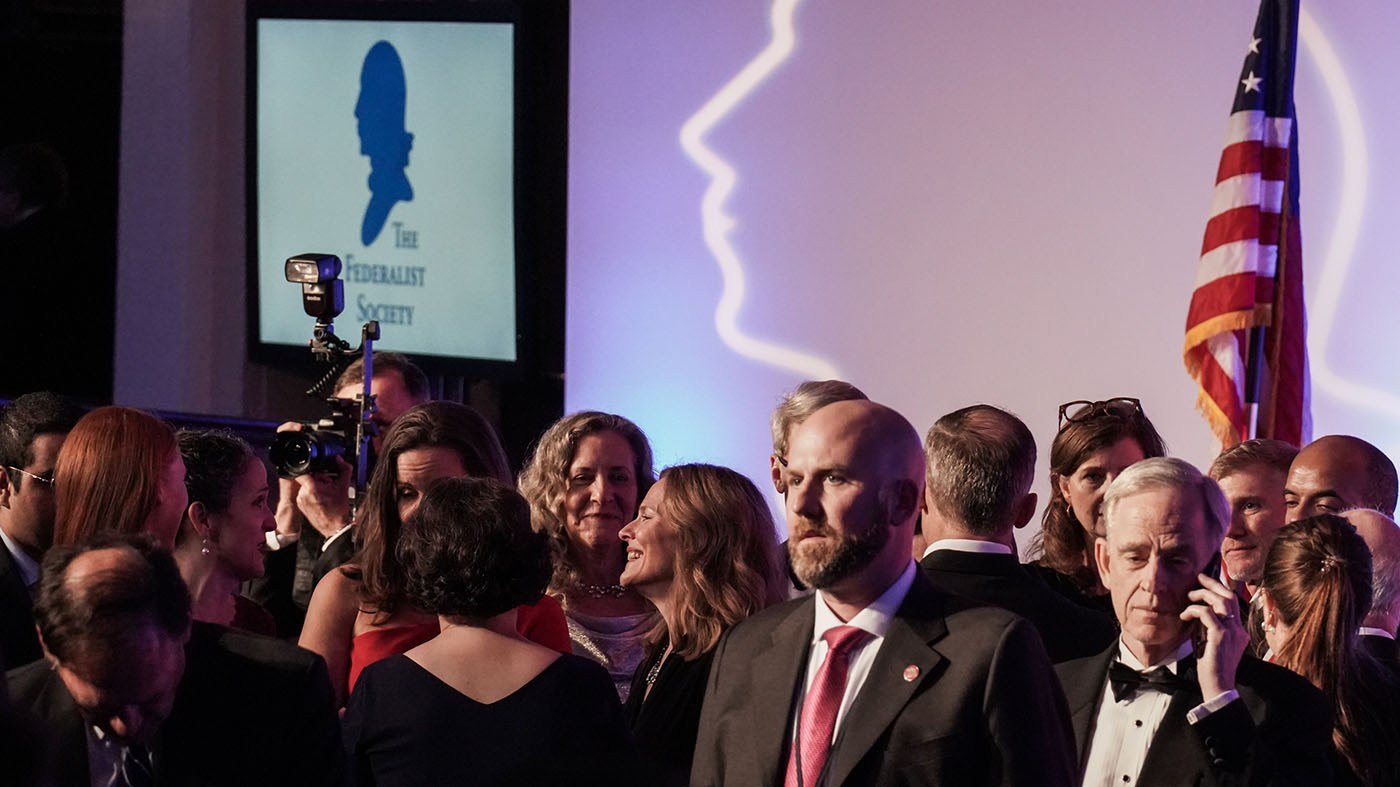
WASHINGTON — Two years ago, the Federalist Society's convention stage erupted in celebration as panelists toasted a string of Supreme Court victories. This year's gathering of the conservative legal movement retained a festive air, but it was tinged with disbelief over Democrats' sweeping midterm wins.
Secretary of State Marco Rubio, addressing attendees Friday evening, quipped about the political climate: "On election night, there was a congressman who said we all need to lawyer up. So, here we are."
The Federalist Society, founded by law students in the 1980s to counter liberal campus orthodoxy, has grown into a cornerstone of conservative legal power. Its network has funneled lawyers into top firms, administration posts, and—most notably—the federal judiciary, culminating in the Supreme Court's 6-3 conservative supermajority. Leonard Leo, the group's longtime leader, built a donor network and crafted the lists from which President Trump selected his first-term high court nominees: Justices Neil Gorsuch, Brett Kavanaugh, and Amy Coney Barrett.
Now in his second term, Trump has publicly feuded with the Federalist Society after some of his judicial picks struck down key administration actions. Last year, the president called Leo a "sleazebag," raising questions about the future of his judicial selection process. With Democrats retaking the Senate, and some analysts predicting they could hold it for years, the path for Trump to extend his conservative judicial legacy looks murkier. Republican senators are racing to confirm remaining vacancies before the chamber flips in January.
The shock of Democratic wins in traditionally red states like Mississippi and Kansas was palpable among lawyers arriving in Washington for the convention. One attorney at a prominent conservative legal group, after learning his lunch companion was from Texas, asked: "Did you think it would be this bad?"
Texas delivered a painful blow: Democrats flipped the open Senate seat, the governorship, and claimed multiple seats on the state supreme court and attorney general's office. Mariah Cermone, president emerita of the Federalist Society's Texas student chapter, introduced a Republican justice with wry humor: "Even though Texans have taken to troubleshooting their grievances by holding their breath till they happen to turn blue, I must say that I still choose Texas every day of the week and twice on Sunday."
Conservative law professor John Yoo, moving from Berkeley to the University of Texas, joked, "I can't even find a red state to move to." He called the midterm results "stunning." On a panel, Yoo attributed the losses partly to administration overreach: "I think the American people supported President Trump's effort to restore order at the border, but gosh, I think that the challenge to birthright citizenship was a serious mistake. Overaggressive enforcement of immigration laws that resulted in the killing of two American citizens was a serious mistake."
Despite the setbacks, the convention celebrated America's 250th birthday and the conservative movement's judicial wins. Rubio, a leading 2028 Republican contender, urged resilience: "Great things that last are built in decades, not election cycles." His remarks have already fueled speculation about his presidential ambitions.
Will Schwieterman, a University of Chicago law student, dismissed the election as a historical blip: "This is not the end of our country that we had, you know, one bad midterm performance. It's only the end if we stop fighting for what we believe in, stop standing for the Constitution, and you know, just kind of accept things as how they are."
The optimistic mood extended to a session moderated by Alliance for Consumers Executive Director O.H. Skinner, who handed out commemorative coins to "lift your spirits about the future of the law in our nation." The coins celebrated last term's "generational wins": expanding presidential firing power, narrowing the Voting Rights Act, allowing states to enforce transgender athlete bans, and invalidating Hawaii's gun restrictions. Skinner wrote that the term showed the Court's "continued commitment to building and expanding off past generational wins."
Trump's Supreme Court appointees each appeared in a video segment, offering a reminder of the movement's enduring influence even as political tides shift. Meanwhile, the broader political landscape remains volatile—Democrats have also pushed Medicare expansion and voter ID measures swept even as they won big. The White House has vowed legal war over Democratic probes, signaling a contentious new era.