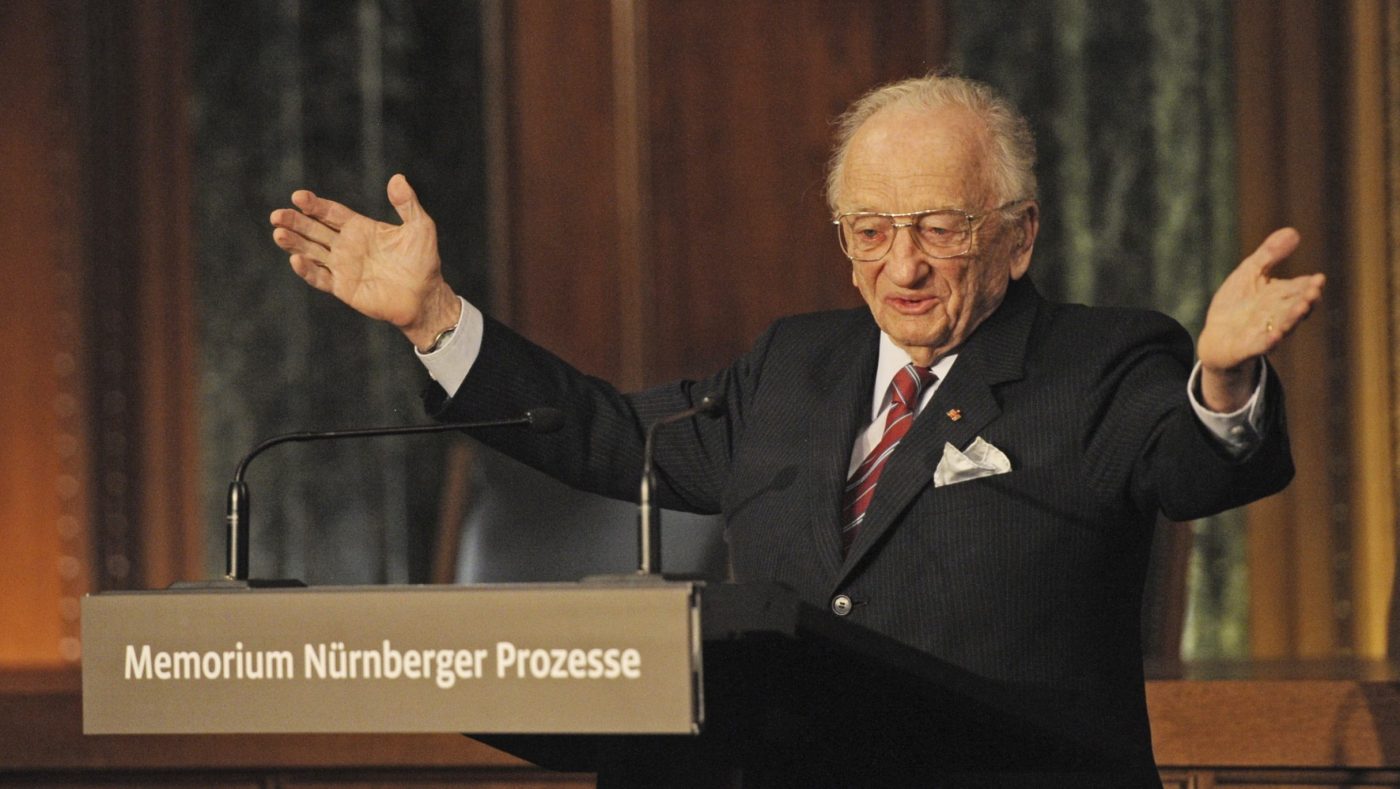
House Speaker Mike Johnson presented the Congressional Gold Medal posthumously to Ben Ferencz, the youngest prosecutor at the historic Nuremberg trials, during a ceremony at the U.S. Capitol on Tuesday. The event coincided with Holocaust Remembrance Day, with Johnson honoring Ferencz's "life of servant leadership and his courage in the face of evil." The Speaker's presentation to Ferencz's family and friends marked a rare moment of bipartisan recognition for a figure whose work helped define international justice.
"Ben spent his life answering the hardest questions and facing the most difficult truths," Johnson said during the ceremony. "And today, let us hope Ben's example can inspire all of us to do the same." The award is Congress's highest civilian honor, reflecting Ferencz's lifelong dedication to pursuing accountability for war crimes and genocide.
From Immigrant to Army Investigator
Born in Transylvania in 1920, Ferencz immigrated to New York as an infant. After graduating from Harvard Law School, he enlisted in the U.S. Army and participated in the Normandy invasion. As the war neared its end, he was assigned to the Army's War Crimes Branch, where he began gathering evidence of atrocities at newly liberated concentration camps. A biography from the U.S. Holocaust Memorial Museum details how his investigations provided crucial documentation of the Holocaust's scale.
"By the time Ben had finished, he had personally uncovered evidence of more than 1 million deaths," Johnson told the audience. In personal writings, Ferencz described being "indelibly traumatized" by what he witnessed at camps like Ohrdruf and Buchenwald, detailing scenes of mass death and profound human suffering.
The Path to Nuremberg
Honorably discharged in late 1945, Ferencz was quickly recruited for the Nuremberg tribunals. He led a team of 50 researchers sifting through official Nazi records, which implicated German professionals—including doctors, lawyers, and generals—in the systematic genocide. Johnson highlighted a pivotal moment when Ferencz, as the trials were concluding, persistently argued for "just one more case."
His advocacy led to the 1947 Einsatzgruppen trial, where Ferencz, at age 27, delivered the opening statement in what Johnson called "the largest murder trial in human history." All 22 Nazi commanders tried were found guilty, cementing Ferencz's legacy as a foundational figure in international law.
A Lifelong Advocate for International Justice
In his later decades, Ferencz became a leading champion for the establishment of a permanent international court to prosecute war crimes, a vision realized with the creation of the International Criminal Court in The Hague. He remained a vocal advocate for the rule of law until his death at age 103 in Boynton Beach, Florida, in April 2023.
Rep. Lois Frankel, a Florida Democrat who represented Ferencz, praised him during the ceremony as a "beacon of hope in humanity's darkest hours." She stated, "He lived one of the most extraordinary lives of our time, defined by courage and justice and unshakable belief in humanity." The ceremony served as a solemn counterpoint to contemporary political divisions, occurring as bipartisan leaders have recently convened for Holocaust remembrance against a backdrop of rising antisemitism.
The posthumous award underscores the enduring relevance of Ferencz's work, particularly as global conflicts continue to raise complex questions of accountability. His legacy intersects with ongoing congressional debates over international affairs and justice, including differing assessments of international conflicts and the mechanisms for holding perpetrators accountable. The recognition by Speaker Johnson, a conservative Republican, of a lifelong advocate for international institutions highlights the cross-ideological respect for Ferencz's historical role in confronting absolute evil.