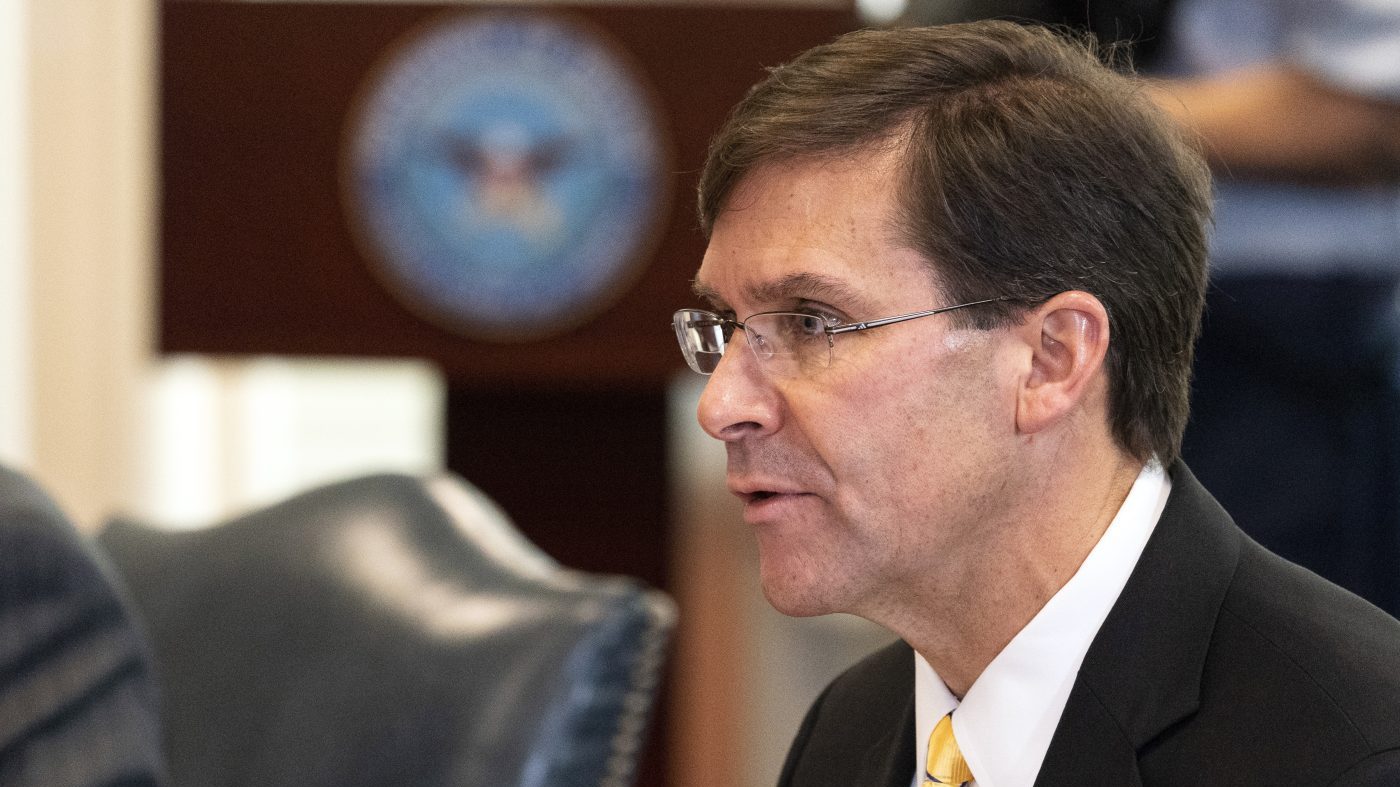
Former Defense Secretary Mark Esper said Friday that a proposed memorandum of understanding between the United States and Iran would relieve pressure on both sides over energy prices and the Strait of Hormuz, but he flagged concerns about Iranian demands that could undermine the deal.
Speaking on NewsNation, Esper described the MOU as a preliminary step toward broader negotiations, not a final settlement. “At the end of the day, all this really does is take us into a negotiating round while lifting the pressure on both sides when it comes to energy and other items moving through the Strait of Hormuz,” he said.
The tentative agreement, which has reportedly been reached after weeks of back-channel talks, would extend a fragile ceasefire by 60 days, reopen the Strait of Hormuz, and create a framework for discussions on Iran’s nuclear program. Negotiators are still finalizing terms, and President Trump said Friday he was meeting in the Situation Room “to make a final determination sign-off.”
Trump posted on Truth Social that Iran must agree never to pursue nuclear weapons, immediately open the Strait of Hormuz without tolls, and remove all remaining mines from the waterway. He also demanded that Iran’s enriched uranium “be unearthed by the United States” and destroyed, adding that “no money will be exchanged, until further notice.”
Iranian state media reported the deal is not yet finalized, and the regime has insisted that any meaningful negotiations require access to $12 billion of its own money currently frozen in foreign banks. Esper, who served as Pentagon chief during Trump’s first term, said “there are some issues” with the MOU, particularly Iranian efforts to insert language demanding U.S. forces leave the region, reclaim frozen funds, and manage the Strait of Hormuz. “In my view, all those things should not be included in this memorandum of understanding,” he said.
Esper noted that Iran is under intense economic strain, unable to sell oil on the open market and losing an estimated $430 million to $450 million per day. But the United States and global economy are also suffering from high energy prices due to the closure of the Strait of Hormuz, a vital chokepoint through which one-fifth of the world’s crude oil and natural gas normally flows. The resulting price spikes have hurt the Trump administration and frustrated Republicans ahead of the November midterm elections.
The deal's fate remains uncertain, with both sides signaling unresolved sticking points. The administration has also warned Oman against imposing tolls on the strait, and the Treasury Department recently sanctioned Iran’s new Strait of Hormuz Authority as an extortion scheme.
For more on the broader energy and economic impact, see our report on how savings rates have plunged as energy costs outpace wages. Additionally, the administration’s strategy for securing alternative energy routes is detailed in Trump’s push for Central Asia energy access.