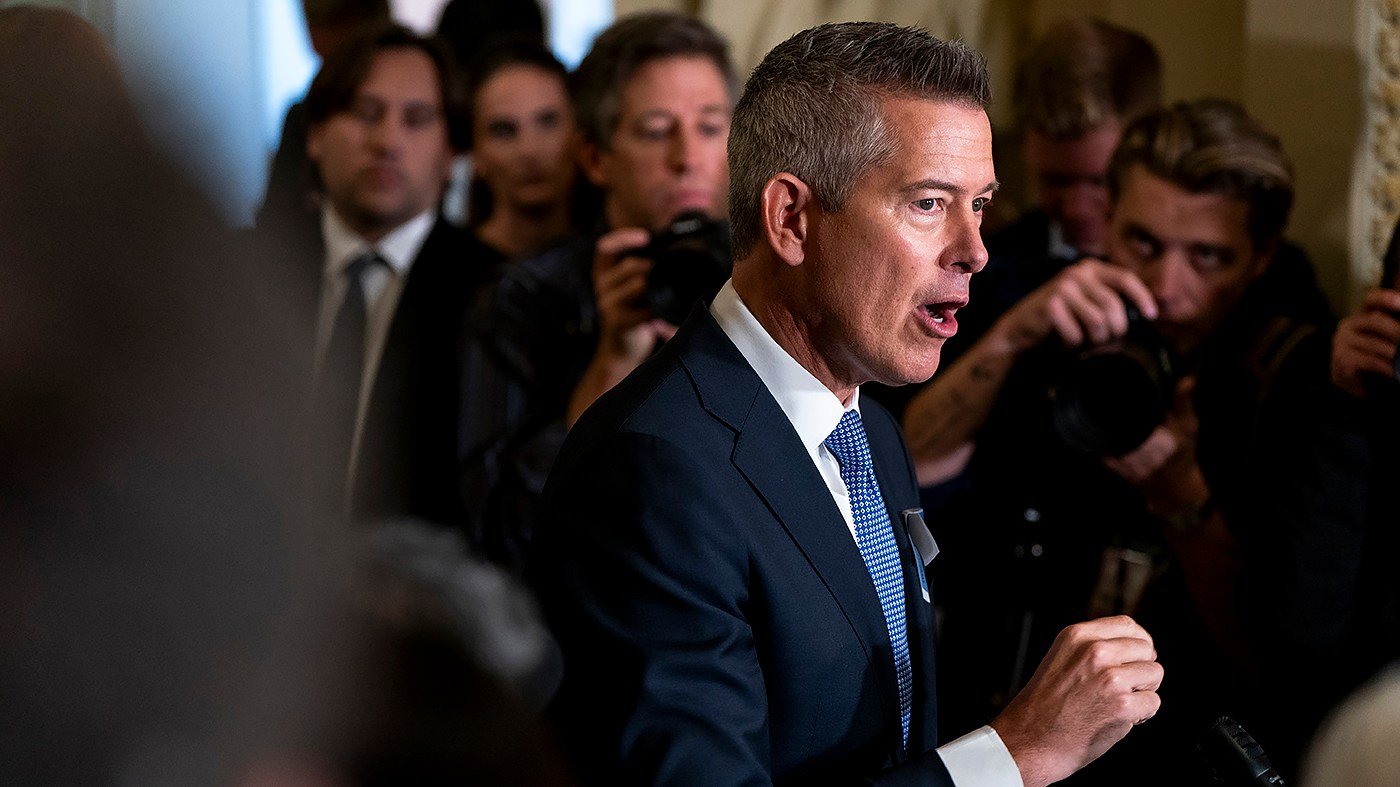
Transportation Secretary Sean Duffy indicated Tuesday that he would accept whatever funding Congress approves for his $50 billion request to modernize the Federal Aviation Administration's aging infrastructure, including replacing copper wiring systems. Speaking at a press conference on Capitol Hill, Duffy said he is already operating with a piecemeal approach and would “take what I can get” from lawmakers.
“The twelve and a half billion was piecemeal, right? And so, yeah, I’ll take what I can get, and I will work with the Congress to make sure that we do the highest priorities first,” Duffy said. “And I would hope that they don’t do that to me, but I’ll take what I can get, and I’m going to build with whatever they give me.”
The request comes in the wake of a nationwide ground stop issued Friday that halted flights for several hours, leading to thousands of delays and cancellations. FAA officials have said a preliminary investigation points to a router in Arkansas and a radar facility in Texas that caused a data flood, forcing operators to shut down the system. Duffy told reporters that the FAA and FBI have not yet determined the root cause, and he has been coordinating with FBI Director Kash Patel on the matter.
“If someone did something wrong, they should be held accountable. But Brian and I do not apologize for shutting down the airspace,” Duffy said, referring to acting FAA Administrator Brian Holmes. “I promise all of you that when I know what happened with that router injecting that overload into our system, I will most definitely share that with you. If we were subject to a hack, we will share that with you as well, but all of my intelligence partners are telling me that wasn’t the case.”
The transportation secretary has been pressing lawmakers for the additional funding since the outage, but Democrats on Capitol Hill are pushing back. Rep. Rosa DeLauro (Conn.), the top Democrat on the House Appropriations Committee, criticized the request on social media, saying Duffy demanded a “$50B ransom with no plan” after $14 billion in FAA funds remained largely unspent. The One Big Beautiful Bill Act, signed in July 2025, allocated $12.5 billion for FAA infrastructure improvements, including modernizing air traffic control towers and boosting controller recruitment.
Duffy’s willingness to accept partial funding reflects the political reality that Congress is unlikely to approve the full $50 billion in one stroke. His comments also echo earlier statements in which he blamed Congress and previous administrations for the FAA’s outdated systems. The secretary has faced scrutiny over his handling of the outage, with some critics pointing to his rejection of a free Starlink offer from Elon Musk as evidence of mismanagement, though Duffy has defended his decisions.
The FAA’s reliance on copper wiring has been a point of concern for years, and Duffy has argued that a comprehensive upgrade is essential to prevent future disruptions. However, Democrats argue that the agency must first demonstrate how it will use the funds effectively. The debate is likely to intensify as Congress considers the FAA reauthorization and appropriations bills in the coming months.
Duffy’s demand for $50 billion comes as the administration faces broader questions about infrastructure spending and oversight. The secretary has also been defending the FAA’s ground stop decision amid a separate scandal involving Nvidia that has shadowed the Trump administration’s Asia trip.
For now, Duffy says he will work with whatever resources Congress provides, prioritizing the most critical upgrades first. “I’m going to build with whatever they give me,” he reiterated. The coming weeks will test whether bipartisan support can be mustered for the FAA’s modernization, or whether the agency will continue to patch together its aging systems.