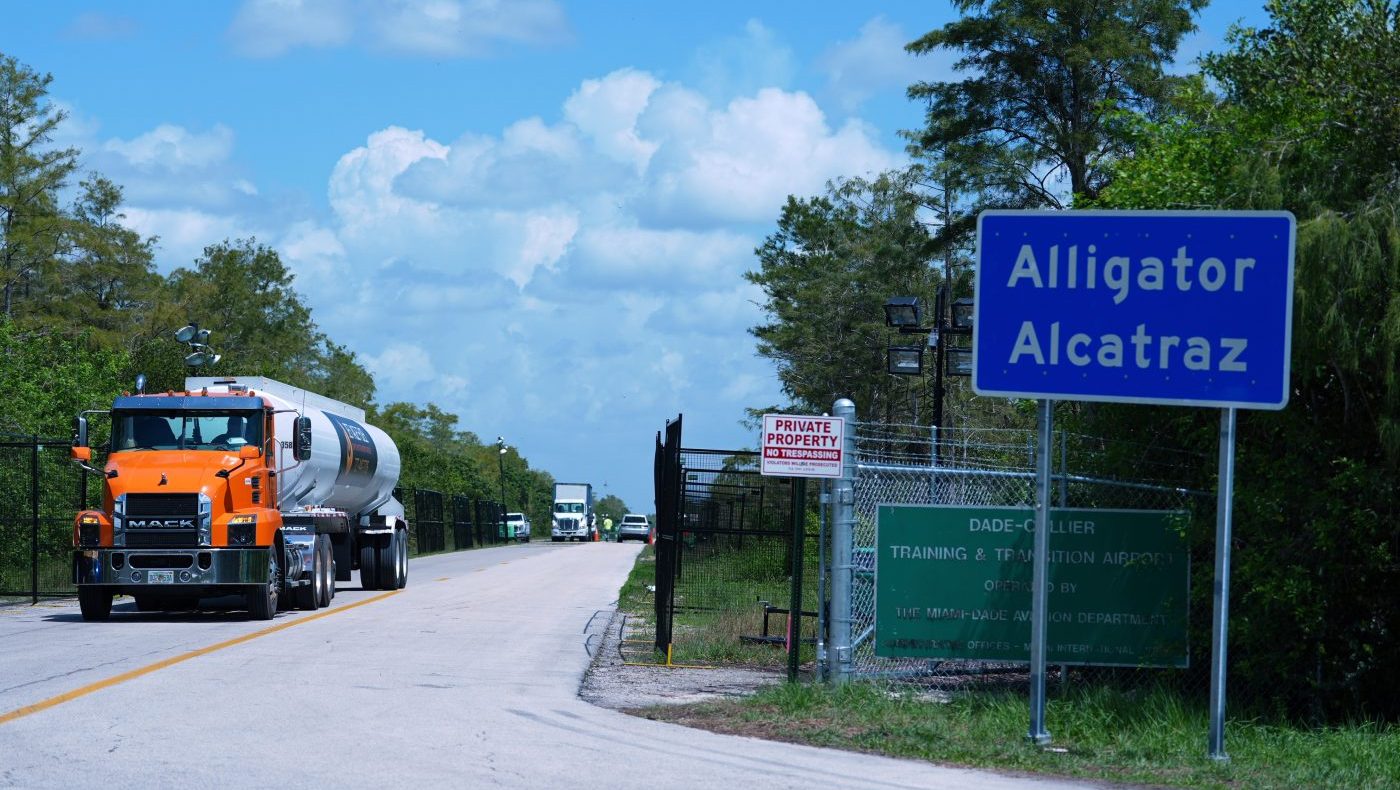
Court Rules Federal Environmental Law Doesn't Apply to Florida Detention Center
A federal appeals court has reversed a lower court order that would have forced officials to dismantle a controversial immigration detention facility in the Florida Everglades, siding with the Trump administration's position that federal environmental review requirements were not triggered. The U.S. Court of Appeals for the 11th Circuit, in a 2-1 decision, found insufficient federal control over the construction of the facility, colloquially known as "Alligator Alcatraz," to mandate review under the National Environmental Policy Act (NEPA).
Split Decision Halts Environmental Challenge
The ruling represents a significant victory for immigration enforcement officials and a setback for environmental groups and the Miccosukee Tribe, who had sued to stop operations at the Dade-Collier Training and Transition Airport site. The plaintiffs argued that the project constituted a "major federal action" under NEPA, requiring thorough environmental assessment before construction could proceed. The Trump administration countered that Florida built the facility with minimal federal involvement, a position the appeals court majority accepted.

"Federal officials made no construction decision capable of triggering the Act," wrote Judge William Pryor in the majority opinion. The court further held that even if environmental reviews were required, parts of the lower court's remedy would conflict with laws limiting judicial intervention in immigration enforcement matters. "Ongoing control of operations—and the provision of technical support for those operations—is irrelevant to whether the construction of the facility required an environmental review," Pryor added.
Ideological Divide on the Bench
The panel's decision split along predictable ideological lines. Judge Pryor, appointed by President George W. Bush, was joined by Trump appointee Judge Andrew Brasher. In dissent, Biden appointee Judge Nancy Abudu argued the federal government cannot evade its legal responsibilities simply because a state assists in carrying out federal functions. "It cannot, and should not, be the case that the federal government, which all parties agree has exclusive control over the detention of migrants, can abdicate its responsibility to exercise that control in a way that is consistent with federal law," Abudu wrote.
The facility, constructed last year to assist with immigration enforcement, began receiving migrants in July. The Trump administration has promoted it as a model for potential replication elsewhere. In August, a federal district judge had blocked new detainee transfers to the site and ordered the removal of fencing, lighting, generators, and other infrastructure within 60 days. The 11th Circuit had previously stayed that ruling while considering the appeal, allowing the facility to remain operational.
Legal and Political Implications
This case highlights ongoing tensions between federal immigration policy, environmental protection statutes, and state cooperation. The ruling narrows the application of NEPA in contexts where federal agencies leverage state-built infrastructure, potentially setting a precedent for similar projects. It arrives amid a broader judicial landscape where courts are frequently asked to delineate the boundaries of federal authority, as seen in other significant rulings like the recent Supreme Court case from Colorado that may reshape religious liberty protections.
The plaintiffs, including Friends of the Everglades and the Center for Biological Diversity, now face the decision of whether to seek an en banc review by the full 11th Circuit or to petition the U.S. Supreme Court. "This fight isn't over," said Eve Samples, executive director of Friends of the Everglades. The legal strategy may consider how this issue intersects with other administrative law challenges, such as those reflected in the appeals court decision that permitted a Trump property construction project to proceed.
The decision also underscores the enduring influence of judicial appointments on policy outcomes. With this ruling, the facility continues to operate as a component of federal immigration enforcement, a policy area where the executive branch often tests the limits of its authority. The dissent's concern about federal abdication of responsibility echoes debates in other domains, including the accelerated dismantling of certain Education Department functions.
As the legal battle continues, the operation of "Alligator Alcatraz" remains a flashpoint in the intersection of immigration policy, environmental law, and states' roles in federal enforcement schemes. The ruling effectively insulates the project from one avenue of legal challenge while leaving open the possibility of further review by higher courts.