European Commission President Ursula von der Leyen on Wednesday signaled a willingness to bring Canada into the European Union's orbit as an associate member, a move that would mark a historic deepening of transatlantic ties while Ottawa is locked in a trade dispute with Washington.
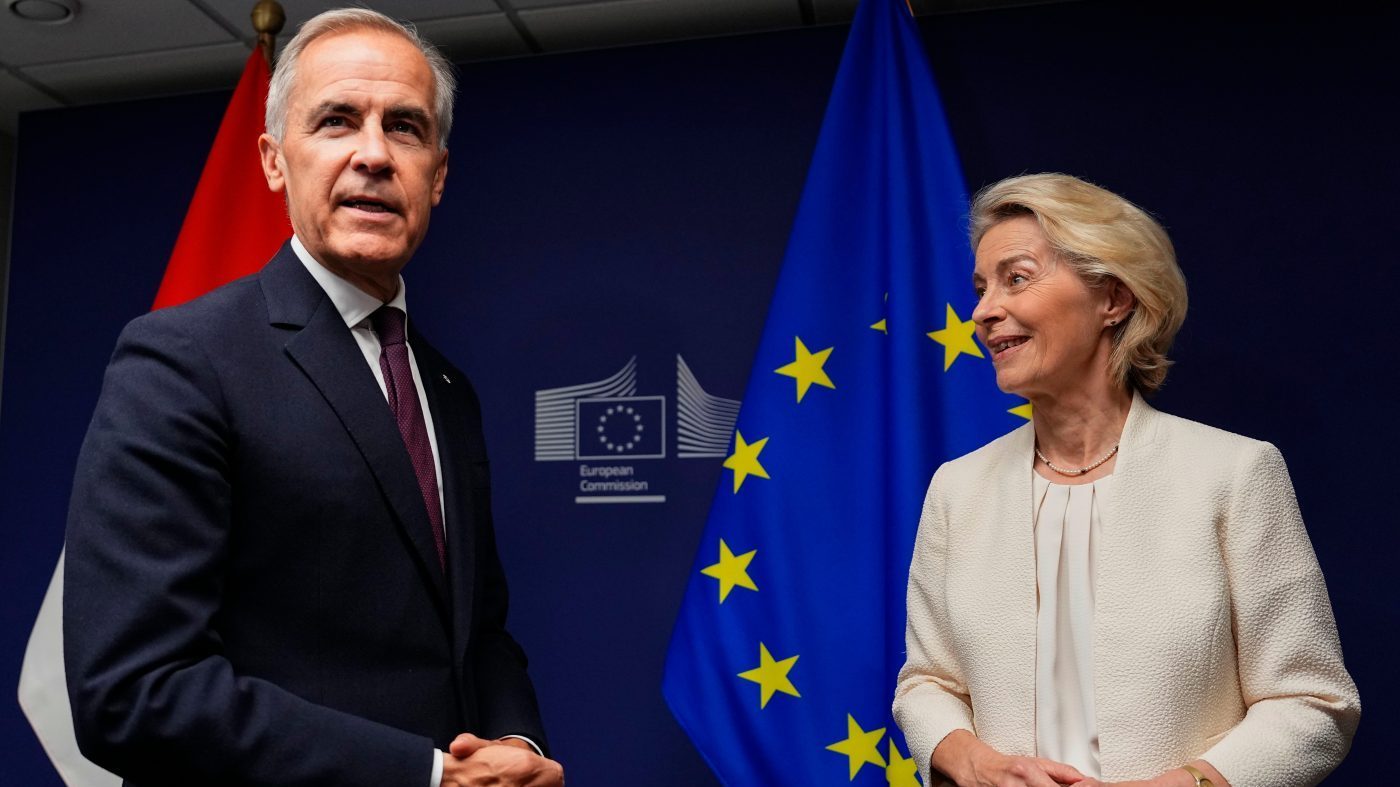
Speaking at her annual State of the Union address in Strasbourg, von der Leyen told Canadian Prime Minister Mark Carney, who was in the audience, that she wanted to "open the door" for Canada to become the EU's first associate member. The proposal drew applause from lawmakers and officials in attendance.

Carney is scheduled to address the European Parliament on Thursday, and his presence at the EU's flagship political event underscores the growing alignment between Brussels and Ottawa on issues ranging from artificial intelligence and climate policy to support for Ukraine, according to Reuters.
After meeting with von der Leyen and European Parliament President Roberta Metsola, Carney described Canada and the EU as "natural partners." His office said the three leaders discussed deepening cooperation in critical minerals, energy, defense, research and development, and advanced technologies.
"In a more dangerous and divided world, Canada is forging stronger relationships with trusted partners to build greater strategic autonomy, resilience, and sovereignty," Carney's office said in a statement. "As a close, trusted partner with shared values, the Prime Minister underscored the EU's central role in these efforts."
The announcement comes as the U.S.-Canada trade war intensifies, with Ottawa matching Washington's 50 percent tariffs on $27.6 billion worth of goods, affecting steel, aluminum, and certain food products. Earlier this month, Carney declared that the era of Canadian reliance on the U.S. was "over," signaling a pivot toward new trade partners.
"Our plan, since I came into office, has been development and diversification," Carney said in a video posted on YouTube. "Not denial, waiting to go back to some good old days, and not continued dependence."
The proposal has drawn sharp criticism from Pierre Poilievre, leader of Canada's opposition Conservative Party, who argued that closer EU ties would effectively turn Canada into the bloc's "28th state." Writing on X, Poilievre questioned whether EU policies on immigration and small businesses would apply to Canada, and noted that Canada already enjoys tariff-free trade with Europe.
"This is not about diversifying trade: we have had tariff-free trade with Europe for over a decade now," he wrote.
The EU's associate membership concept is still undefined, but it would likely grant Canada deeper integration in certain policy areas without full voting rights. The proposal reflects a broader realignment as traditional alliances shift, and it could have significant implications for U.S. political dynamics as well.