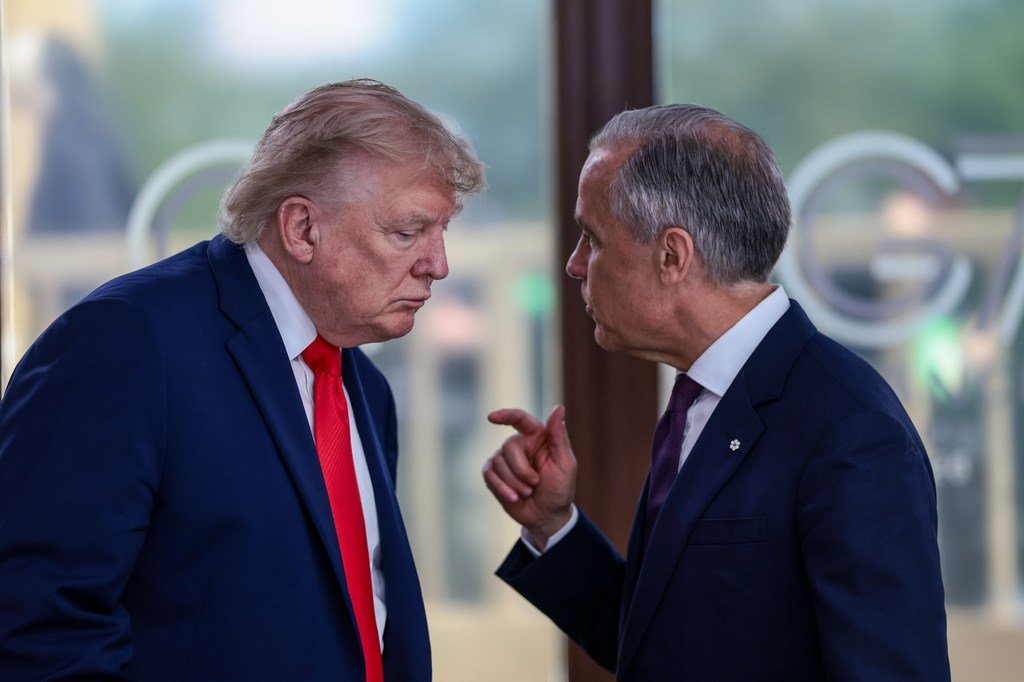
President Trump's decision to slap tariffs on Canadian imports—and Ottawa's swift retaliation—has created a political headache for Republicans in several states they cannot afford to lose. With the November midterms just weeks away, the trade dispute is fueling voter anger in areas where GOP candidates are already fighting for their political lives.
The White House has framed the tariffs as a necessary correction to a trade imbalance. But the numbers tell a more complicated story. In 2025, the United States imported $454 billion from Canada while exporting $426 billion—a $27 billion deficit that Trump has seized upon. However, critics note that America's population is nearly nine times larger than Canada's, so higher import volumes are hardly surprising.

Canada remains the United States' second-largest trading partner, and the cross-border commerce supports jobs and sales in dozens of states. A new analysis by Visual Capitalist identifies 23 states that rely on Canada for the majority of their imports. Among those with high-stakes elections are Maine (68.7 percent of imports from Canada), Alaska (40.7 percent), Minnesota (33.5 percent), Iowa (26.6 percent), and Ohio (18.7 percent).
The pain is not one-sided. American exporters—from farms to manufacturers—are also feeling the pinch as Canada imposes retaliatory tariffs on U.S. goods. Ohio sends $2.3 billion in exports to Canada annually, Pennsylvania $1.8 billion, and Wisconsin $1.4 billion. Even smaller states like Maine, which exports $453 million, depend heavily on Canadian buyers.
These trade flows are colliding with a series of closely watched Senate races. In Maine, Republican Senator Susan Collins has consistently trailed her Democratic challenger in recent polls. She has publicly criticized Trump's tariff policies, a stance that may help her survive in a state where voters are feeling the economic sting. But her fate remains uncertain.
In Iowa, the open Senate seat vacated by Republican Joni Ernst has become a toss-up. Democrat Josh Turek has pulled ahead of Republican Representative Ashley Hinson in recent surveys, coinciding with the collapse of trade talks. The governor's race there also shows a Democratic lead. In Ohio, appointed Republican Senator Jon Husted is running five points behind former Democratic Senator Sherrod Brown. And in Michigan—where Canada is a vital economic partner—progressive Democrat Abdul El-Sayed holds a three-point edge over Republican Mike Rogers.
GOP candidates are now caught in a bind. Defending Trump's tariffs risks alienating voters worried about rising costs. Criticizing them risks drawing the president's wrath. As NPR's Mara Liasson noted, focus groups of swing voters who backed Trump in 2024 consistently cite affordability and the cost of living as their top concern—issues that tariffs directly worsen.
The timing is particularly puzzling. Trump could have postponed the trade fight until after the midterms. Instead, he chose to escalate just weeks before voters head to the polls. That has some wondering whether the administration is inadvertently—or deliberately—sabotaging Republican prospects. As the Supreme Court blocked Trump's mail-in voting overhaul, the political landscape grows more treacherous for the GOP.
Even in states where Republicans have traditionally dominated, the tariff fallout is eroding support. Georgia, which exports $908 million to Canada, is now a battleground. North Carolina ($601 million) and Minnesota ($594 million) are also feeling the pressure. With control of the Senate hanging in the balance, the trade war may prove to be the decisive factor in November.
For now, Republican candidates are left to navigate a politically toxic issue. Some, like Collins, have distanced themselves from the president. Others are hoping voters will focus on other issues. But as the economic pain spreads, the GOP senators push back on Trump's $5,000 dividend plan, suggesting even loyalists are uneasy. The conspiracy theorists may be onto something.