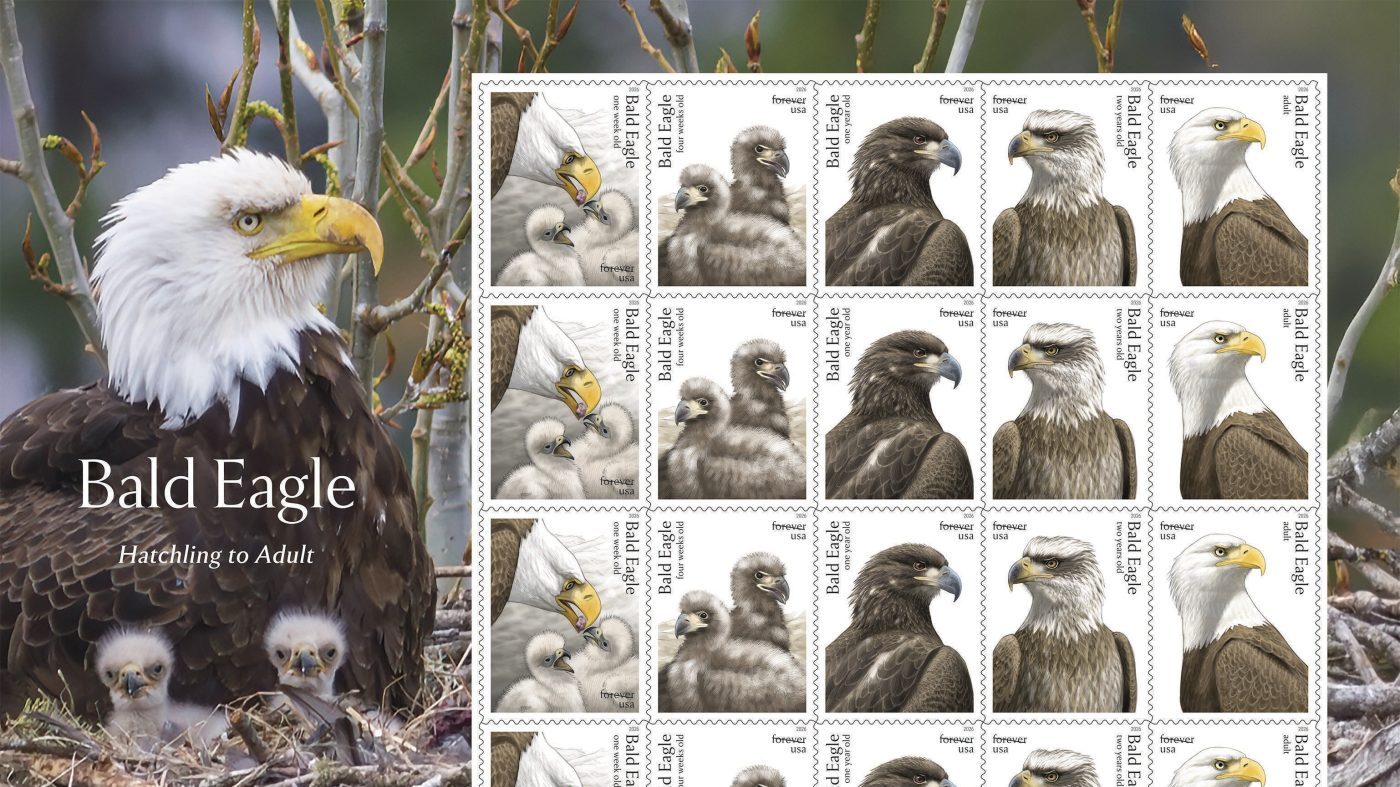
The U.S. Postal Service is marking America’s 250th birthday with a new stamp series that puts the bald eagle front and center. Unveiled Thursday at the National Eagle Center in Wabasha, Minnesota, the collection traces the bird through five key life stages—from a downy hatchling to the mature white-headed adult that appears on the Great Seal.
“The fact that we’re seeing the eagles in all different stages of its life, it’s sort of making us look back at the stages of the life of our country,” said Steve Kochersperger, a Postal Service historian. “At one time, we were just fuzzy little hatchlings, too.”

The bald eagle has been a national emblem since Congress adopted the Great Seal in 1782, but it wasn’t formally designated the national bird until 2024. Kochersperger noted that the eagle has long symbolized American values like strength, freedom, and independence, dominating the sky with its wingspan and sharp talons.
Contrary to a persistent myth, Benjamin Franklin did not push for the wild turkey as the national bird over the eagle. Kochersperger dismissed the story as a misconception.
The stamps also underscore a major conservation achievement. In the 1960s, bald eagles had become rare due to DDT poisoning. A 1972 ban on the pesticide and the species’ listing as endangered in 1978 reversed the decline. “The public relations campaign brought greater awareness that, ‘Hey, this is our national symbol, but they may all be gone if we don’t change our ways,’” Kochersperger said. “That turned out to be very effective.”
By 2007, the bald eagle was removed from the endangered list. Today, the U.S. Fish and Wildlife Service estimates more than 300,000 eagles live in the continental United States.
Artist David Sibley, a Massachusetts-based bird watcher, created the digital illustrations over nearly a year. He said the conservation story is part of what makes the eagle a powerful symbol. “Maybe seeing a bald eagle on the stamp as a bird, living its life from nestling to adult, will hopefully make people think about the natural world and how important things like eagles are, not as a symbol but as part of the ecosystem around us,” Sibley explained. The tiny stamp size forced him to focus on the eagle’s head to capture detail.
Postage stamps have long served as cultural touchstones and educational tools. “A stamp does not demand your attention, but it rewards it,” Kochersperger said. “A tremendous amount of planning and effort went into producing that tiny little piece of paper.”
The stamps were available for immediate purchase nationwide, offering collectors and patriots a tangible link to the nation’s history and its natural heritage. For more on national symbols and recent political developments, see coverage of Trump’s selection of West Potomac Park for a garden of American heroes and the U.S.-Indonesia defense pact that strengthens American presence at the Malacca Strait.
As America approaches its 250th anniversary, the bald eagle’s journey from near-extinction to recovery mirrors the nation’s own resilience. The stamps serve as a reminder of that story, one tiny piece of paper at a time.