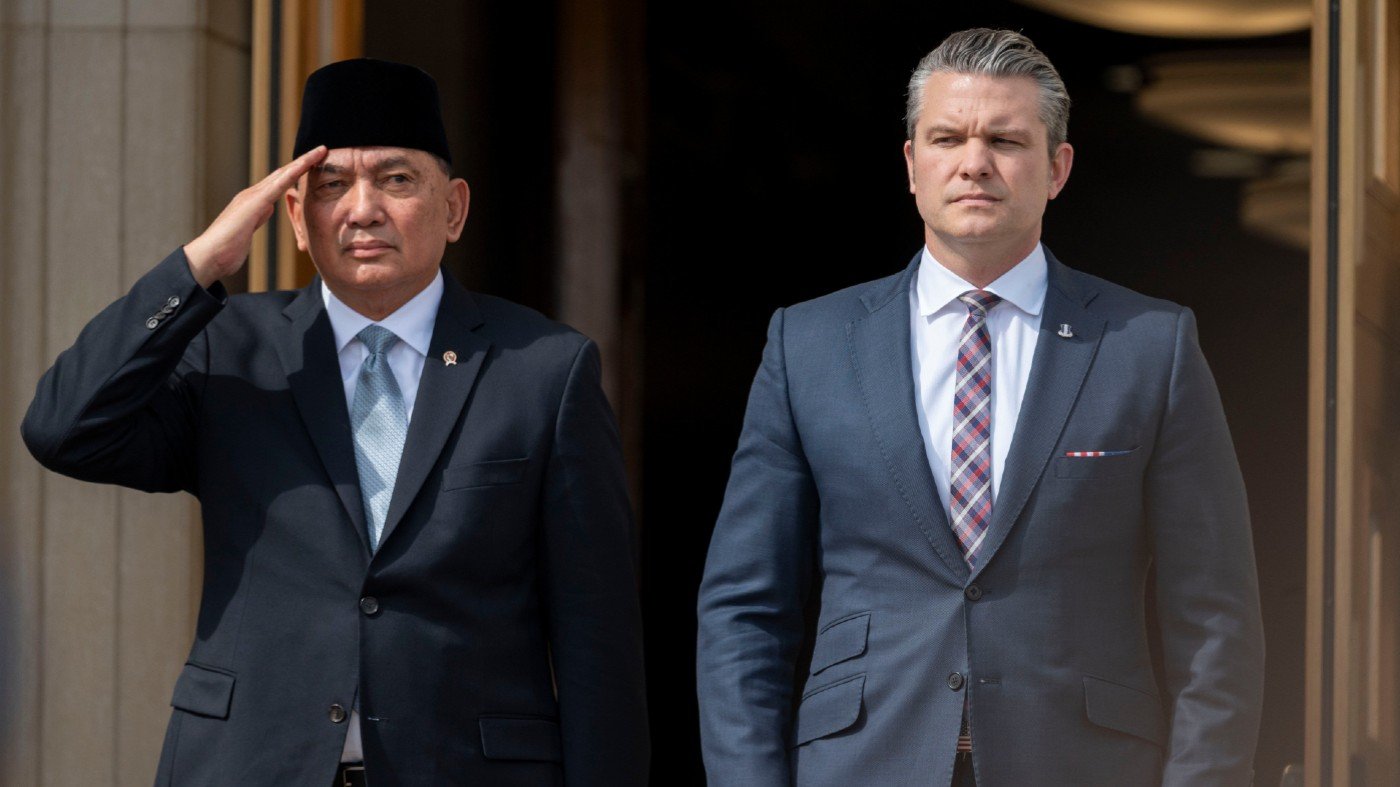
Washington has secured a strategic foothold at the world's most vital maritime chokepoint. On April 13, the United States and Indonesia signed the Major Defense Cooperation Partnership, a pact the Pentagon describes as a framework to deepen bilateral defense ties. The agreement rests on three pillars: capacity building, training, and operational cooperation.
Indonesia, the fourth most populous nation and largest archipelago, is also weighing a letter of intent that would grant the U.S. case-by-case access to its airspace for emergency operations and routine transits. While specifics remain sparse, the real test lies in translating paper commitments into on-the-ground practice. Both nations, however, have a shared incentive to forge a lasting military partnership: China.

“Indonesia needs friends, as indeed we all do,” said James Holmes, J. C. Wylie Chair of Maritime Strategy at the U.S. Naval War College. “Mutual access helps us mount combined pushback against Chinese aggression.”
The Strait of Malacca, flanked by Malaysia to the north and Indonesia’s Sumatra to the south, is the shortest shipping route between East Asia and the Indian Ocean. It carries an estimated 23.2 million barrels of oil daily—roughly 29% of global maritime oil traffic—and saw over 102,500 vessels last year. For China, the strait is a lifeline: nearly two-thirds of its maritime trade, including about 80% of its oil imports, passes through these waters.
Jakarta has historically maintained a non-aligned stance, often leaning toward Beijing. This defense pact marks a notable tilt toward Washington. China has only itself to blame for alienating Indonesia, experts argue. Beijing clung to an unsupportable claim over the Natuna Islands until 2015, despite clear Indonesian sovereignty, and has refused to acknowledge Indonesia’s exclusive economic zone rights under UNCLOS. Instead, China asserts “traditional fishing grounds” within that zone—a claim with no legal basis.
China’s ten-dash line asserts sovereignty over most of the South China Sea, where it employs gray-zone tactics—deploying its “blue hull” fishing militia and “white hull” coast guard vessels to intrude into Indonesia’s EEZ. Jakarta was slow to recognize Beijing’s ambitions. Holmes recalled a 2012 presentation in Paris where an Indonesian diplomat smirked at concerns over Chinese belligerence at Scarborough Shoal. “Look at the map,” Holmes told him. “It was obvious Beijing would sprawl southward even back then. And so it has.”
Indonesia has pursued a three-pronged strategy to counter Chinese expansion. First, it has used ambiguous language in official dealings, such as President Prabowo Subianto’s November 2024 offer to jointly develop the North Natuna Sea. Second, Jakarta has resorted to force, seizing and scuttling intruding fishing vessels, including Chinese ones, over the past decade. Third, it has built military ties with Australia, Japan, India, and France—and now with the United States.
For Washington, the agreement advances a consistent foreign policy goal: defending the global commons. The U.S. now has a perch on a critical chokepoint, while China—which seeks dominion over the seas—emerges as the clear loser. This development echoes other strategic alignments, such as the bipartisan Senate coalition warning against unilateral shifts in Taiwan policy, underscoring the broader geopolitical stakes in the Indo-Pacific.
As the partnership moves from paper to practice, the implications for regional security are profound. The Malacca Strait remains the fulcrum of global trade, and America’s new foothold there signals a determined response to Beijing’s southward creep.