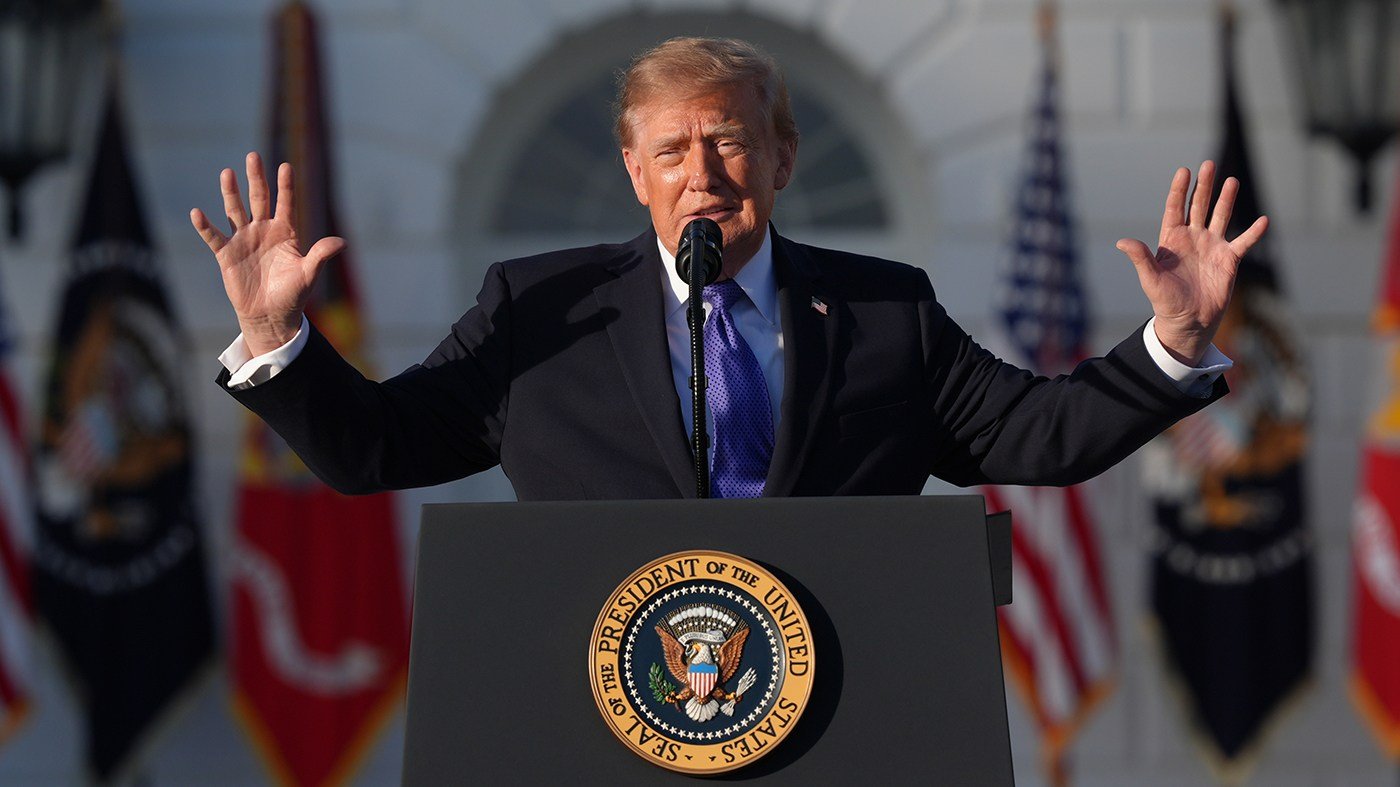
President Trump is signaling a willingness to collaborate with Democrats on healthcare, hinting at a rare avenue for bipartisan compromise as the opposition party prepares to assume control of both chambers of Congress next year. The president's recent overtures, including a social media post amplifying a Democratic senator-elect's proposal, have sparked speculation about a potential deal.
Over the weekend, Trump shared on Truth Social a post from Sen.-elect Abdul El-Sayed (D-Mich.), who had floated a "Medicare for All" plan branded as "TrumpCare." The move came days after Trump told reporters he would be open to compromise with Democrats on several issues, including healthcare, provided it was a genuine give-and-take.
Trump has historically criticized Democratic healthcare initiatives, including the Affordable Care Act, but has also expressed support for universal coverage in the past. In 2015, he told CBS News's "60 Minutes" that "everybody has got to be covered," though his first administration later pushed to dismantle ObamaCare.
Joe Grogan, who served as Trump's domestic policy director during his first term, said it would not be surprising for Trump to engage with El-Sayed despite their political differences. "I don't think Trump is going to not have the conversation with anybody in the Democratic Congress, frankly," Grogan told The Hill, now a senior adviser at Covington & Burling LLP.
Trump reiterated his openness during a White House briefing on Friday, saying, "I am open to great healthcare. Now, can it be what they want? No, but it can be a combination of what we all want. We could end up with great healthcare in our country." He added that there would be "tremendous Republican support" for such a compromise.
This would not be the first time Trump has worked across the aisle on healthcare. During his first term, his administration collaborated with House Democrats on coronavirus-funding packages, despite ongoing clashes over the issue. Republicans also point to Trump's efforts to lower prescription drug prices as a potential area of agreement. Earlier this year, billionaire investor Mark Cuban, a frequent critic, endorsed Trump's drug coupon platform, TrumpRx, and appeared alongside the president at the White House when 600 generic drugs were added to the program.
Alex Jacquez, senior vice president of policy at Groundwork Collaborative and a former Biden administration official, noted that "there's a world in which the president could directly strike a deal here," but cautioned, "let's not fool ourselves. He's also talked a big game on these kinds of deals before." Jacquez added that it is "very difficult to imagine a Republican Senate or House, particularly in the Senate if you need to break a filibuster, desire to move forward with some of the plans that Abdul El-Sayed is rightly putting forward."
El-Sayed's strategy of framing his proposal as "TrumpCare" appears aimed at appealing to a president who has long valued his personal brand. One Republican strategist called the move "brilliant," noting that "you always have to know your audience." El-Sayed, in an interview with NBC News's "Meet the Press," said he would be open to passing a plan called "TrumpCare," adding that he does not "really care what it's called." He also expressed willingness to meet with Trump to discuss the issue.
In a statement to The Hill, El-Sayed said, "If the President is serious about meeting the unmet promise of guaranteed healthcare in this country, I'm ready to work alongside leaders in the Senate like Senators Van Hollen, Sanders, Wyden, and Warren to deliver. President Trump, give me a call. I'm happy to chat." This comes as Sen. Bernie Sanders (I-Vt.) unveiled a "Medicare for All" plan that would lower the Medicare eligibility age to 55 and expand coverage to include dental and vision care, among other provisions.
Vice President Vance's office has already reached out to El-Sayed's team, signaling interest in dialogue. "If you were to make progress, and try to find some common ground, now is exactly the time to do it," the unnamed Republican strategist said, referring to the lame-duck session. "This is the honeymoon period. You got accepted to college, but you haven't started classes yet, and that's always the most fun period. But once classes get underway, these types of ideas and negotiations become exponentially more complicated."
Potential complications include the ongoing Senate leadership race between Democratic Leader Chuck Schumer and Sen. Chris Van Hollen, which could shape the party's negotiating stance. As Trump highlights Schumer's age in leadership fight, the dynamics could influence bipartisan efforts. Meanwhile, Trump's recent actions, such as his DOJ speech targeting Newsom's commutations, show his willingness to engage in contentious issues, but healthcare may offer a rare path to cooperation.