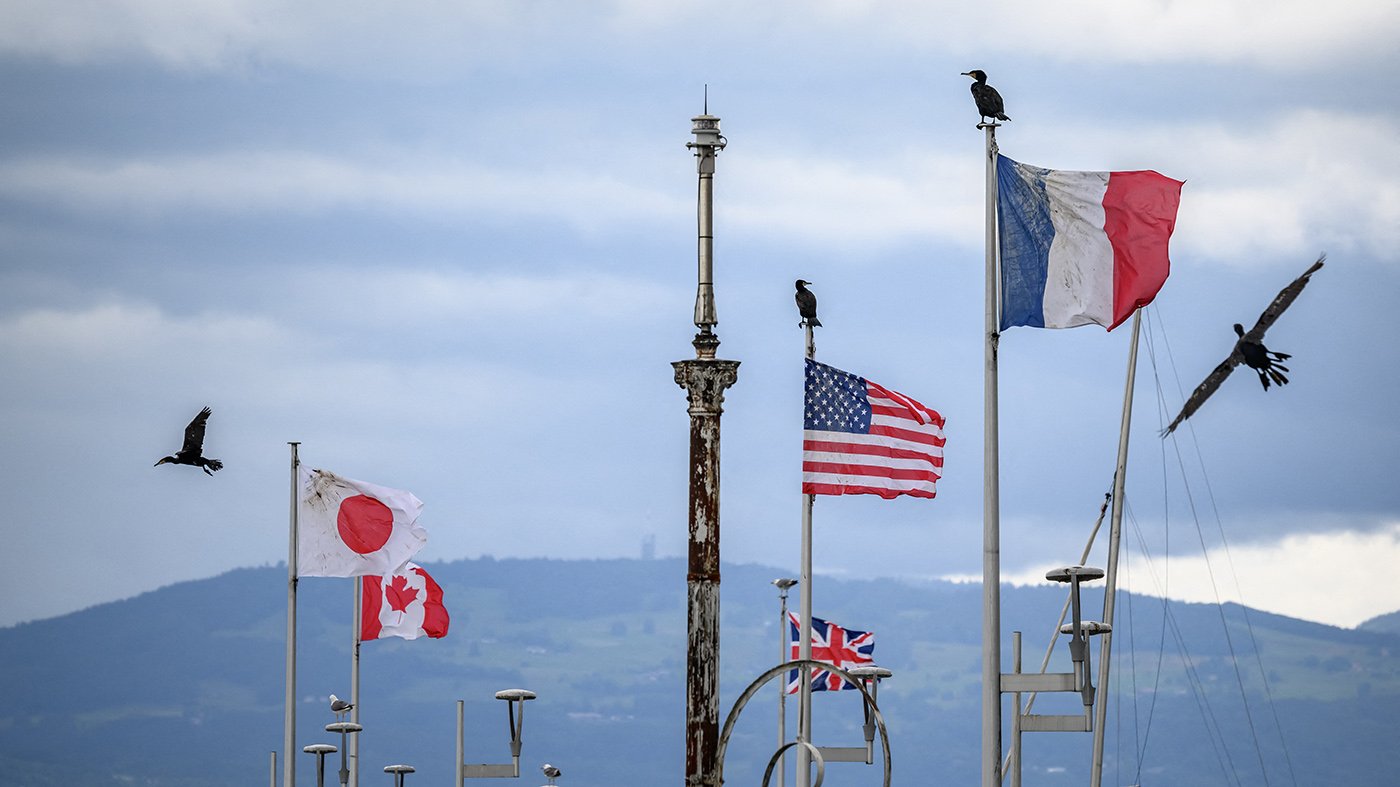
President Trump is set to meet with longstanding U.S. allies next week at the Group of Seven (G7) summit in Évian-les-Bains, France, as tensions simmer over a range of issues including the war in Iran, trade disputes, and defense commitments. The gathering comes just a year after Trump abruptly walked out of the 2024 summit in Alberta, Canada, citing the need to return to Washington to address the Israel-Iran conflict.
Now, Trump finds himself at odds with the Islamic Republic, a flashpoint that has driven a wedge between the U.S. and other G7 nations whose consumers are grappling with higher energy prices due to the conflict. The summit also follows Washington's announcement that it would reduce the number of aircraft and warships available for a European security crisis, adding another layer of friction.

France: A Bromance Gone Cold
Trump and French President Emmanuel Macron once enjoyed what many called a "bromance," with Macron wooing Trump during his first term. Macron hosted Trump for France's 2017 Bastille Day celebrations, and Trump returned the favor with a state visit to the White House in 2018. Macron told Vanity Fair that year that he had "developed trust and respect" for Trump and that they spoke regularly by phone. But the relationship has soured publicly, with both leaders trading barbs on multiple fronts.
Last year, Macron slammed Trump's 20% tariffs on the European Union as "brutal and unfounded." He also urged Trump to abandon his push to acquire Greenland, according to a private text message that Trump later shared publicly. Their approaches to the war in Ukraine also diverge sharply. Macron, alongside British Prime Minister Keir Starmer, has formed a "coalition of the willing" to support Ukraine against Russia, while Trump has taken a more neutral stance, drawing criticism from European leaders who see Moscow as the aggressor.
The U.S. war in Iran is expected to be a major point of contention. Trump has publicly scolded Macron and other allies for not doing more to help reopen the Strait of Hormuz. At a private event in April, Trump remarked that Macron's wife "treats him extremely badly," referencing a video of Brigitte Macron appearing to shove the French president. Macron hit back, calling the comments "neither elegant nor up to the standard." As host of this year's G7, Macron must navigate a diplomatic tightrope, balancing alliance interests while avoiding a repeat of last year's early exit.
United Kingdom: Starmer Under Fire
Like Macron, Starmer has faced Trump's ire over Iran. Starmer has insisted the U.K. will not be drawn into the conflict, but he has co-chaired the International Summit on the Strait of Hormuz alongside Macron, a separate effort from Trump's push to reopen the waterway. Trump has called Starmer and other allies "cowardly" for not assisting the U.S., while Starmer has blamed both the U.S. war in Iran and Russia's war in Ukraine for spiking global energy prices.
"I'm fed up with the fact that families across the country see their bills go up and down on energy because of the actions of Putin or Trump across the world," Starmer said in April, notably lumping Trump and Russian President Vladimir Putin together. The U.S.-U.K. relationship is also strained over the Chagos Islands dispute. A 2025 agreement would give Mauritius control of the islands, including Diego Garcia, where the U.S. and U.K. share a military base, with the U.K. paying an average of $136 million annually to lease it back. Trump initially backed the deal but reversed course in January, criticizing the U.K. for giving up control. The U.K. halted the transfer in April amid Trump's criticism, and reports suggest the U.S. is now considering purchasing the islands.
Canada: Carney's Vocal Criticism
Canadian Prime Minister Mark Carney has emerged as one of Trump's most vocal critics. At the World Economic Forum in Davos in January, Carney declared a "rupture" in the post-Cold War world order due to U.S. policies under Trump. Trump shot back in his own speech, "declaring Canada lives because of the United States." Trump and his allies have also stirred controversy by repeatedly floating the idea of Canada becoming the 51st U.S. state. Trade remains the biggest flashpoint, with Trump this week expressing uncertainty about renewing the U.S.-Mexico-Canada Agreement (USMCA).
Broader Implications
The G7 summit will test Trump's ability to manage relationships with allies as he pushes his agenda on Iran and trade. The event comes amid broader political battles, including Democratic lawmakers blasting Trump's Iran deal as worse than Obama's and Trump pushing for a $350 billion Pentagon boost via reconciliation. The summit's outcomes could shape U.S. foreign policy for months to come.