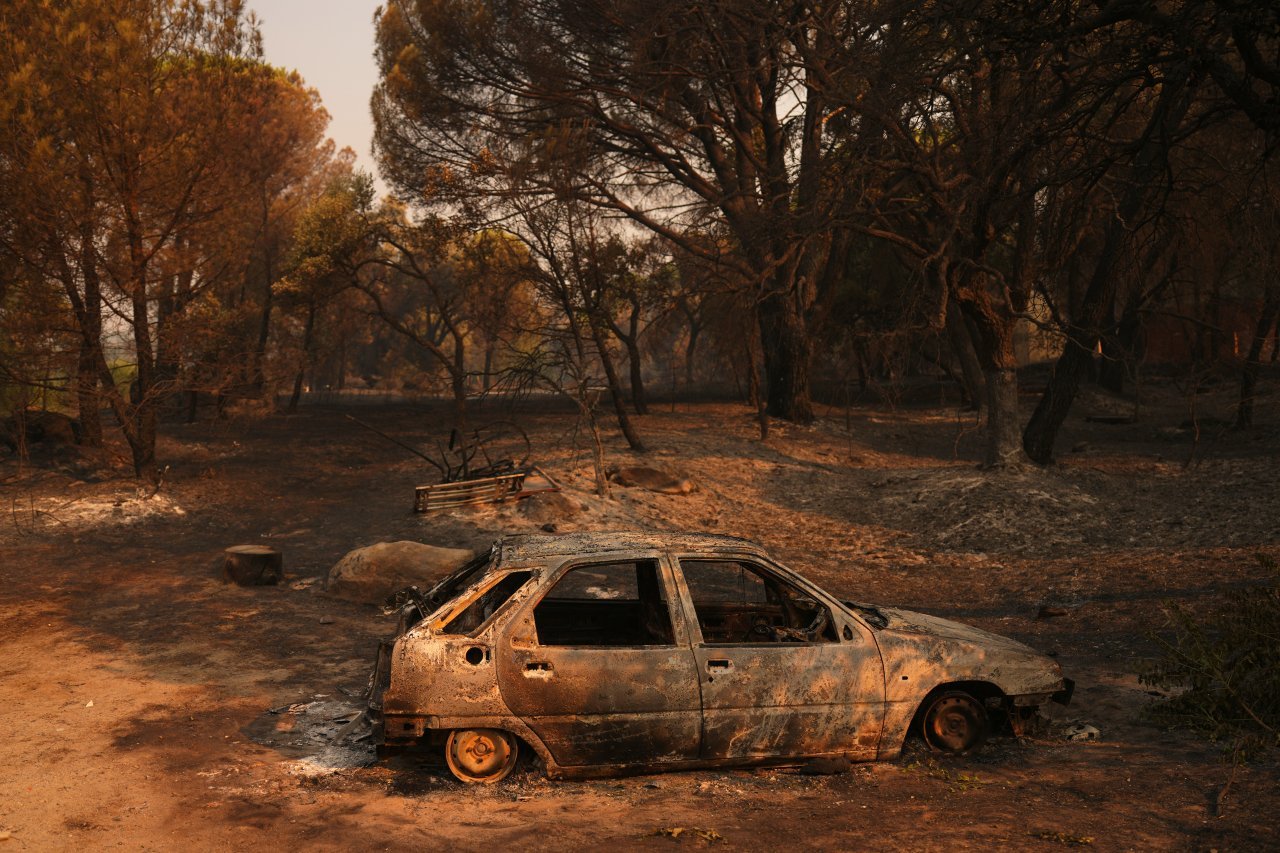
LEGE-CAP FERRET, France — A wildfire four times the area of Paris remained uncontained in southwest France on Wednesday, as the death of three firefighters in Greece underscored the lethal toll of a crisis sweeping southern Europe. Crews across the region are battling a punishing combination of extreme heat, drought, and gusting winds.
The fatalities on Crete added a grim new dimension to an emergency that has already driven roughly a third of a million people from their homes and vacation spots in France and Spain. In France's Gironde region, authorities reported that the country's largest blaze did not spread overnight, but the reprieve may be short-lived as temperatures near 40°C (104°F) and winds strengthen.

Investigators suspect the inferno was sparked by routine brush-clearing work near a high-voltage line, even though the work appeared to comply with regulations. The landscape has become so combustible that such routine activity could ignite a massive fire.
At the command center in Lège, firefighters tracked three danger zones: northern Cap-Ferret; the wooded corridor around Marcheprime, Cestas, and Saint-Jean-d'Illac; and a military site near Martignas, where a major outbreak required a large deployment. More than 2,200 firefighters and over 20 aircraft are mobilized, backed by crews from across France and European partners.
“We strike quickly and strike hard at any new smoke emissions,” said Gironde fire commander Matthieu Jomain.
Civilians have also stepped up. In Souge, volunteers flooded dirt tracks, and a local digger driver plowed through burning soil to prevent flames from crossing back when the expected west wind arrives. In Lacanau, residents pumped water from a lake into tanks for hot spots and firefighters' cisterns. “If one day the fire starts in our neck of the woods, I know very well that all the people here would do the same for us,” said Flavien Dubuch, 33, who drove from Saint-Émilion with his father to help.
The advance of major fires in the Landes and Var regions has been halted, leaving Gironde as France's biggest remaining wildfire battle, Interior Minister Laurent Nuñez said. The Gironde fire forced 220,000 people to flee at the peak of the crisis. Tens of thousands have since been allowed home, but authorities warned the danger had not passed. Extreme heat strips moisture from vegetation, turning grasses and brush into faster-burning fuel.
Météo-France said Wednesday would be the hottest and driest day of the week, with elevated wildfire danger across every region. Drought now covers mainland France and Corsica, with soils nearing the record dryness of August 2022. Smoke from the fires pushed particulate pollution higher in both Gironde and Landes, regional air-quality monitors said.
Gironde authorities ordered 4,000 more people out of tourist sites along the Atlantic coast on Tuesday, widening what may be France's largest peacetime evacuation. “The situation remains complicated. That's clear. We're not out of the woods,” said Gironde prefect Sophie Brocas, who also authorized 60,000 evacuees to return to three Bordeaux suburbs untouched by fire. The opposing movements — thousands ordered out of coastal resorts as others returned with phones on and emergency bags packed — captured how precarious the situation remains.
The disruption is spreading into Bordeaux's peak tourism season. Edouard le Grix de la Salle, who runs Château du Grand Verdus with his brother, said official appeals to avoid the region threaten its wine-tourism trade. “How did they not think about protecting that sector?” he told The Associated Press. At one point, the Gironde blaze created a pyrocumulonimbus cloud — the first recorded in France — that generated lightning, violent winds, and new fires beyond the original front.
In Greece, two firefighters died Wednesday battling a wildfire in the Rethymno region of Crete, the fire department said. They were among about 125 firefighters confronting flames fanned by strong winds, with four helicopters and four water-dropping planes deployed. A third firefighter also died outside the fire perimeter after tackling a separate blaze in the Peloponnese region. The department said they died “in the line of duty to protect the lives and property of citizens and the natural environment.”
In Spain, tens of thousands began returning home after firefighters made progress around Madrid and Ávila. Evacuation orders were lifted for about 20,000 people in the Madrid region, while stay-at-home restrictions ended for another 14,000. But 10,000 people remain under evacuation orders in Castellón, where a fire was still out of control as Spain braced for its fourth heat wave of the summer. More than 1,160 square kilometers (448 square miles) have burned across France this year, according to the Interior Ministry. Europe is the world's fastest-warming continent, warming at more than twice the global average, according to the EU's climate service.
This crisis comes amid broader political tensions. U.S. envoys recently walked out on France at the UN over a human rights spat, highlighting strained transatlantic relations. Meanwhile, the UK defence chief credited Trump for jolting Europe out of complacency on NATO spending, as the continent faces multiple security and environmental challenges.