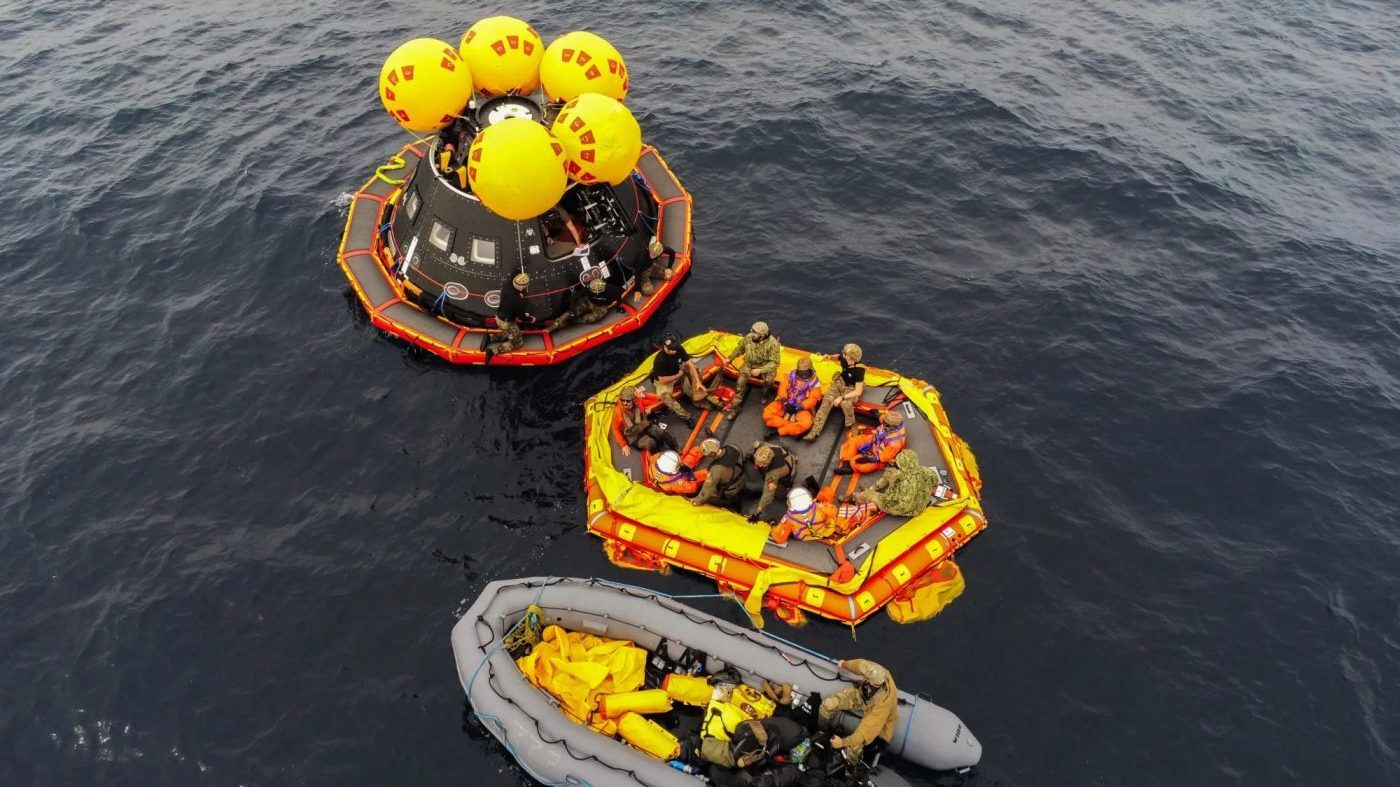
The four astronauts of NASA's Artemis II mission are scheduled to return to Earth Friday evening, concluding a historic journey around the Moon that marks America's first crewed lunar flight in more than half a century. Their Orion capsule is set to splash down in the Pacific Ocean approximately 60 miles off the coast of San Diego at 8:07 p.m. Eastern Time, weather permitting.
The crew—NASA astronauts Reid Wiseman, Victor Glover, and Christina Koch, alongside Canadian Space Agency astronaut Jeremy Hansen—will face a dramatic re-entry. The spacecraft will pierce the atmosphere traveling at nearly 25,000 miles per hour, creating a fiery plasma sheath around the capsule as its heat shield endures temperatures approaching 5,000 degrees Fahrenheit.

A Choreographed Naval Recovery
The return hinges on a meticulously planned military and civilian recovery operation. A sequence of 11 parachutes will deploy to slow the capsule from roughly 300 mph to about 20 mph for a gentle ocean landing. A U.S. Navy ship, positioned 1.5 to 2 miles from the target point, will serve as the command center.
Navy divers and medical personnel, deployed hours in advance, will conduct an immediate hazard assessment of the water. After securing the capsule with a stabilization collar, they will attach an inflatable raft—dubbed the "front porch"—to the hatch. The astronauts will exit onto this platform before being moved about 100 yards away for helicopter extraction.
Live Coverage and Broadcast Details
NewsNation, The Hill's sister network, will provide live coverage of the event. A special edition of "CUOMO" at 8 p.m. EDT will feature live footage of the splashdown, followed by analysis on "On Balance with Leland Vittert" at 9 p.m. A live NASA press conference will air during "Katie Pavlich Tonight" at 10 p.m. Correspondents will report from San Diego, NASA's Johnson Space Center in Houston, and New York.
Two Navy Seahawk helicopters will ferry the astronauts back to the recovery ship, two at a time, with two additional helicopters providing aerial overwatch and live imaging for NASA TV. NASA expects the full crew to be aboard the ship within one to two hours of splashdown. Following initial medical checks, the astronauts will be flown to San Diego and then onward to Houston for further evaluation. NASA is expected to detail the final mission status and crew condition in a formal briefing after recovery.
The recovery of the Orion capsule itself is a separate, lengthy operation. The ship will maneuver to guide the spacecraft into its well deck using a system of lines and a pneumatic winch, a process that typically takes four to six hours after the crew is safe.
This mission paves the way for future Artemis lunar landings. The crew recently shattered the distance record from Earth set by Apollo 13, demonstrating the capabilities of the Orion spacecraft. The success of this return is critical for NASA's timeline, which aims to land astronauts on the Moon again by 2028.
The return concludes a nearly 10-day mission that has captured global attention. During their flight, the crew reported unprecedented views of the lunar surface and emphasized their team bonding, aspects vital for the long-duration missions planned under the Artemis program.