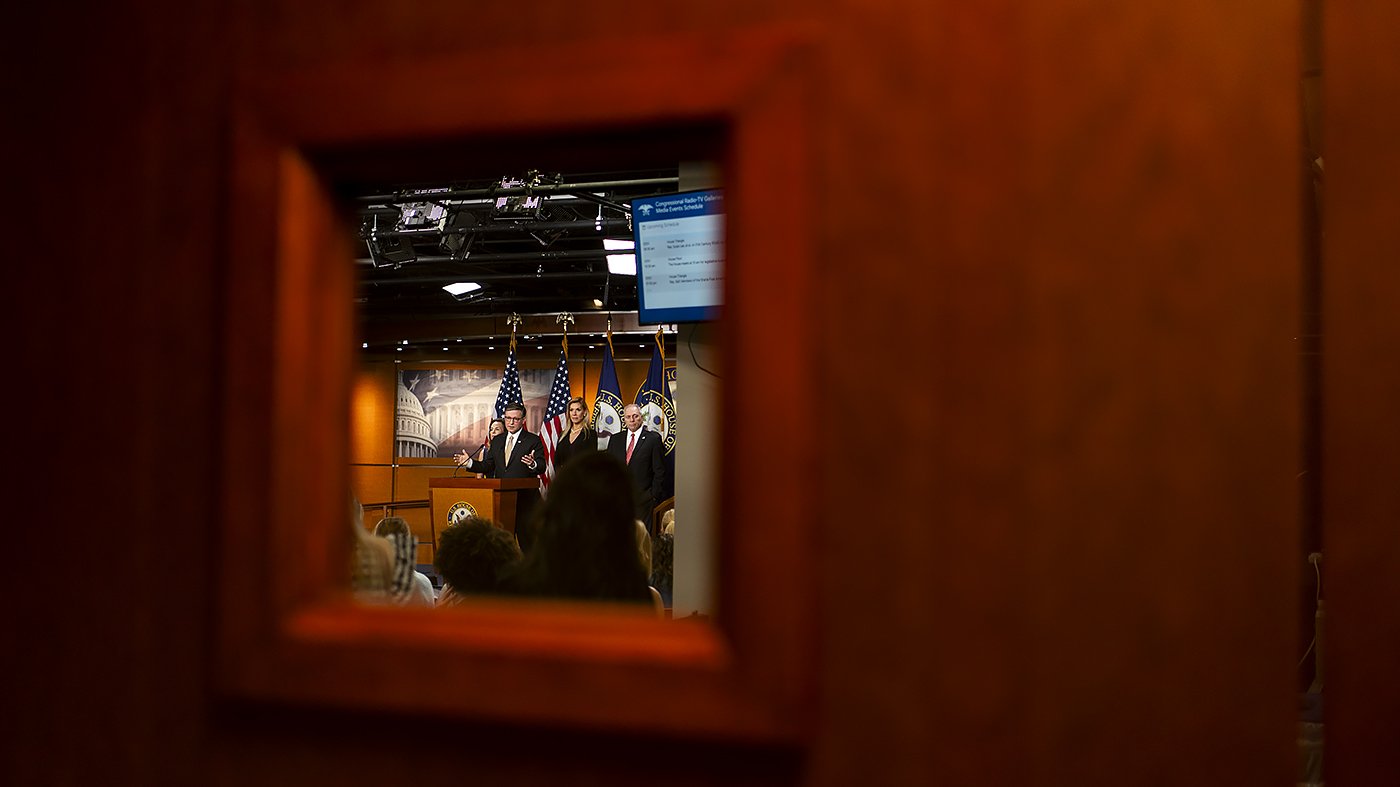
House Republicans are scrambling against a tight deadline after a conservative revolt forced Speaker Mike Johnson (R-La.) to cut last week's session short for the second consecutive time, squeezing an already narrow window to advance their agenda in an election year.
Lawmakers left for the July Fourth break earlier than planned when a group of hard-liners joined Democrats to sink a procedural rule that would have set up debate on several bills. The rebellion was fueled by frustrations over the stalled SAVE America Act, a voter ID measure, and a border security bill, leaving Johnson with a fractured caucus and a ticking clock.
The House has only two legislative weeks before the monthlong August recess, followed by a brief return in September before another break in October. That leaves Republicans little time to tackle a heavy slate that includes a third party-line spending package, the annual defense policy bill, and a renewal of warrantless surveillance powers—each carrying its own political landmines.
National Defense Authorization Act
The National Defense Authorization Act (NDAA), a must-pass bill setting Pentagon policy and funding, is a top priority. House Armed Services Committee Chair Mike Rogers (R-Ala.) touted the FY27 version as a way to “revitalize our defense industrial base” and “restock the Arsenal of Freedom.” But 13 Republicans blocked a vote to advance the bill last week, leaving its fate uncertain.
Johnson had proposed a maneuver to attach the SAVE America Act to the NDAA after passage, but Rep. Anna Paulina Luna (R-Fla.), a key rebel, insists the voter ID language must be in the base text. “1,000%, the rule will go down until you attach the SAVE America Act,” she wrote on X, adding she doesn't care who opposes her. Other Republicans voted no due to a broken promise on a border bill vote.
Reconciliation 3.0 and Spending Bills
Republicans are also pushing a third budget reconciliation package to boost defense spending, bolster fraud prevention, and fund affordability initiatives. But divisions between moderates and hard-liners over what to include remain unresolved. The White House has requested $87.6 billion in supplemental funding for the Iran conflict, which House Budget Chair Jodey Arrington (R-Texas) said will likely need to go through reconciliation, given Democratic opposition to regular order.
Johnson has proposed a grant program in the reconciliation bill to help states implement the SAVE America Act, but conservatives like Rep. Lauren Boebert (R-Colo.) criticize it as merely incentive-based. Meanwhile, the House has passed only two of 12 appropriations bills for fiscal 2027, with a third shelved after last week's revolt. Appropriations Chair Tom Cole (R-Okla.) told Politico that “doing nothing in the House is ridiculous” and urged passing bills to pressure the Senate.
The SAVE America Act remains stalled in the Senate over Democratic opposition, and the clock is running out. With internal fractures and a packed calendar, Johnson faces a steep climb to deliver on his party's promises before the August break.